Hi from Rick: Another Day at the Office — in Venice
![]() |
Venice's St. Mark's Square before the crowds hit. |
![]() |
Giants swing their huge clappers over St. Mark's Square. |
![]() |
Producer Simon Griffith pops off his shoes and wades through mucky crypt water to remove a piece of garbage from the flooded crypt scene. |
![]() |
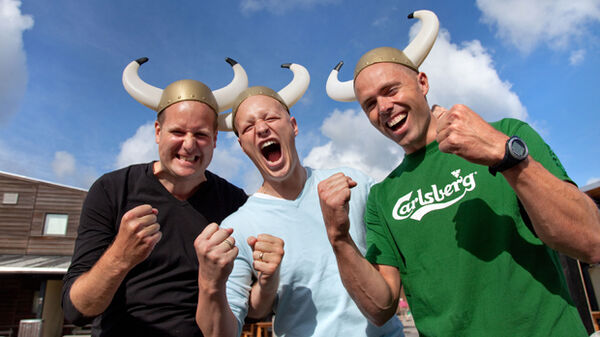
The hardest-working, most talented crew you can imagine — looking for a beer on a marshy island in the lagoon of Venice. |
Dear Traveler,
I've just returned from filming two new TV shows in Venice. Thinking back over a very productive week, I realize how much I love this work. In this month's Travel News, I'd like to share with you what a typical day is like, when your "office" is one of the world's most amazing cities. (Note: in related Travel News features, you can eavesdrop on revealing conversations I've had with Venetian friends, risk being seduced by a special slideshow on the city they call la serenissima, and more.)
This day was particularly productive, requiring a typical dose of on-the-fly creativity from the crew. "On-cameras" (OC) have me working the hardest, and we got six in the can today. [Our scripts — about 3,400 words per half-hour show — are split between "on-cameras," with me talking directly to the camera, and "B-roll," where we "cover the script" with footage that illustrates what we're describing.]
We started early on St. Mark's Square. While it's littered with kitschy souvenir carts and jammed with tour groups most of the day, at 7:30 a.m., there is no tourism. The square is clean, with just a few well-dressed businesspeople walking to work, the random jogger, and very focused photographers like us marveling at how the history "pops" with the architecture (and without the modern tourism). The Gothic is so lacy, and the Renaissance so capable. We got a few "walk-bys" to establish me in what looks like a pure, unpopulated, almost computer-generated Venetian cityscape.
At 8:30 a.m., we meet our local guide, Michael, who has been instrumental in setting things up in advance for us. He's brilliantly navigating the Byzantine bureaucracy of the city and helping us open all the right doors — some of them literally pillaged from Byzantium.
We climb the Torre dell'Orologio, or Clock Tower. This was built 500 years ago, providing the city with an appropriately aristocratic front door and an impressive clock — something any self-respecting city during the Renaissance was expected to have. At the top of the hour, on the rooftop, two bronze giants pivot, swinging their massive clappers — pendulous hammers with which they bang the bells. (Their other "clappers" are big, too — surprisingly hanging out under their John the Baptist-style tunics.) We have to capture this on film — a rare instance when we shoot a sequence before I even know where we'll splice it in.
The day before, we were atop the higher Campanile — the red brick bell tower just across the square — hoping to shoot an aerial view of the distant causeway that connects Venice with the mainland. It was almost invisible in the haze. Today the air is crisp. The snowcapped Alps are vivid on the horizon, a striking backdrop for the elaborately Eastern-looking domes of St. Mark's Basilica. We ask Michael to beg us into that tower again ("Just one man for five minutes...pleeeze?") to take advantage of the crisper air. They agree, but "no tripod!" Our shooter, Karel, goes back up the Campanile, zooms in, and the causeway pops crisply — giving us a tiny but important piece of the puzzle that will eventually be a 30-minute TV show.
At 10 a.m., we have an appointment at the oldest and most venerable café on St. Mark's Square, Caffè Florian. I love this place, with its smoke-stained mirrors, white-tuxed waiters, and finicky piano-and-string quartet, which somehow gets called an "orchestra."
- Here's the B-roll text from our script: "The venerable Caffè Florian, one of the first places in Europe to serve coffee, has been the place for a discreet rendezvous since 1720. Today, whenever locals want to impress visitors, they take them here for a drink. In these richly decorated 18th-century rooms, Casanova, Lord Byron, and Charles Dickens have all happily paid too much for their prosecco."
- And here's the on-camera: "Venice peaked in the 16th century. But after the discovery of the Americas and new trade routes outside of the Mediterranean, its power plummeted. As Venice fell, its appetite for decadence grew. Through the 17th and 18th centuries, the Venetians partied, as if drunk on the wealth accumulated through earlier centuries as a trading power."
We'd like to have a sophisticated-looking clientele in this café as we shoot. Historically, people dressed up to come here. The manager laments how, in the last decade, the café's elegance and class has been trampled with poorly-dressed tourists. (Not unlike me, I must admit.) There's also a big concern about "discretion." People come here to share a private meeting in public — not to be filmed. We decorate my table with an elegant coffee setting and I nail my on-camera quickly. Then I troll for any well-dressed couple who would sit for us. With my bait of free coffee, I have some success.
- Illustrating the fact that Venice floods and is sinking turns out to be a fun challenge. My on-camera: "With the right combination of high tide, wind, and barometric pressure, the city floods. Locals are used to it. Elevated walkways are put up, they pull on their rubber boots, and life goes on."
For B-roll, I really want to shoot the crypt of the San Zaccaria Church, which floods a lot. We drop by before we get permission to shoot, and sure enough, it's beautifully flooded. As soon as we are handed our permit, it dries up. Today we return, and the altar is floating on a glimmering platform of water under romantic 12th-century brick vaults. We tossed a pebble and film tiny waves lapping against the altar — a powerfully beautiful way to illustrate our point.
While we like to show reality, we are also shameless about making things beautiful — taking time to clean up garbage, avoiding graffiti (which is a real problem in Venice), scrubbing pigeon poop off of statues, luring well-dressed people into a café, and — to be honest — shooting around the scruffy ones. Badly-dressed tourists, local kids with goofy haircuts, and immigrants selling kitschy knickknacks don't get in our show.
I am really fascinated by Venice's "Age of Decadence," and the tradition of Venetian masks need to be explained in that context. After filming a great mask shop, we take our favorite mask out into the back lanes. The sun is still high in the sky, making it tough to find a place where I could be in moody low light with a picturesque background that's also in low light (rather than in sunlight, which causes it to burn out on film). We find a fine spot moments before the arcing sun would mess up the light. I look at the camera (covering my face mysteriously with the delightfully painted mask for the last three words) and say:
- "Throughout Europe, but especially here in Venice, Carnevale provided a safety valve for people to really cut lose before Lent — a time of austerity leading up to Easter. That's when rich and poor alike enjoyed a burst of Mardi Gras-style fun, when anything goes...and nobody knows."
Tourists in Venice hardly notice the wellheads that decorate almost every square. After "scouting" these for a week, looking for a pretty, graffiti-free stone well on just the right square with good light, we are ready with our B-roll content:
- "While plenty wet, Venice had no natural source of drinking water. But a thousand years ago, residents devised a clever way of using town squares as cisterns."
At Campo Santi Giovanni e Paolo, we hit the jackpot. Walking up to its wellhead, I explain the cistern system, saying:
- "The rainwater would flow into these stone grilles, through a sand filtering system, and on to a central well. Only after it devised this safe, local source of drinking water was Venice's population able to grow."
- For B-roll: "Hundreds of these rain-collection systems provided drinking water right up until 1884, when an aqueduct was opened, bringing water in from nearby mountains."
It's fun to share "aha!" insights, and one of those is the fact that Europe's original "ghetto" was in Venice. I'm wishing we could shoot the ghetto's main square in the early evening for lower light and a more casual ambience, but we don't have the luxury to wait. We are determined to cover a lot of on-cameras today, as we have only two days left to shoot (and one of them is forecast to be rainy).
We usually shoot six or eight takes to get the background action, the camera moves, and my performance all right at the same time. As I do my takes at the ghetto, we are stopped by a group of four policemen. (Filming at a Jewish sight in Europe always brings out some type of security.) I enjoy the occasion to pull out the permission letter we've obtained — the only time we've ever needed to show it. Later, an Orthodox Jewish man stops by to check us out. He listens to my delivery, gives us a smile and a thumbs-up, and walks on.
With the police cool and the Jewish Orthodox man's approval, I look into the big lens and say:
- "In medieval times, Jews — who were the moneylenders of the day — were allowed to do their business. But they were segregated on this easy-to-isolate island, which was a former copper foundry. In fact, the term "ghetto" comes from the Venetian word for "foundry."
With the ghetto in the can, we head to the far side of Venice (Zattere) for our "get lost" segment. This is where I really want the "magic hour" light (the hour before sunset, when the colors are richest and the harsh shadows are gone). By now the light is just perfect, and the crew catches me wandering back lanes, looking happily lost:
- "Venice can be mobbed with tourists. But savvy travelers leave the center and explore. Walk and walk to the far reaches of town. Don't worry about getting lost. Keep reminding yourself, 'I'm on an island, and I can't get off.'"
For my next on-camera, I'm envisioning using a favorite hotel's canal-side café terrace. The café is closed but, since the hotel is in my guidebook, they are happy to set up a couple of tables literally hanging over the edge of the city, with the vast lagoon beyond me.
We needed to populate the background and, thankfully, we bump into a fine "PBS-looking" couple happily using my guidebook. We offer them drinks and they are happy to sit behind me. I assume the hotel's business card comes with a map (as most do, which I want to illustrate on camera), but this one doesn't. So I have to hike for a few minutes to find a restaurant whose card has a little map for my show-and-tell. Only then are we ready to shoot the on-camera. Sipping my spritz, I say:
- "The worst-case scenario: Your island ends, and you have to enjoy a drink on the edge of town while studying your map. Invest in a good map. If you do lose your way, pop into any business and ask for their card — it comes with a map and a prominent 'you are here.'"
All week, we've been trying to capture romance in Venice. For 30 years, I've marveled at how Venice pumps up the romance in people. I even had an unforgettable "Stendhal syndrome" experience (where someone literally goes crazy over the overwhelming beauty of an experience) with one tour member back in the 1980s — an incident that has become part of our company lore. But these days, people seem to be so distracted by their electronic gadgets that they hardly notice each other. Even on the ultimate romantic experience in Europe — a $130 gondola ride — we rarely saw two lovers enjoying their threesome with Venice.
The final on-camera on today's wish list is showing how great the vaporetto water buses are for simply joyriding, while also illustrating the contrast between the midday/rush-hour mobs and the easygoing joy of riding at quiet times. We have all been really struck by how Venice is two cities: one garishly touristic, and the other so romantic and tranquil that it makes you go fortissimo in describing it.
Apparently they're phasing out the vaporetti with seats up in the bow where, for years, I've recommended sitting to enjoy the dazzling Grand Canal can-can of floating palaces. There are still a few, but every time we hop on a boat, it has no front seats. It's nearly 8 p.m., and the sun is going down. We are all getting tired. I really want those front seats, but time after time, the boat we draw has none. Finally, we frame a shot of me enjoying the ride from the standing point mid-boat. The light is gorgeous. Gondolas glide by. And, leaning against the cleat with its beefy and classic old hemp rope, I say:
- "Not only is it handy public transportation, the ride's great for sightseeing — especial late in the day or early...when there are fewer crowds."
Updating our script back at the hotel later that evening (my nightly chore), it occurs to me what a productive and fascinating day we've enjoyed — and how much I love Venice. After 12 similarly rewarding days, we'll fly home with two new shows on Venice. Stay tuned this fall as we release season seven of Rick Steves' Europe (with 14 exciting new episodes) across the USA on public television.
Happy travels,
Rick
Read more Travel News!