Italian Sports
By Gene Openshaw, co-author of eight of Rick's travel guidebooks
![]() |
| Sports are on the top of everyone's minds in Italy. |
Italian Football (Soccer) Leagues
It seems that on almost any given night of the year, there's yet another "absolutely crucial" football match in Italy. That's because the only way to feed fans' insatiable appetite for the game is to run the sport year-round, with different leagues that play their seasons concurrently, staggering the different playoffs and finals throughout the year.
Italy's top domestic league is known as Serie A. It's comprised of professional football clubs (the for-profit teams like those in America's NFL, NBA, or Major League Baseball). Italy's national team is called La Squadra Azzura ("The Blue Team," named for the uniforms). It plays against other countries' national teams in international, Olympic-style competitions. The best Italian players play both for their professional club, and for the national team.
Serie A football clubs are usually based in a major city (e.g., AS Roma, AC Milan, or Juventus of Turin), and employ the best players money can buy. For example, AS Roma fields well-known players not just from Italy, but also from Brazil, France, Nigeria, and many other countries. The Serie A season normally runs from September to May, as clubs from around Italy play each other — usually on Sundays — for the league title (known as the scudetto, and won by Juventus in 2005). While the Serie A season is going on, the top four Italian teams are also playing in the Champions League, which pits the best teams from a host of other domestic European leagues (England, France, Spain) hoping to emerge as Europe's top club (Liverpool of England did it in 2005).
Besides the Serie A football clubs, smaller Italian cities have their own clubs, which compete in Serie B, C, and so on. Each year, a handful of the best "B" clubs get promoted to the "A" league (cue celebrations in the streets)...while the worst of the "A" clubs get demoted to the "B" league (cue weeping and gnashing of teeth). Promotion to Serie A is a big deal in small-town Italy, but in reality, the upper echelon of Italian soccer is dominated by a handful of elite teams — Roma, Milan, Juventus — based in big-market, big-money cities.
In addition to its professional football clubs, Italy also fields a national team that takes on other countries. Only Italians can play on it, so whenever they play, national pride is on the line. The team competes in two huge international tournaments: the World Cup (the most important, held every 4 years — hosted by Germany in 2006) and the European Championships (a.k.a. the "Euro Cup," or simply the "Euro," held every 4 years, hosted by Portugal in 2004, and by Austria and Switzerland jointly in 2008). Both of these tournaments involve two years of matches (usually on weeknights) just to qualify for, and culminate in a final game watched by millions and millions of fans.
With so many different leagues and tournaments (World Cup, Champions League, European Championships, Serie A) — each requiring months of qualifying rounds — scheduling can be a nightmare. Consider Italy's most famous player, Francesco Totti. On Sunday, he plays for Roma against AC Milan in an "absolutely crucial" Italian league match. On Wednesday, he switches jerseys and joins Italy's national squad for a World Cup-qualifying match, against France (and one of his Roma teammates). A few days later, he returns to his club team in Rome to face Real Madrid in a Champions League match watched by all of Italy and Spain. Then it's suiting up for La Squadra Azzura again for a "friendly" (an exhibition match), against a visiting squad from Brazil — and another of his AS Roma teammates. Whew!
Tifosi ("Fever Boys"): The Life of a Football Fan
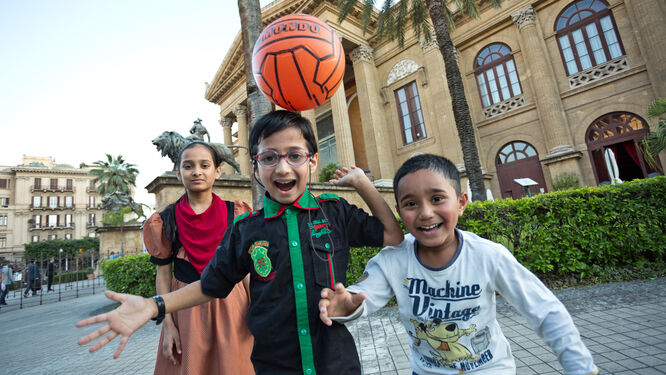
Italian soccer players (such as Francesco Totti or Antonio Cassano) make millions and are treated like movie stars. The paparazzi stalk them, they appear on talk shows, and little kids everywhere pretend to score the winning goal just like them. Every week, Italian fans place their national, regional, and personal pride on the backs of these athletes. It's a cliché that remains true: In a Europe at peace, the football field is the new battleground.
Fans arrive at the match wearing team colors and take their seat in the home or visiting section — each stadium keeps them strictly segregated. The match lasts 90 minutes, plus a 15-minute break between halves. Through the entire game, true fans remain standing, waving flags, singing team songs, yelling insults at the opposition, and drinking to excess — you can buy alcohol there or bring your own.
"Hooligan" is a pan-European word for a fan that gets too rowdy. The problem is also pan-European, and each country tends to blame someone else for the worst cases of drunken vandalism. That said, the reality is that Italians, though fervent, are rarely a cause of major hooliganism. Still, football matches usually require a large police presence and lots of clean-up afterward. After the game, the fans linger to cheer their team, then drive through the city streets honking horns to celebrate.