

Tuning In to Tasty Italy
By Rick Steves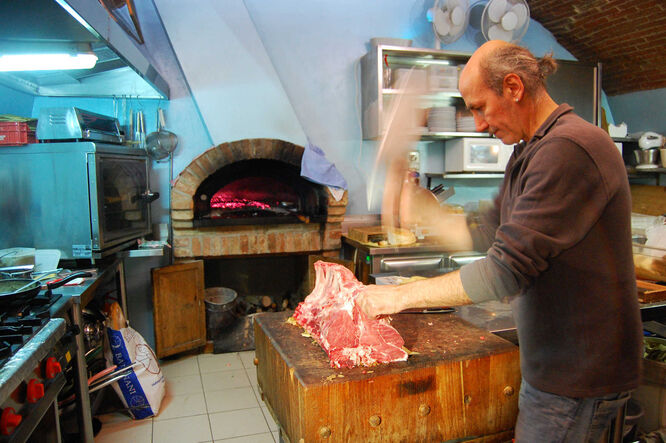
On a recent visit to Tuscany, a region fiercely proud of its beef, I sunk my teeth into a carnivore's dream come true. In a stony cellar, under one long, tough vault, I joined a local crowd for dinner. The scene was powered by an open fire in the far back of the vault. Flickering in front of the flames was a gurney, upon which lay a huge hunk of beef. Like a blacksmith in hell, Giulio — a lanky man in a T-shirt — hacked at the beef with a cleaver, lopping off a steak every few minutes.
In a kind of mouth-watering tango, he pranced past the boisterous tables of customers, holding a raw slab of beef on butcher's paper like a tray of drinks. Giulio presented the slabs to each table of diners, telling them the weight and price (the minimum was about $40) and getting their OK to cook it. He'd then dance back to the inferno and cook the slab: seven minutes on one side, seven on the other. There's no asking how you'd like it done; this is the way it is done. And about 15 minutes later, you got your steak.
Giulio's place — Osteria dell'Acquacheta in Montepulciano — was just one of many Italian dining experiences I had on that trip. Afterward, I came up with some theories about eating out in Italy:
While I've never liked putting up with TV noise when grabbing a simple meal in Italy, I now realize that when an eatery has the TV playing, it's often because it's where the local workers drop by to eat…and that indicates a low price and a good value.
Beware of cheap eateries that sport big color photos of pizza and piles of different pastas. They have no kitchens and simply microwave disgusting, prepackaged food. Unless you like lasagna with ice in the center, avoid these. Some restaurants have self-serve antipasti buffets, offering a variety of cooked appetizers spread out like a salad bar (pay per plate, not weight; usually costs about $11). A plate of antipasti combined with a pasta dish makes a healthy, affordable, interesting meal.
An enoteca (wine bar) is a popular, fast, and inexpensive option for lunch. Surrounded by the city's office crowd, you can get a fancy salad, plate of meats and cheeses, and a glass of fine wine (check the blackboard for the day's selection and price per glass — and go for the top end). Some of my favorite Italian eating experiences have been at wine bars.
Italy's no-smoking rules are working, but they've caused some bars to stop serving drinks earlier than before the ban went into effect. Now that bars have to be smoke-free, young drinkers who want a cigarette take their drinks outside. Their noise disturbs the neighbors — who didn't hear the action back when people stayed (and smoked) inside. In Italy, when neighbors complain, bars comply.
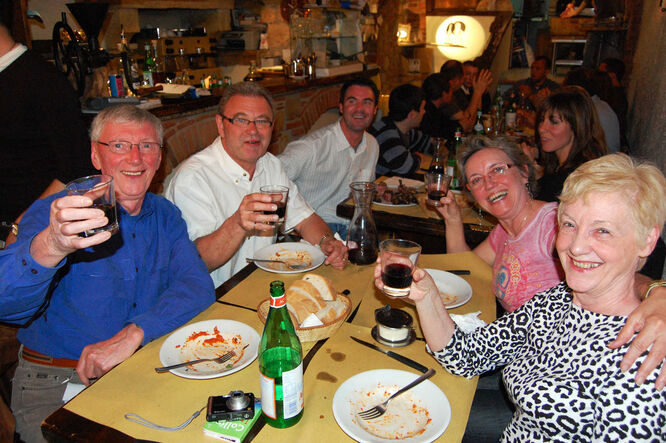
Restaurants parked on famous squares generally serve bad food at high prices to tourists. Locals eat better at lower-rent locales. Family-run places operate without hired help and can offer cheaper meals. Good restaurants don't open for dinner before 19:00.
While I pride myself in not needing to dress up to enjoy a good restaurant, there is a limit. I was in a restaurant recently where a couple of American travelers made me get my notebook out and jot down, "Even in a modest trattoria, shorts and T-shirts look goofy at dinner."
I've realized I should stay away from restaurants famous for inventing a pasta dish. Alfredo (of fettuccini fame) and Carbonara (of penne fame) are both Roman restaurants — and they're both much more famous than they are good.
One of my favorite Italian specialties isn't even on the menu — the conversations with other customers. In Rome, I talked about dessert with a man at a nearby table. He told me how his grandfather always said, in the local dialect, "The mouth cannot be finished until it smells of cows." The rustic foodie meant you must finish the meal with cheese.
La vita è bella...life is good in Italy. And the good life seems, like the cuisine, simple. Locals are really into the "marriage" of correct foods. An older wine needs a stronger cheese. Only a tourist would pull the fat off the prosciutto.
To me, Italian cuisine is a symphony — the ingredients are the instruments. The quality is important...but even good instruments can be out of tune. The marriage of the ingredients is what provides the tonality. When things are in tune, you taste it.