

Pickles, Nuns, and Bullfights: España
By Rick Steves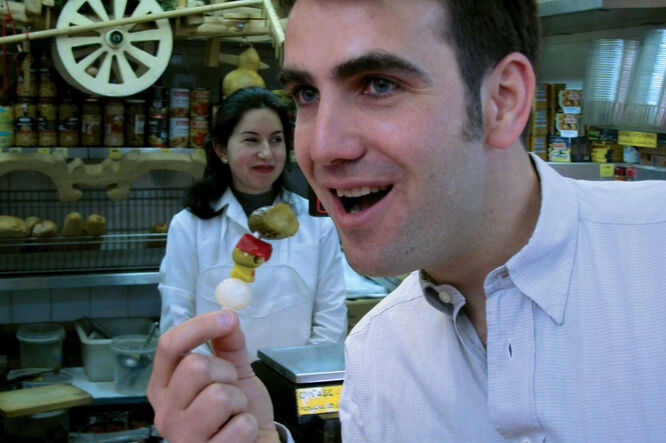
Markets with a passion for pickles and ham, bars with bullfights blaring on the TV, cloistered nuns selling cupcakes, Spanish towns — whether famous among tourists or unknown — come with plenty of ways to connect with the local culture.
I'm in Arcos de la Frontera, in the south of Andalucía, but I could be just about anywhere in Spain. The town's entertaining market is my first stop. The pickle woman encourages me to try a banderilla, named for the bangled spear that a matador sticks into the bull. As I gingerly slide an onion off the tiny skewer of pickled olives, onions, and carrots, she tells me to eat it all at once — the pickle equivalent of throwing down a shot of vodka. Explosivo! The lady in the adjacent meat stall bursts into laughter at my shock.
Like the pickle section, the meat stall — or salchichería — is an important part of any Spanish market. In Spain, ever since Roman times, December has been the month to slaughter pigs. After the slaughter, Spaniards salt and dry every possible bit of meat into various sausages, hams, and other pork products. By late spring, that now-salty meat is cured, able to withstand the heat, and hanging in tempting market displays. Ham appreciation is big here. While in Spain, I am an aficionado.
Still enjoying my ham sample, I step across the street and into a cool, dark bar — the kind that had long been filled with very short old guys. (Any Spanish man born in the late 1910s or early '20s spent his growth-spurt years trying to survive the brutal Civil War — and those who did struggled. That generation was a head shorter than Spaniards of the next.)
In the bar, today's gang of old men — side-lit like a Rembrandt portrait — is fixed on the TV, watching the finale of a long series of bullfights. El Cordobés is fighting. His father, also El Cordobés, was the Babe Ruth of bullfighting. El Cordobés uses his dad's name even though his dad had sued in an effort to stop him.
Marveling at the bar's cheap list of wines and hard drinks, I order a Cuba Libre for about $2. The drink comes tall and stiff, with a dish of peanuts.
Suddenly the room gasps. I can't believe the vivid scene on the screen. El Cordobés has been hooked and is flung, doing a cartwheel over the angry bull's head. The gang roars as El Cordobés lands in a heap and buries his head in his arms as the bull tramples and tries to gore him. The TV replays the scene many times, each time drawing gasps in the bar.
El Cordobés survives and — no surprise — eventually kills the bull. As he takes a victory lap, picking up bouquets tossed by adoring fans, the camera zooms in on the rip exposing his hip and a long, bloody wound. The men around me will remember and talk about this moment for years to come.
At the convent, located piously on the next corner, no one notices. Its windows are striped with heavy bars and spikes as if to protect the cloistered nuns from the bull bar. Popping into the dimly lit foyer, I push the buzzer and the creaky lazy Susan spins, revealing a bag of freshly-baked macaroons and cupcakes. I buy cupcakes to support the mission work of the convent. Feeling like a religious peeping Tom, I can actually see — through the not-quite one-way mirror — the not-meant-to-be-seen sister in her flowing robe and habit momentarily appear and disappear.
Saving my appetite for dinner, I dole my cupcakes out to children as I wander on. My town walk culminates at another convent — which is now the best restaurant in town, Restaurante El Convento. María Moreno Moreno, the proud owner, explains the menu. (Spanish children take the name of both parents — María's must have been distant cousins.) As church bells clang, she pours me a glass of vino tinto con mucho cuerpo (full-bodied red wine) from the Rioja region.
Asking for top-quality ham, I get a plate of jamón ibérico. Maria explains that, while quite expensive, it's first class, from acorn-fed pigs with black feet. It actually does taste better, with a bouquet of its own and a sweet aftertaste. It goes just right with my vino con mucho cuerpo.
I tell Maria the man at the next table looks like El Cordobés. One glance and she says, "El Cordobés is much more handsome." When I mention his recent drama, she says, "It's been a difficult year for matadors."