Home > Plan Your Trip > Best Destinations > Germany

Marksburg Castle Tour

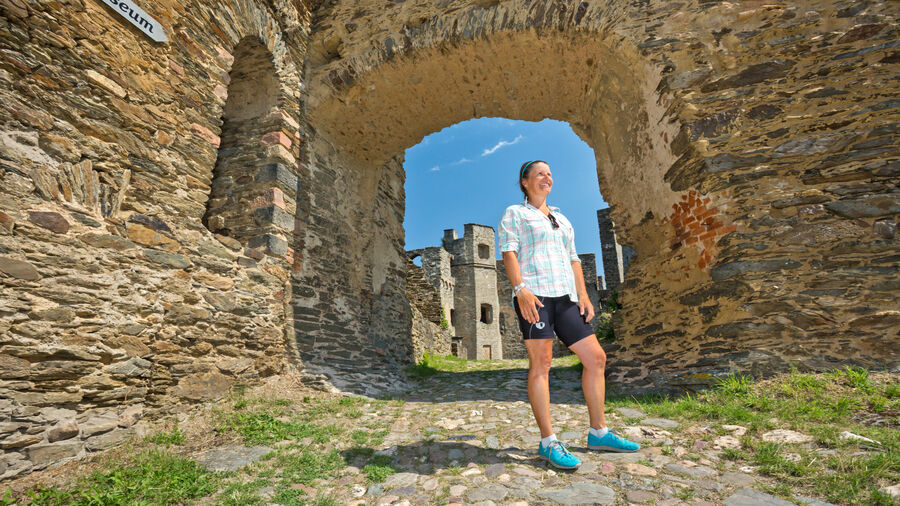
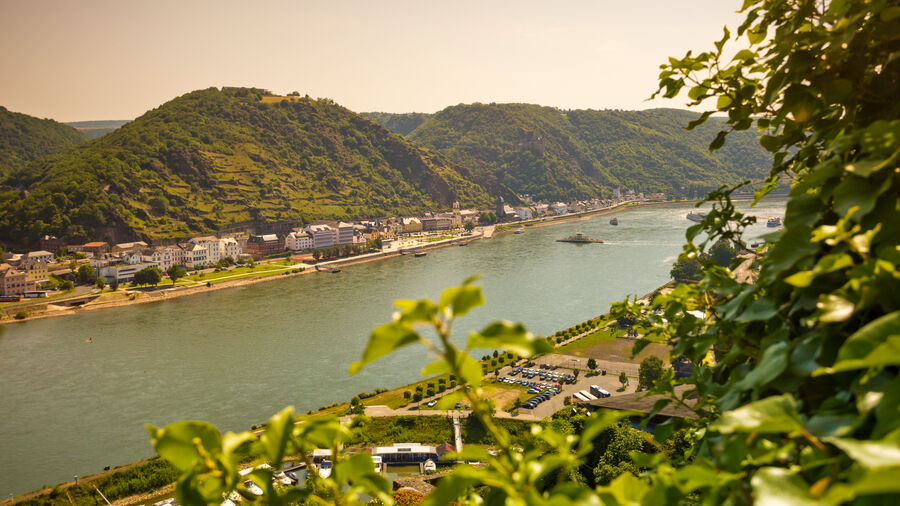
Thanks to its formidable defenses, medieval invaders decided to give Marksburg a miss. This best-preserved castle on the Rhine can be toured only with a guide, and tours are generally in German only. Still, it's an awesome castle, and my self-guided walking tour (below) fits the 50-minute German-language tour. Marksburg caps a hill above the Rhine town of Braubach (a short hike or shuttle train from the boat dock). Our tour starts inside the castle's first gate.

1. Inside the First Gate: While the dramatic castles lining the Rhine are generally Romantic rebuilds, Marksburg is the real McCoy — nearly all original construction. It's littered with bits of its medieval past, like the big stone ball that was swung on a rope to be used as a battering ram. Ahead, notice how the inner gate — originally tall enough for knights on horseback to gallop through — was made smaller, therefore safer from enemies on horseback. Climb the "Knights' Stairway" carved out of slate rock and pass under the murder hole — handy for pouring boiling pitch on invaders. (Germans still say someone with bad luck "has pitch on his head.")

2. Coats of Arms: Colorful coats of arms line the wall just inside the gate. These are from the noble families who have owned the castle since 1283. In 1283, financial troubles drove the first family to sell to the powerful and wealthy Katzenelnbogen family (who made the castle into what you see today). When Napoleon took this region in 1803, an Austrian family who sided with the French got the keys. When Prussia took the region in 1866, control passed to a friend of the Prussians who had a passion for medieval things — typical of this Romantic period. Then it was sold to the German Castles Association in 1900. Its offices are in the main palace at the top of the stairs.

3. Romanesque Palace: White outlines mark where the larger original windows were located, before they were replaced by easier-to-defend smaller ones. On the far right, a bit of the original plaster survives. Slate, which is soft and vulnerable to the elements, needs to be covered — in this case, by plaster. Because this is a protected historic building, restorers can use only the traditional plaster methods...but no one knows how to make plaster that works as well as the 800-year-old surviving bits.

4. Cannons: The oldest cannon here — from 1500 — was back-loaded. This was good because many cartridges could be preloaded. But since the seal was leaky, it wasn't very powerful. The bigger, more modern cannons — from 1640 — were one piece and therefore airtight, but had to be front-loaded. They could easily hit targets across the river from here. Stone balls were rough, so they let the explosive force leak out. The best cannonballs were stones covered in smooth lead — airtight and therefore more powerful and more accurate.

5. Gothic Garden: Walking along an outer wall, you'll see 160 plants from the Middle Ages — used for cooking, medicine, and witchcraft. The Schierling (in the first corner, "hemlock" in English) is the same poison that killed Socrates.

6. Inland Rampart: This most vulnerable part of the castle had a triangular construction to better deflect attacks. Notice the factory in the valley. In the 14th century, this was a lead, copper, and silver mine. Today's factory — Europe's largest car battery recycling plant — uses the old mine shafts as a vent (see the three modern smokestacks).

7. Wine Cellar: Since Roman times, wine has been the traditional Rhineland drink. Because castle water was impure, wine — less alcoholic than today's beer — was the way knights got their fluids. The pitchers on the wall were their daily allotment. The bellows were part of the barrel's filtering system. Stairs lead to the...

8. Gothic Hall: This hall is set up as a kitchen, with an oven designed to roast an ox whole. The arms holding the pots have notches to control the heat. To this day, when Germans want someone to hurry up, they say, "give it one tooth more." Medieval windows were thin sheets of translucent alabaster or animal skins. A nearby wall is peeled away to show the wattle-and-daub construction (sticks, straw, clay, mud, then plaster) of a castle's inner walls. The iron plate to the left of the next door enabled servants to stoke the heater without being seen by the noble family.

9. Bedroom: This was the only heated room in the castle. The canopy kept in heat and kept out critters. In medieval times, it was impolite for a lady to argue with her lord in public. She would wait for him in bed to give him what Germans still call "a curtain lecture." The deep window seat caught maximum light for handwork and reading. Women would sit here and chat (or "spin a yarn") while working the spinning wheel.

10. Hall of the Knights: This was the dining hall. The long table is an unattached plank. After each course, servants could replace it with another pre-set plank. Even today, when a meal is over and Germans are ready for the action to begin, they say, "Let's lift up the table." The "action" back then was traveling minstrels who sang and told of news gleaned from their travels. The outhouse locked from the outside because any invader knew that the toilet — which simply hung over thin air — was a weak point in the castle's defenses.

11. Chapel: This chapel is still painted in Gothic style with the castle's namesake, St. Mark, and his lion. Even the chapel was designed with defense in mind. The small doorway kept out heavily armed attackers. The staircase spirals clockwise, favoring the sword-wielding defender (assuming he was right-handed).

12. Linen Room: Around 1800, the castle — with diminished military value — housed disabled soldiers. They'd earn a little extra money working raw flax into linen.

13. Two Thousand Years of Armor: Follow the evolution of armor since Celtic times. Since helmets covered the entire head, soldiers identified themselves as friendly by tipping their visor up with their right hand. This evolved into the military salute that is still used around the world today. Armor and the close-range weapons along the back were made obsolete by the invention of the rifle. Armor was replaced with breastplates — pointed (like the castle itself) to deflect enemy fire. This design was used as late as the start of World War I. A medieval lady's armor hangs over the door. While popular fiction has men locking their women up before heading off to battle, chastity belts were actually used by women as protection against rape when traveling.

14. The Keep: This served as an observation tower, a dungeon (with a 22-square-foot cell in the bottom), and a place of last refuge. When all was nearly lost, the defenders would bundle into the keep and burn the wooden bridge, hoping to outwait their enemies.

15. Horse Stable: The stable shows off bits of medieval crime and punishment. Cheaters were attached to stones or pillories. Shame masks punished gossipmongers. A mask with a heavy ball had its victim crawling around with his nose in the mud. The handcuffs with a neck hole were for the transport of prisoners. The pictures on the wall show various medieval capital punishments. Many times the accused was simply taken into a torture dungeon to see all these tools and, guilty or not, confessions spilled out of him. On that cheery note, your tour is over.