St. Goar's Rheinfels Castle
By Rick Steves
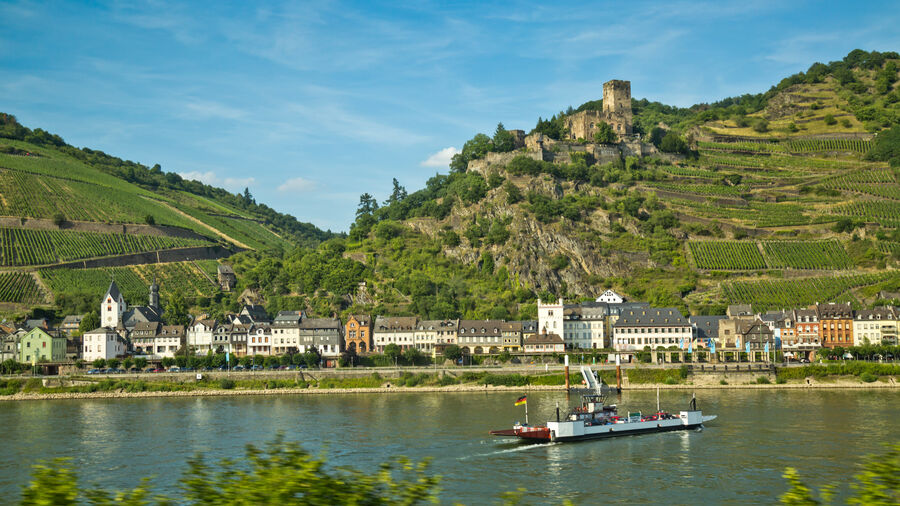
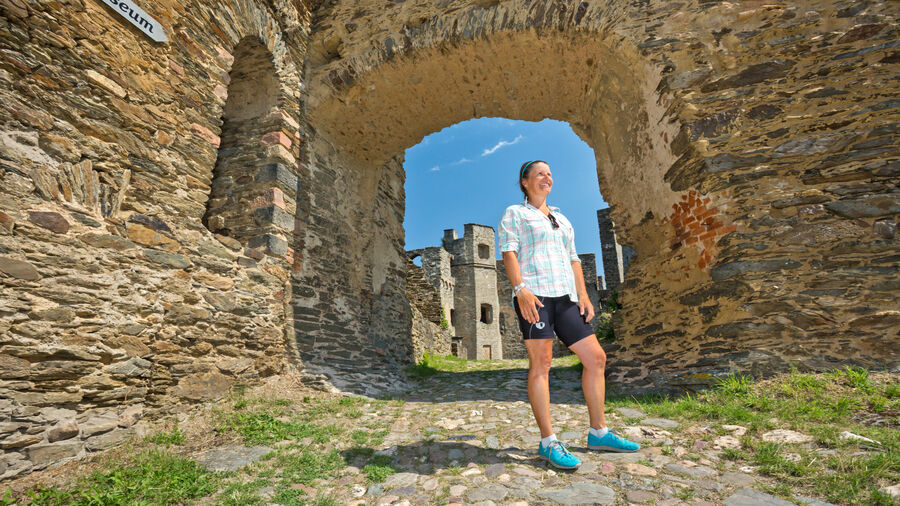
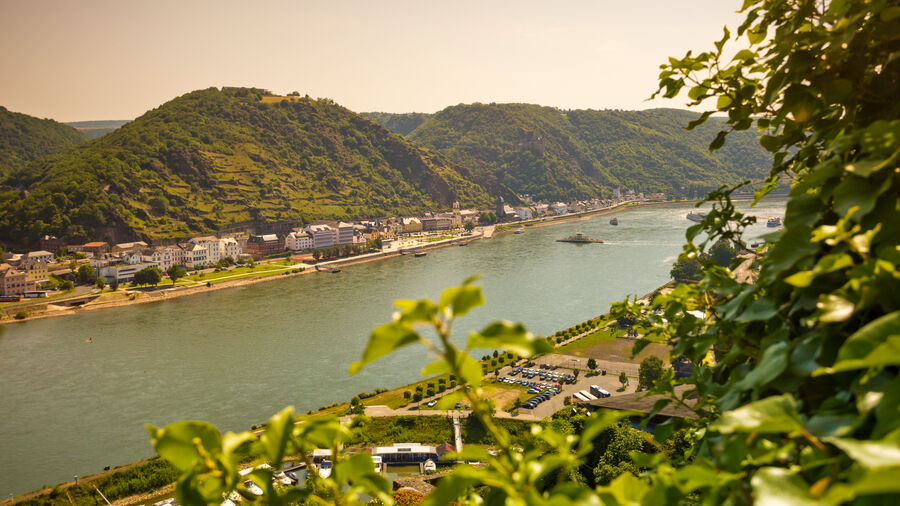
Sitting like a dead pit bull above St. Goar, this mightiest of Rhine castles rumbles with ghosts from its hard-fought past. Burg Rheinfels was huge — once the biggest castle on the Rhine (built in 1245). It withstood a siege of 28,000 French troops in 1692. But in 1797, the French Revolutionary army destroyed it. The castle was used for ages as a quarry, and today — while still mighty — it's only a small fraction of its original size. This hollow but interesting shell offers your single best hands-on ruined-castle experience on the river.
Self-Guided Tour
Rather than wander aimlessly, visit the castle by following this tour: From the ticket gate, walk straight. Pass Grosser Keller on the left (where we'll end this tour), walk through an internal gate past the zu den gedeckten Wehrgängen sign on the right (where we'll pass later) uphill to the museum (daily 10:00-12:30 & 13:00-17:30) in the only finished room of the castle.
1. Museum and Castle Model: The seven-foot-tall carved stone immediately inside the door (marked Keltische Säule von Pfalzfeld) — a tombstone from a nearby Celtic grave — is from 400 years before Christ. There were people here long before the Romans...and this castle. Find the old wooden library chair near the tombstone. If you smile sweetly, the man behind the desk may demonstrate — pull the back forward and it becomes stairs for getting to the highest shelves.
The sweeping castle history exhibit in the center of the room is well-described in English. The massive fortification was the only Rhineland castle to withstand Louis XIV's assault during the 17th century. At the far end of the room is a model reconstruction of the castle (not the one with the toy soldiers) showing how much bigger it was before French revolutionary troops destroyed it in the 18th century. Study this. Find where you are (hint: look for the tall tower). This was the living quarters of the original castle, which was only the smallest ring of buildings around the tiny central courtyard (13th century). The ramparts were added in the 14th century. By 1650, the fortress was largely complete. Ever since its destruction by the French in the late 18th century, it's had no military value. While no WWII bombs were wasted on this ruin, it served St. Goar as a quarry for generations. The basement of the museum shows the castle pharmacy and an exhibit on Rhine region odds and ends, including tools and an 1830 loom. Don't miss the photos of ice-breaking on the Rhine — which, thanks to global warming, hasn't been necessary since 1963.
Exit the museum and walk 30 yards directly out, slightly uphill into the castle courtyard.
2. Medieval Castle Courtyard: Five hundred years ago, the entire castle circled this courtyard. The place was self-sufficient and ready for a siege with a bakery, pharmacy, herb garden, animals, brewery, well (top of yard), and livestock. During peacetime, 300 to 600 people lived here; during a siege, there would be as many as 4,500. The walls were plastered and painted white. Bits of the original 13th-century plaster survive.
Continue through the courtyard, out Erste Schildmauer, turn left into the next courtyard, and walk straight to the two old, wooden, upright posts. Find the pyramid of stone catapult balls on your left.
3. Castle Garden: Catapult balls like these were too expensive not to recycle — they'd be retrieved after any battle. Across from the balls is a well — essential for any castle during the age of sieges. Look in. The old posts are for the ceremonial baptizing of new members of the local trading league. While this guild goes back centuries, it's now a social club that fills this court with a huge wine party the third weekend of each September.
If weary, skip to #5; otherwise, climb the cobbled path up to the castle's best viewpoint — up where the German flag waves.
4. Highest Castle Tower Lookout: Enjoy a great view of the river, castle, and the forest that was once all part of this castle. Remember, the fortress once covered five times the land it does today. Notice how the other castles (across the river) don't poke above the top of the Rhine canyon. That would make them easy for invading armies to see.
Return to the catapult balls,
walk down the road, go through the tunnel, veer left through the arch
marked zu den gedeckten Wehrgängen, go down two flights
of stairs, and stop at the top of the next staircase before turning left
into the dark covered passageway. From here, we will begin a rectangular
walk taking us completely around the perimeter of the castle. But first,
take a look at the... 
5. Covered Defense Galleries: Soldiers — the castle's "minutemen" — had a short commute: defensive positions on the outside, home in the holes in the wall you see below. Even though these living quarters were padded with straw, life was unpleasant. A peasant was lucky to live beyond age 45.
Now let's walk left through the dark gallery and to the corner of the castle, where you'll see a white painted arrow at eye level. Stand with your back to the arrow on the wall.
6. Corner of Castle: Look up. A three-story, half-timbered building originally rose beyond the highest stone fortification. The two stone tongues near the top just around the corner supported the toilet. (Insert your own joke here.) Turn around and face the wall. The crossbow slits below the white arrow were once steeper. The bigger hole on the riverside was for hot pitch.
Follow that white arrow along the outside to the next corner. Midway you'll pass stairs on the right leading down zu den Minengängen (sign on upper left). Adventurers with flashlights can detour here (see "Into the Mine Tunnels," below). You may come out around the next corner. Otherwise, stay with me, walking level to the corner. At the corner, turn left.
7. Thoop...You're Dead. Look ahead at the smartly placed crossbow arrow slit. While you're lying there, notice the stone-work. The little round holes were for scaffolds used as they built up. They indicate this stonework is original. Notice also the fine stonework on the chutes. More boiling pitch...now you're toast, too.
Continue along the castle wall around the corner. At the railing, look up the valley and uphill where the sprawling fort stretched. Below, just outside the wall, is land where attackers would gather. The mine tunnels are under there, waiting to blow up any attackers (read below).
Continue along the perimeter, jog left, go down five steps and into an open field, and walk toward the wooden bridge. You may detour here into the passageway (on right) marked 13 Hals Graben . The "old" wooden bridge is actually modern. Angle left through two arches (before the bridge) and through the rough entry to Verliess (prison) on the left.
8. Prison: This is one of six dungeons. You walked through an entry prisoners only dreamed of 400 years ago. They came and went through the little square hole in the ceiling. The holes in the walls supported timbers that thoughtfully gave as many as 15 residents something to sit on to keep them out of the filthy slop that gathered on the floor. Twice a day, they were given bread and water. Some prisoners actually survived longer than two years in here. While the town could torture and execute, the castle only had permission to imprison criminals in these dungeons. Consider this: According to town records, the two men who spent the most time down here — 2.5 years each — died within three weeks of regaining their freedom. Perhaps after a diet of bread and water, feasting on meat and wine was simply too much.
Continue through the next arch, under the white arrow, and turn left and walk 30 yards to the Schlachthaus .
9. Slaughterhouse: Any proper castle was prepared to survive a six-month siege. With 4,000 people, that's a lot of provisions. The cattle that lived within the walls were slaughtered in this room. The castle's mortar was congealed here (by packing all the organic waste from the kitchen into kegs and sealing it). Notice the drainage gutters. "Running water" came through from drains built into the walls (to keep the mortar dry and therefore strong...and less smelly).
Back outside, climb the modern stairs to the left. A skinny, dark passage (yes, that's the one) leads you into the...
10. Big Cellar: This Grosser Keller was a big pantry. When the castle was smaller, this was the original moat — you can see the rough lower parts of the wall. The original floor was 13 feet deeper. The drawbridge rested upon the stone nubs on the left. When the castle expanded, the moat became this cellar. Halfway up the walls on the entry side of the room, square holes mark spots where timbers made a storage loft, perhaps filled with grain. In the back, an arch leads to the wine cellar (sometimes blocked off) where finer wine was kept. Part of a soldier's pay was wine...table wine. This wine was kept in a single 180,000-liter stone barrel (that's 47,550 gallons), which generally lasted about 18 months.
The count owned the surrounding farmland. Farmers got to keep 20 percent of their production. Later, in more liberal feudal times, the nobility let them keep 40 percent. Today, the German government leaves the workers with 60 percent...and provides a few more services.
You're free. Climb out, turn right, and leave. For coffee on a great view terrace, visit the Rheinfels Castle Hotel, opposite the entrance (WC at base of steps).
![]() |
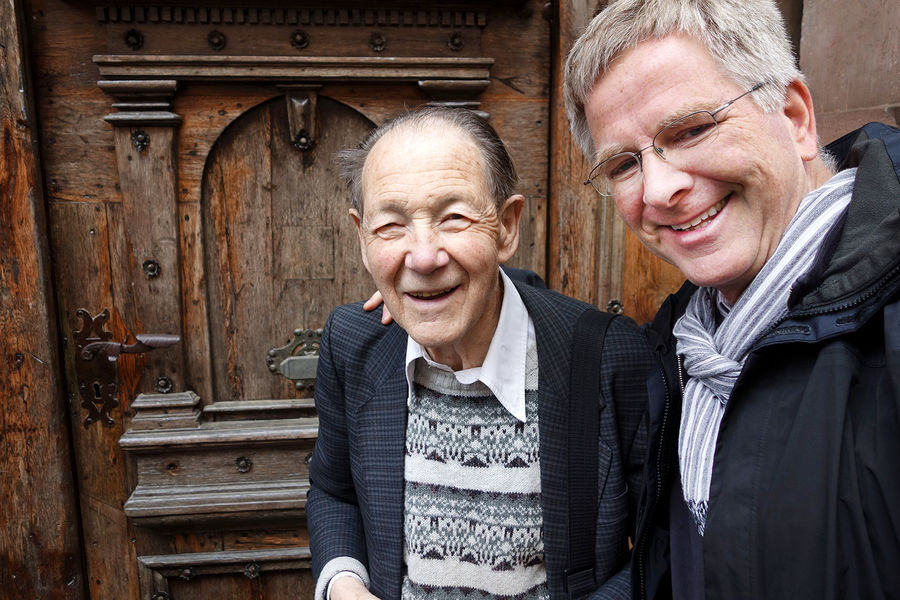
| Günther, the "last knight of Rheinfels," explores deep beneath the castle in the secret tunnels. |
Optional Detour — Into the Mine Tunnels: To protect their castle around 1600, the Rheinfellers cleverly booby-trapped the land just outside their walls by building tunnels topped with thin slate roofs and packed with explosives. By detonating the explosives when under attack, they could kill hundreds of invaders. In 1626, a handful of underground Protestant Germans blew 300 Catholic Spaniards to — they figured — hell. You're welcome to wander through a set of never-blown-up tunnels. But be warned: it's 600 feet long, assuming you make no wrong turns; it's pitch-dark, muddy, and claustrophobic, with confusing dead-ends; and you'll never get higher than a deep crouch. It cannot be done without a light (bring a flashlight or candles and matches available at entry — see sidebar). At stop #6 of the above tour, follow the stairs on the right leading down zu den Minengängen (sign on upper left).
The Fuchsloch sign welcomes you to the foxhole. Walk level (take no stairs) past the first steel railing (where you hope to emerge later) to the second steel railing. Climb down. The "highway" in this foxhole is three feet high. The ceiling may be painted with a white line indicating the correct path. Don't venture into the more narrow side aisles. These were once filled with the gunpowder. After a small decline, take the second right. At the T-intersection, go right (uphill). After about 10 feet, go left. Take the next right and look for a light at the end of the tunnel. Head up a rocky incline under the narrowest part of the tunnel and you'll emerge at that first steel railing. The stairs on the right lead to freedom. Cross the field, walk under the bigger archway, and continue uphill toward the old wooden bridge. Angle left through two arches (before the bridge) and through the rough entry to Verliess (prison) on the left. Rejoin the tour here at stop #8.