Home > Plan Your Trip > Best Destinations > Eastern Europe

St. Petersburg, Russia

For your interest we have kept the basic chapters of out of print Russia and the Baltics book available online. Please note that the information is from 1998 and therefore only good for general ideas on travel there. Printer-friendly version.


Once a swamp, then an imperial capital, and now a showpiece of vanished aristocratic opulence shot through with the grimy ruins of socialism, St. Petersburg is Russia's most accessible and most tourist-worthy city. Standing in Palace Square, you'll shiver and think, The revolution started here. (You may also shiver and think, "I'm as far north as Alaska.") Palaces, gardens, statues, and arched bridges over graceful canals bring back the time of the czars. Two of the world's greatest art museums top it off. Amid such artistic and historical splendor, modern Russia and its problems seem terribly out of place, but here they are: streets of legless beggars, Mafia-controlled kiosks, wheezing buses, shabby bread stores, broken signs, exhaust-stained facades, pornography dealers, and ice-cream stands in see-your-breath weather.

Compared to Moscow, St. Petersburg is compact, walkable, friendly, manageable, and architecturally intact. Don't get overly uptight about timing your visit to the summer solstice for St. Petersburg's much-bandied White Nights. You'll be able to enjoy bright evenings here all summer long. If you want the real midnight sun, go to Finland.

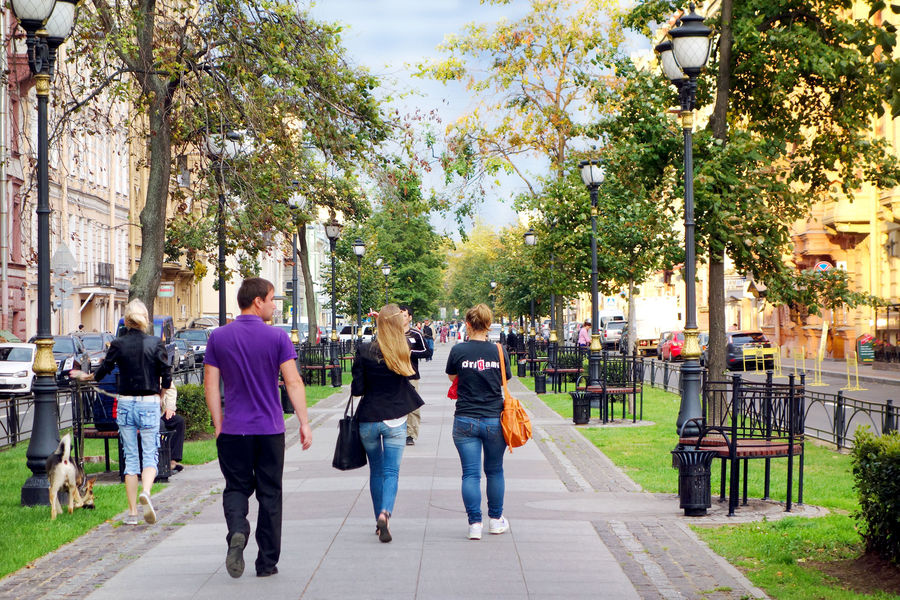
Save a sunny day just to walk. Keep your head up — ugly Soviet shops mar the first floor of many buildings, but the upper facades are sun-warmed and untouched by street grime. Make sure you get off Nevsky Prospekt to explore the back streets along the canals. Climb St. Isaac's Cathedral for the view. Visit the Summer Gardens. The next day, when the Baltic Sea brings clouds and drizzle, plunge into the Hermitage or the Russian Museum.

Planning Your Time

Day 1: 10:00, after breakfast, take a leisurely walk along Nevsky Prospekt to acquaint yourself with the city; 11:00, climb up St. Isaac's Cathedral; 11:30, walk back to Sadko's for lunch; 13:30, the Russian Museum is just up the street; 18:30, taxi to the Korean House for dinner.

Day 2: 10:30, tour the Hermitage; 13:30, have lunch at the Count Suvorov or Bistro Laima; 15:00, take the Metro to the Peter and Paul Fortress; 18:30, come back to the center for dinner at Tandoor.

Day 3 (optional): Spend more time in the Hermitage, visit the Piskaryovskoe cemetery, or go to Petrodvorets for the day.

Orientation

Get to know Nevsky Prospekt, St. Petersburg's main street. Almost everything you'll want to see is either along Nevsky or between it and the river. A few spots, like the Finland train station and the Peter and Paul Fortress, are just across the river.

Nevsky starts at the slender-spired Admiralty, next to the river and the Winter Palace. Running outward from the city it crosses three canals: first the Moika, then Kanal Griboyedova, and finally the Fontanka . Tourist Nevsky ends a little farther out at Ploshchad Vosstaniya (Uprising Square, home to a tall obelisk and the Moskovskii train station.

Walking distances are manageable (from Ploshchad Vosstaniya to the Admiralty takes 30-45 minutes), and St. Petersburg has enough natural landmarks that on a nice summer day you can easily get around on foot without using a map.

Tourist Information: Ost-West Kontact Service, a private information office run by Westerners, is the closest thing to a tourist information office that St. Pete has to offer (Monday-Saturday 10:00-18:00, Sunday 12:00-18:00, ul. Mayakovskogo 7, down the road from the Nevsky Palace Hotel, tel. 279-7045, fax 327-3417, mailing address P.O. Box 109, SF-53101 Lappeenranta, Finland). They give out tourist info and book theater tickets, cruises, bus tours, homestays, and hotel rooms. If you arrange accommodations in advance with Ost-West, they will send you a visa support letter, and if you want to visit Russian friends in St. Petersburg they will set up the invitation for $7 per night, which is much less bother than having your friends work through OVIR.

English-language periodicals like Pulse and the St. Petersburg Times, which comes out on Tuesday and Friday, will keep you up to date on events in the city.

American Embassy: Furshtadtskaya ulitsa 15, Metro: Chernyshevskaya, tel. 275-1701.

Bookstore: The Mir international bookshop at Nevsky Prospekt 13, near Palace Square, has lots of new and used art books, English fiction (in the back room), and St. Petersburg maps at better prices than the outdoor stalls (daily 10:00-14:00 and 15:00-19:00).

Guides: Local guides are cheap, eager, and helpful. Try Alexandra Ivanova (who gives Hermitage tours, gets cheap tickets for concerts and ballets, and even takes people to the airport, $20/hr, tel. 232-6458), and Alexy Alyoshetkin (who tailors sightseeing to your needs, $5/hr for city walking tours, $20/day for 2-3 days, tel. mobile 79-21-353-3091, email: alexpetrograd@mail.ru).

Currency Exchange

It's available everywhere and ATMs are increasingly common. Exchange offices are usually closed by 18:00 weekday evenings and all day on weekends. The American Express office is inside the Grand Hotel Europe (Monday-Friday 9:00-17:00, Saturday 9:00-13:00, Mikhailovskaya ulitsa 1, Metro: Nevsky Prospekt, tel. 329-6060). Their exchange desk is run by a Russian bank, not by Amex; at last report they took a 1 percent commission on traveler's checks. Emergency check cashing is available, but not cash advances.

Telephones and Mail

Brand-new, bright green card telephones have sprouted along the streets of St. Petersburg. Cards are available at shops and offices throughout the city for example, at Ost-West Kontact Service. The cheapest card costs about $9 for 100 units. For each minute, local calls cost 1 unit; to Moscow or the Baltics, 14 units; to Europe, 22; and to America, 54. The older public phones use the same tokens as the Metro.

You can also make long-distance calls at the central telephone office at Bolshaya Morskaya ulitsa 5 (between Palace Square and Nevsky Prospekt on the street with the big arches; look for the "PHONE" sign). For calls within the former Soviet Union, enter and turn right to Hall #1; a booth sells wide-grooved tokens for the intercity phones in the surrounding booths numbered 15 through 37 (24 hours daily). One 40-cent token buys 43 seconds to Moscow. For international calls, go to Halls #2 and #3. In Hall #2, you pick up a numbered token, go to the cabin with that number, make your call, and pay afterwards (daily 8:00-23:00). Or if you choose, Hall #3 provides operator assistance: fill out a form and wait to be told when your party answers; you're liable for one minute if an answering machine responds (24 hours daily).

Calls to America or Europe cost about $2.60 per minute (cheaper after 20:00 and on weekends). On most phones at this office you have to push the "OTBET" button when the other side answers. Hall #4 is all new with the cheapest photocopies, computer rentals, email, and fax services in town (daily 9:00-21:00), along with comfortable card-operated phone booths and a DHL express mail office.

The central post office is at Pochtamtskaya ulitsa 9, under the arch a couple of blocks down from St. Isaac's Cathedral. Send international mail from window 24 (Monday-Saturday 9:00-19:30, Sunday 10:00-17:45).

Getting Around St. Petersburg

The Metro is not that helpful for getting around the center of the city, but essential for longer trips. It requires metal tokens swhich you can buy at station entrances for 30 cents and which also work in the pay phones. Trams and buses can be quite useful, but it takes some time to familiarize yourself with stops and routes. Buy yourself a street map. The Mir bookstore at Nevsky 13 has the best selection, but you can also try the Dom Knigi bookstore at Nevsky 28, or street stalls.

Taxis are a good option in St. Petersburg. You should pay the ruble equivalent of about $2 for an average trip within the center. Pay $1 if it's just a hop, skip, and a jump. Longer trips will run $3 to $5. Some cabs are official and use the meter. Unofficial cab drivers around major tourist sights may try to rip you off; refuse any driver who asks for payment in dollars.

Sights


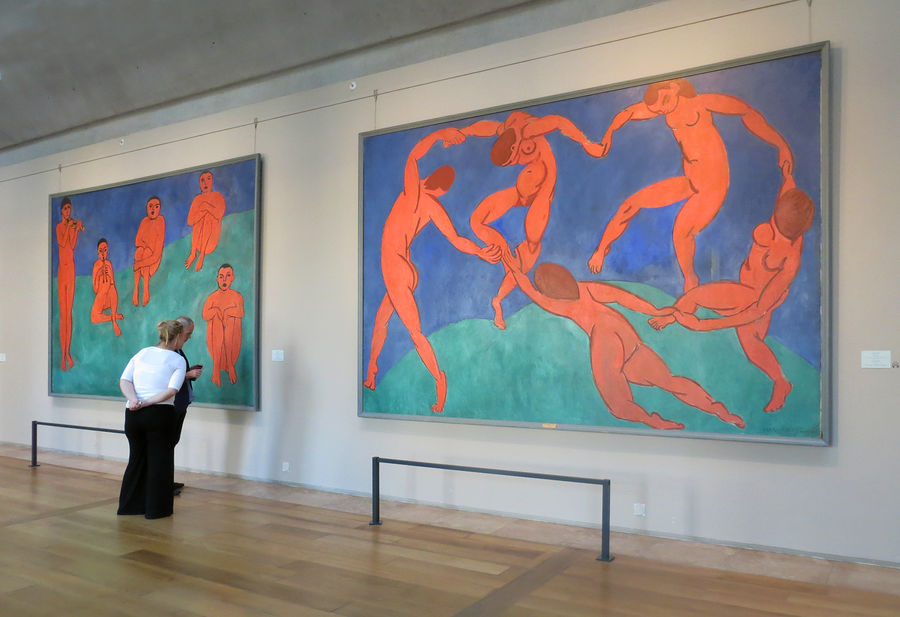
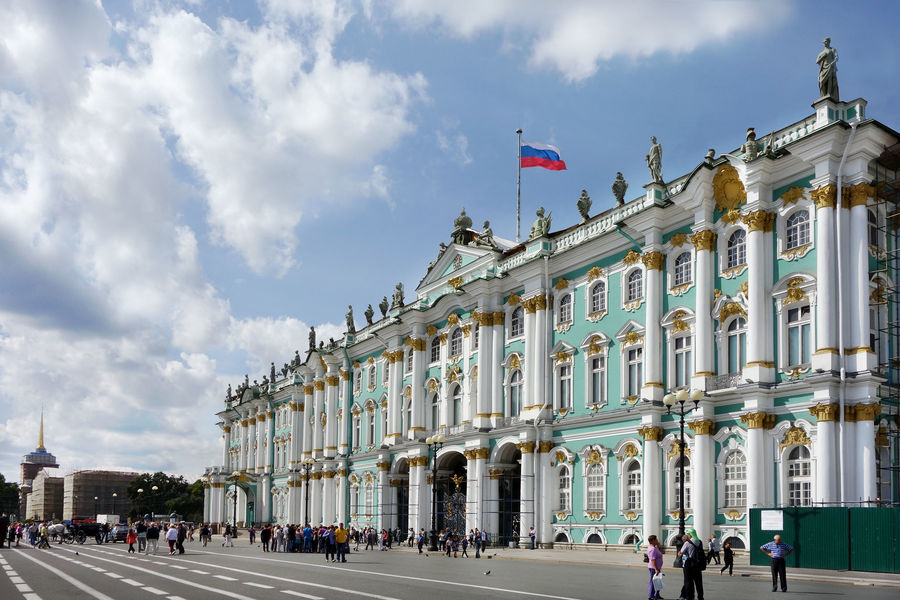
*** The Hermitage — The Hermitage's vast collection of European masters makes it one of the world's top art museums, ranking up there with the Louvre and the Prado. Some people come to Russia just to see this place. Others don't want to spend time on painters whose work can be admired more easily in New York, Paris or Madrid. The first sort of person could spend days inside without exhausting the Hermitage's treasures; the second might want to bypass the place entirely in favor of the Russian Museum (see below) or no museums at all. Here's a middle strategy. First, pick one artistic period that you really like, and head straight for that. Modern art is on the top floor, antiquities at ground level, and everything in between on the second floor. Second, visit rooms 188-198 on the second floor, where the attraction is history, not art. Russian royalty once partied and feasted in these begilded, bedraped, and bejeweled chambers. In 1917, the Provisional Government met for the very last time in the green-pillared Malachite Hall (room 198), before being arrested in the adjacent dining room. The building faces Palace Square, where Bolshevik forces assembled before storming in. The museum is in the czars' old Winter Palace, the green-and-white building between Palace Square and the river. The museum entrance is on the other, riverfront side of the building (admission $8; Tue-Sat 10:30-18:00, Sun 10:30-17:00, closed Mon; ticket windows close an hour before the museum; the top floor closes 40 minutes early). The number of people employed at the Hermitage is amazing — practically each one of the hundreds of rooms has an attendant.

** Russian Museum — Here's a fascinating collection of prerevolutionary Russian art, particularly 18th- and 19th-century painting and portraiture. People who complain that the Hermitage is just more Monets and Rembrandts love the Russian Museum, since the artists are less well-known in the West. Much of the work reveals Russians exploring their own landscape: marshes, birch stands, muddy village streets, the conquest of Siberia, firelit scenes in family huts, and Repin's portrait of Tolstoy standing barefoot in the woods. You may enjoy Rerikh, an early 20th-century Russian artist who painted startling, imaginary, Himalayan landscapes in icy blue colors, or Vrubel's painting of The Russian Hero. Use either the main entrance (closer to the medieval art) or the side door along Kanal Griboyedova (closer to the early 20th-century paintings). (Admission $7, students $3.50, guided tours $20, free the first Wed of every month; open Wed-Sun 10:00-18:00, Mon 10:00-17:00, closed Tue; ticket window closes an hour before the museum; Inzhenernaya ulitsa 4, a block off Nevsky behind the Grand Hotel Europe).

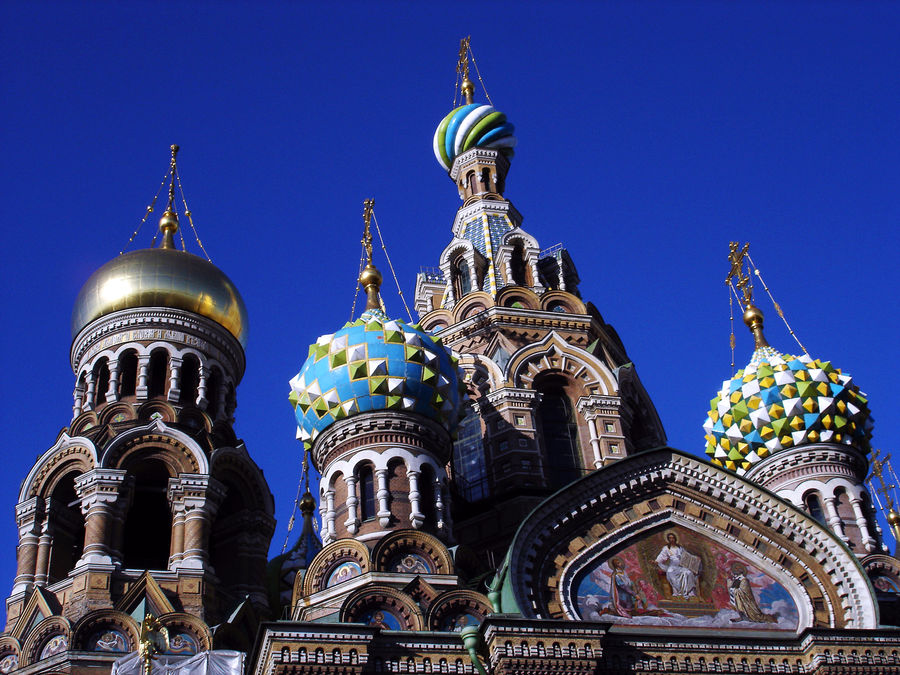
*** Churches — Russian Orthodox churches are reopening all over St. Petersburg (and Moscow). When you see onion domes, walk in. Smaller churches are full of Russians morning, noon, and night, and will give you more of a feeling for Russian religion than will church-museums like St. Isaac's or the Kazan Cathedral. Plus, entrance is free, though you can leave a small donation towards renovations, or buy and light a candle. In St. Petersburg, there's a nice church at Vladimirskaya metro, across from the indoor market, and another at the south end of Mokhovaya ulitsa, by the first bridge across the Fontanka going north from Nevsky. For the best Orthodox service in St. Petersburg, take the Metro to ploshchad Aleksandra Nevskovo and attend the church in the lavra (seminary) across the street from the Metro exit, either on Sunday morning or for evening services daily at 18:00. It doesn't cost anything, except if you want to see Dostoevsky's grave in the cemetery across from the lavra (entrance $1).

** St. Isaac's Cathedral — Head down Malaya Morskaya ulitsa from Nevsky Prospekt. The thing to do here is climb the colonnade stairway to the roof. The view is worth the climb and the money. Russians buy tickets at the booth outside the fence; foreigners have to go to the desk just inside the door. The inside of of St. Isaac's is a museum, not a functioning church, and at $8 for the museum, $3 for the colonnade (students $4 and $1), I'd simply take a peek at the massive 19th-century interior while you buy your cheaper colonnade ticket. You can (and should) visit a real Russian house of worship for nothing. (Thu-Tue 11:00-18:00, last entry at 17:00, closed Wed.)

* Kazan Cathedral — Reopened after years as a Museum of Atheism, this huge brown cathedral is on Nevsky at Kanal Griboyedova. It's not quite yet a functioning church either, but entrance is free (daily 9:00-20:00); one wing houses a museum of the history of religion ($3, students $1.50, Thu-Tue 11:00-17:00, closed Wed).

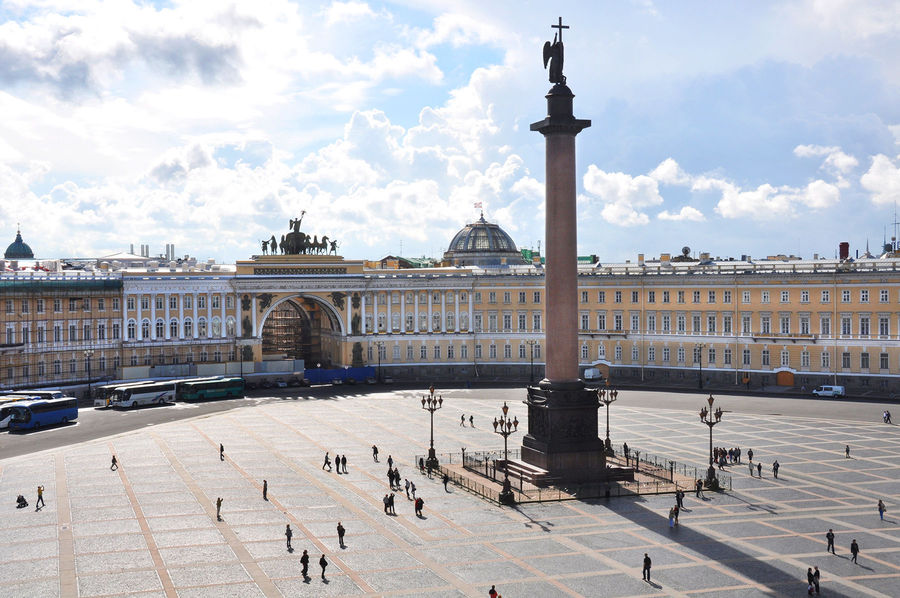
** Nevsky Prospekt — Nevsky's architectural highlights include the magnificent arch of the General Staff Building down Bolshaya Morskaya ulitsa, the Kazan Cathedral, and the views down the canals. You should also check out the sign at Nevsky 14, preserved from World War II, warning citizens that the north side of the street was more dangerous during shelling. The building with the distinctive tower at #28 is the city's main Dom Knigi (bookstore), formerly the Russian headquarters of the Singer sewing machine company.

* Peter and Paul Fortress — Founded by Peter the Great in 1703 during the Great Northern War with Sweden, this fortress on an island in the Neva was the birthplace of the city of St. Petersburg. Its gold steeple catches the sunlight, and the blank walls facing the Winter Palace across the river. You can wander through and climb the bastions for free. Your ticket lets you into the church (where Peter is buried), the jail (which housed numerous 19th-century revolutionaries including Lenin's older brother), and several museum-style exhibits. The main entrance is through the park from Metro: Gorkovskaya. Buy tickets inside the museum gift shop opposite the church, or from the "kassa" to your right after you cross the bridge onto the island ($3, students half-price, Thu-Mon 11:00-18:00, Tue 11:00-17:00, last entry 1 hr before closing, closed Wed and the last Tue of each month).

Moored in the river along Petrogradskaya nab. not far from the fortress is the Cruiser Aurora, which fired the shot that signalled the start of the Russian Revolution. Now a museum, it's worth visiting if you are a history buff or a Bolshevik, and with the Lenin Museum in Moscow closed, the Aurora now has one of Russia's best collections of Soviet kitsch (free, Tue-Thu and Sat-Sun 10:30-16:00, closed Mon and Fri, no English descriptions).

Halfway between the fortress and the Aurora, at Petrovskaya nab. 6, is Peter the Great's log cabin, entombed in a small 19th-century brick house in a tiny park. Peter lived here briefly in 1703. When we last visited, the cabin was under renovation, expected to last several years.

* Dostoevski Museum — Although much of the furnishings are gone, you can get some feel for how the famous writer lived from visiting the six-room apartment where he wrote The Brothers Karamazov. Duck when you enter. Captions are in English. The babushki who run the place put a new half-cup of tea on Dostoevski's desk every morning ($2.50, students $1.25, Tue-Sun 11:00-18:30, last entry 17:30, closed Mon and the last Wed of every month; Kuznechii pereulok 5, a block from Metro: Dostoevskaya).

* Piskaryovskoe Memorial Cemetery — This is a memorial to the hundreds of thousands who died in the city during the German siege of Leningrad in World War II. The cemetery, with its eternal flame, acres of mass grave bunkers (marked only with the year of death), moving statue of Mother Russia, and many pilgrims bringing flowers to remember lost loved ones, is an awe-inspiring experience even for an American tourist to whom the siege of Leningrad is just another page from the history books. To get there, take the Metro north to Ploshchad Muzhestva, exit, walk through the large brick apartment complex to the street, cross it to the eastbound bus stop, and take bus #123 to the sixth stop — you'll see the buildings on your left.

* Kunstkamera — This is officially known as the Peter the Great Museum of Anthropology and Ethnography. Truthfully, though, most people come only for the collection of hideously deformed preserved fetuses that Peter the Great bought from an Amsterdam doctor and had brought back to Russia. The rest is a vast, dusty, poorly lit collection of Soviet-era dioramas and displays on world cultures. Check out the excellent American Indian section, the "Our Baltic Neighbors" display, or the selection of photographs of socialist Africa's public buildings. No English captions ($2, Fri-Wed 11:00-18:00, last entry 16:45, closed Thu, Universitetskaya naberezhnaya 3, in the blue-and-white building across the big bridge from the Hermitage).

** Ballet, Opera, and Music — Keep an eye out for ballet and opera performances, advertised on posters all around town. The Marinskii (formerly Kirov) Ballet performs in Teatralnaya Ploshchad, a little ways southwest of Nevsky — you may need to take a taxi. More convenient is the Malii Opera, which also has ballet, at ploshchad Isskustv 1, by the Russian Museum. The symphony is on Mikhailovskaya ulitsa across the street from the Grand Hotel Europe; the box office is next door. The theaters in St. Petersburg have cleaned up their act and in 1996 scalpers were nowhere to be seen. Just go to the box office (usually open daily 11:00-19:00 with a lunch break at 14:00 or 15:00) for tickets. The most popular ballets sell out a few days in advance, but for others there are seats left the day of the performance. At the Malii, foreigners pay about $25 for the nicest seats, less than $5 in the upper balconies. The symphony is always cheaper. If you don't want to brave the box office, your hostel or hotel may be able to help you with tickets.

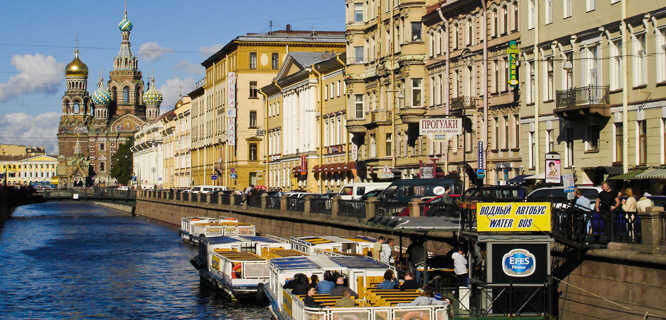
* Boat trips — From June into September trips on the St. Petersburg canals leave every half-hour from a dock on the Fontanka at Nevsky Prospekt (about $8).

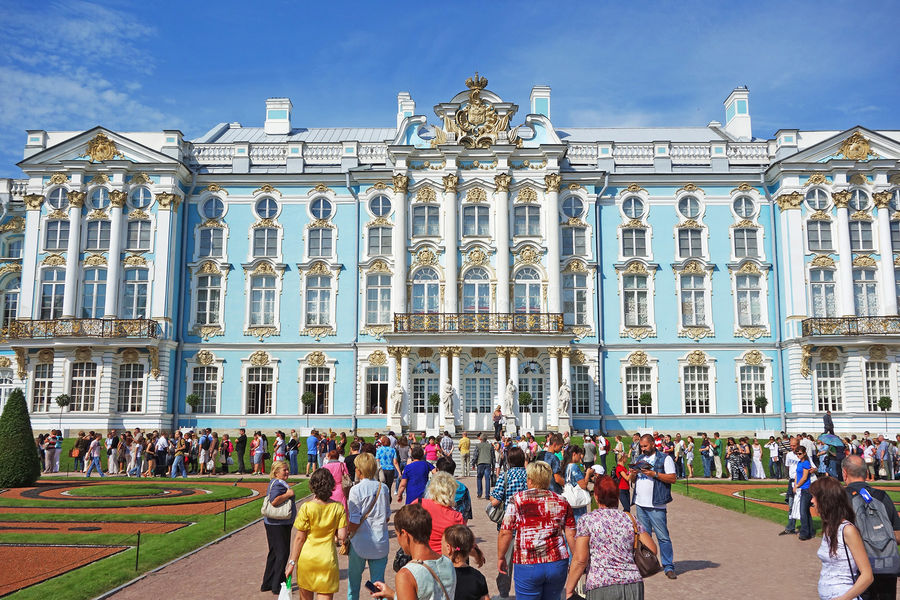
** Peterhof — If you have time for a day trip, go to Peter the Great's lavish palace at Peterhof, also known as Petrodvorets, along the Gulf of Finland west of the city. This is Russia's Versailles and the target of many tour groups and travel poster photographers. Promenade along the grand canal, which runs through landscaped grounds from the boat dock up to the terraced fountains in front of the palace. There are ice cream stands aplenty and a nice indoor cafe with coffee and pastries. You can visit the museum inside the palace if you want for $3, but it's more fun to stay outdoors here. Children love to run past the so-called trick fountains — sometimes they splash you, sometimes they don't. In summer, "Meteor" hydrofoils leave for Peterhof every half-hour during the daytime from a dock across from the Hermitage entrance (30-40 min. trip, $8 each way, plus $6 entry to the palace grounds). In winter, you have to take a suburban train and then switch to a bus — ask for details (Tue-Sun 11:00-20:00, closed Mon and last Tue of month).

Sleeping

(If calling from the U.S., dial 011-7-812, then the local number.)

Hostels

St. Petersburg International Hostel is a normal hostel like those in Western Europe, with friendly English-speaking staff, 60 beds in clean three- to five-bed rooms with clean showers, a members' kitchen, a small shop, a cybercafe for Internet addicts, and Western movies every night. Seventeen dollars a night (hostel members $15) includes continental breakfast (credit cards accepted). They're busy in summer, so reserve ahead by phone (tel. 329-8018, fax 329-8019, www.ryh.ru) or through the hostel's American office, listed below. At 3rd Sovetskaya ulitsa 28, the hostel is about a 10-minute walk from Nevsky Prospekt, Ploshchad Vosstaniya, the Moskovskii Vokzal (train station), and the associated Metro stations. Coming out the front door of the train station, walk right, heading into the major street with overhead trolley wires. Take your first left off this street onto Suvorovskii prospekt. Walk two blocks (past the blue signs of the Philips housewares store) and then turn right onto 3rd Sovetskaya ulitsa. The hostel is the remodeled cream-and-magenta building half a block down on your left. Downstairs you'll see Sindbad Travel, a fully accredited budget and student travel agency like STA and Council Travel in the U.S. Run by the hostel, Sindbad sells train and air tickets at fair prices (tel. 327-8384, fax 329-8019, Mon-Fri 9:00-17:00, closed Sat-Sun). The best thing about the St. Petersburg International Hostel is its efficient system of visa support. If you're in the U.S.A. or Canada, the St. Petersburg Hostel office in Redondo Beach, California, will take your reservations and get your visa for you. Outside the U.S.A. or Canada, contact the hostel through the Hostelling International booking network. Once you send all your details to the hostel (see below), they will send you a confirmation voucher and your visa support letter, which you can take or send to the nearest Russian consulate or embassy to get your visa. If you go through the California office, they'll get your visa for you too. You will usually receive visa support for ten days longer than you plan to stay in the hostel, which gives you the flexibility to stay longer without ridiculous extension hassles. The hostel can also provide one-year multiple-entry visas for $320. The hostel will also take reservations for Hostel "All Seasons" in St. Petersburg, Travellers Guest House and the Heritage Hostel in Moscow, and any future hostels that may open in Russia (there are plans for one in Irkutsk) and give visa support for your time there. In the summertime they can get busy; if there's no room left they will confirm you for Hostel "All Seasons." The hostel's handy American office is at 409 N. Pacific Coast Highway, Bldg. #106, Suite 390, Redondo Beach, CA 90277 (tel. 310/379-4316, fax 310/379-8420). Upon request, they will mail you a reservation form and information package. To get your Russian visa, they charge a $15 reservation fee, a $30 visa service fee, and as little as $40 for your visa (more if you need it quickly). You'll also pay $17 for each night you plan to stay at the hostel. You should plan to work at least four weeks in advance; faster processing is possible but more expensive. If you are contacting the hostel by fax or Email, it will save time if your first communication includes your full legal name; citizenship; birthdate; passport number and expiration date; dates you plan to stay at the hostel; place, date, and means of entry into Russia; place, date, and means of exit from Russia; location of the Russian consulate where you plan to have your visa processed; Visa or MasterCard number; your name as it is written on the credit card; card expiration date; and signature. They need this information to make up your visa support letter and confirmation voucher. The hostel will charge you $52, which includes your first night at the hostel. The hostel has a close relationship with Eurohostel in Helsinki and you can also make reservations there.

Hostel "All Seasons" has more doubles and more congenial common space, is less strict (no curfew), and has a nicer view than the International Hostel. On the other hand, the bathrooms are not as modern, the door is harder to find and get into, the hostel is not as tightly run, and it is beyond walking distance from Nevsky Prospekt (ulitsa Mikhailova 1, tel. 542 7364, fax 325-8559, www.hostel.ru). Hostel "All Seasons" has about a hundred beds in two- to six-bed rooms on several floors of a larger building, and charges $16-19 per person per night, depending on the season. Breakfast is included and laundry service is available. Visa and MasterCard accepted. The hostel is less than a 5-minute walk from the Ploshchad Lenina Metro station at the Finlyandskii Vokzal (train station). Coming out the front door of the Metro station, walk straight down through the park to the river, then turn left one block to ulitsa Mikhailova; the hostel is in the building on the far left corner with the fourth-floor corner balcony. The hostel entrance is in the inside corner of the L-shaped building; go in through the archway off of ulitsa Mikhailova, look for the "YH" sign on the wall, and ring the bell — the hostel is on the third floor. (You can't get in yourself without punching in the code they'll give you.)

Hotels

The St. Petersburg hotel scene is frustrating. The cheaper hotels — with doubles under $50 — are usually too sleazy or too far from the Metro. Hotels with new furniture, appealing bathrooms, and a modern lobby start at $100 for a double, and even that often means a pompous Soviet-style reception desk, congealed breakfast, distant location, and shady characters in the lobby who possibly drive the $40,000 cars without license plates that are parked outside. What's more, these hotels generally aren't together enough to fax you an invitation letter to support your visa application. For enlightened service, propriety, and visa support in the center of the city, there are first-world fortresses such as the Nevsky Palace (tel. 311-6366), the Grand Hotel Europe (329-6000), and the Astoria (311-4206), but they cost upwards of $200 a night. Here are a few places worth recommending:

The cheapest of the high-price hotels (though its rooms are correspondingly small — it's a ship, after all) is the Swiss-run Hotelship Peterhof, moored at naberezhnaya Makarova 24 (tel. 325-8888, fax 325-8889) where double rooms start at $190 (reserve at 415/398-7947 in the U.S.A.)

If you're booking a flight-plus-hotel package from Finnair or another tour operator, the Hotel Deson-Ladoga is a safe bet: the rooms are nice, the reception staff are young and speak English, it's only a block from the Novocherkasskaya metro, and it's possible to get doubles for less than $100 through Peter T.i.P.S. or a tour operator (prospekt Shaumyana 26, tel. 528-5200, fax 528-5448).

If you're already in Russia, don't need visa support, and are just looking for a cheap, central, livable hotel with private facilities, try the Hotel Rus, on a quiet street just blocks from Nevsky Prospekt (Artilleriiskaya ulitsa 1, Metro: Chernyshevskaya, tel. 273-4683). Built for the 1980 Olympics, it's definitely one of the world's ugliest hotels, but the rooms are standard and the lobby is surprisingly welcoming. Doubles with bath run about $50; the bathrooms are typically Soviet, but OK.

Private Rooms

An organization which has been around for several years and which seems reliable is the Host Family Association, which sets up homestays with families in St. Petersburg for $50-60/day per two persons, $100 with all meals. Contact them by email to alexei@hofak.hop.stu.neva.ru, or use tel./fax 7/812/275-1992 in St. Petersburg. They meet you at the train or the airport and bring you to your hosts' apartment.

Eating

The listings below are your best bets for good food served honestly for $10-15 a meal.

At Koreiskii Domik (i.e., Korean House), a full meal runs about $12 per person, including tea, rice, spicy pickled vegetables, and an entree like chapche (noodles with vegetables and meat), lapsha (noodles and meat in broth), or pulgogi (spicy Korean-style meat cooked on a burner on your table). Quick service, English menu. And I've drunk their filtered water and never gotten sick. In summer especially, try to reserve at tel. 259-9333 (daily 13:00-22:00). It's at Izmailovskii prospekt 2, at the intersection with the Fontanka canal and near the blue-domed church; the entrance is on Izmailovskii. It's easiest to taxi there along the Fontanka, but you can get there by foot in 15-20 minutes from Metro: Teknologicheskii Institut, walk west to Izmailovskii, then take a right to the canal.

Sadko's, the cheapest of the three restaurants in the Grand Hotel Europe, is St. Petersburg's yuppie American hangout. Inside it feels like Manhattan. The menu is chalked on blackboards, and parts of it vary daily. Main dishes, which vary daily, cost about $9.50-15; desserts (they have great cakes) go for $4-6. Beverages are expensive (Cokes, $3). Visa, MasterCard, and AmEx accepted. No non-smoking section. Live music every evening after about 9:00 or 10:00. Ask a lady at the bar what her name is, and she'll answer "$200." (Daily 12:00-1:00, last orders at 00:30; at the corner of Nevsky Prospekt and ulitsa Mikhailovskaya, almost across the street from Gostinii Dvor; tel. 329-6000 for reservations.)

Restaurant Tandoor serves normal Indian food near St. Isaac's Cathedral for about $15 per person. Service could be faster and portions larger, but for St. Petersburg it's not bad and the staff speaks English and accepts credit cards (Voznesenskii prospekt 2, at the corner of Admiralteiskii prospekt, tel. 312-3886, daily 12:00-23:00).

Carrols, Nevsky 45 at the corner of ulitsa Rubinshteina, serves the best fast food in the center — a burger, fries, and Coke for about $4. Another branch is at ulitsa Vosstaniya 3, near the Moscow Station (daily 9:00-23:00).

Count Suvorov is a not-bad place to get real Russian food for lunch in between a day's sightseeing. For about $12 you can get, for example, borscht, chicken Kiev, and your choice of "garnishes" (potato, cauliflower, or french fries) well-presented on big plates in this small modern restaurant near the south end of the Gostinii Dvor department store (ulitsa Lomonosova 6, tel. 315-4328, daily 12:00-24:00).

Kavkaz is a good Georgian restaurant which you should try if you won't make it to Moscow (see our Georgian food ordering guide in the Moscow section). A meal in the restaurant section will run you $15-20. There's also a cafe section (right on the corner of the street) with the same food for much lower prices (e.g. khachapuri costs less than a dollar for a quarter-pie). Avoid the "Georgian national soup" (khashi). Take the metro to Novocherkasskaya, then walk downhill towards the river and the bridge one block; it's on the far right corner (ulitsa Stakhanovtsev 5, tel. 221-4309, restaurant open daily 12:00-23:00, cafe Monday-Saturday 9:00-21:00, Sunday 10:00-19:00).

In summer the Afrodite restaurant at Nevsky 86 runs a beer garden in its courtyard (go through the archway; daily 12:00-1:00).

La Cucuracha is a Mexican restaurant staffed by Cubans with $6 enchiladas (naberezhnaya Reki Fontanki 39, a block and a half south of Nevsky along the inner side of the Fontanka, tel. 110-4006, Sunday-Thursday 12:00-1:00, Friday-Saturday 12:00-5:00).

Bars: The St. Petersburg bar scene centers around Galernaya ulitsa, near St. Isaacs; Senat, at Galernaya 1, and Tribunal, at Senatskaya ploshchad 1, are two popular places.

Picnics

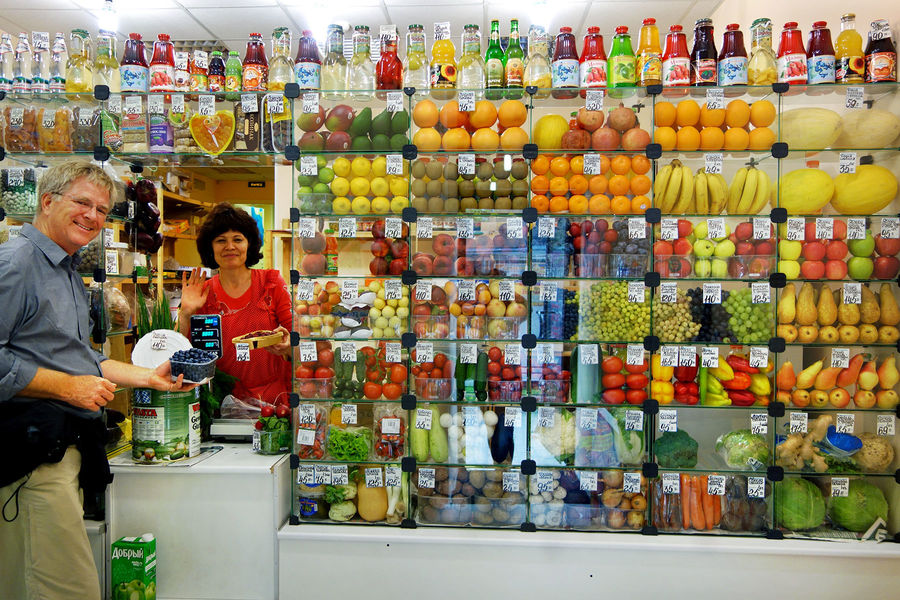
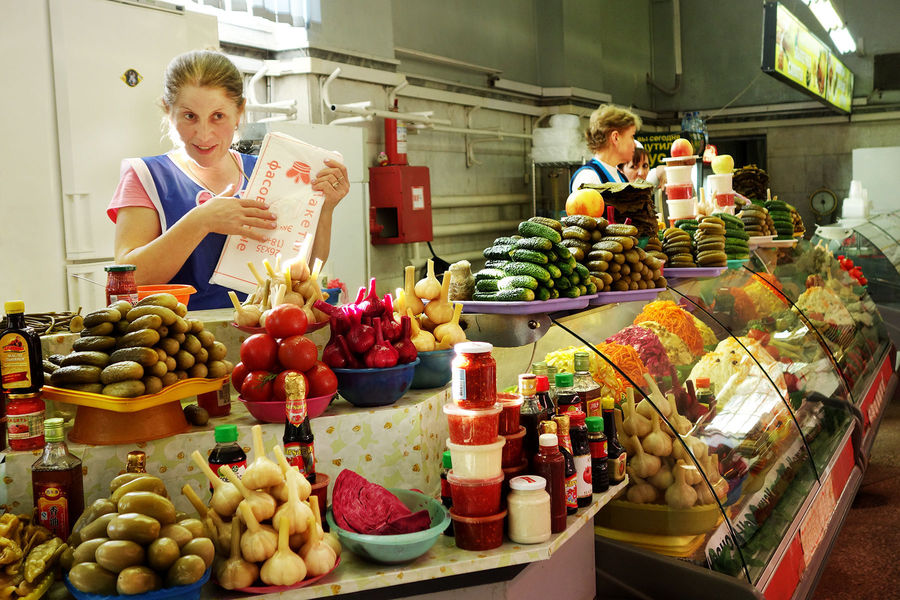
Farmer's market: A trip here will show you the true scope of Russia's agricultural richness (and fill your picnic basket). St. Petersburg's best and most central farmer's market is at Kuznechii pereulok, right across the street from the Dostoevski museum (look for the big "Rynok" sign; Metro: Vladimirskaya). Any Russian farmer's market is worth a visit even if you're not shopping. First you'll pass babushki selling plastic bags, then Georgians shouting "Molodoi chelovyek!" (young man) and "Devushka!" (young lady) as they try to entice you towards their piles of oranges, tomatoes, cucumbers, and pears. In the honey (Med) section, a chorus line of white-aproned babushki stands ready to let you dip and test each kind. Check out the barrels of sauerkraut and trays of pickled garlic and cabbage. In the herbs section, you can sniff massive bunches of fresh coriander and wade through a lifetime of horseradish; nearby, look for a Central Asian spice trader with wares of every color laid out in little bags. (Monday-Saturday 8:00-19:00, Sunday 8:00-16:00, closed one Monday a month for cleaning.)

Grocery stores: There are now small markets in every neighborhood where you can pick up bread, fruit, bottled water, Finnish or Estonian milk, cheese, and yogurt, and other necessities. If you need to do a major shopping, the Finnish chain Stockmann has a store at Finlyandskii prospekt 1 (daily 10:00-21:00), across the street from the round building of the Hotel St. Petersburg and across the Sampsonievskii Most (bridge) from the Cruiser Aurora. This is about three stops on tram #6 from either Metro: Gorkovskaya or Ploshchad Lenina, or you can walk.

Transportation Connections

By Train

Trains to Moscow leave from the Moskovskii Vokzal (Moscow Station, Metro: Ploshchad Vosstaniya).

Trains to the Baltics leave from the Varshavskii Vokzal (Warsaw Station). Metro: Baltiiskaya brings you to the nearby (and confusingly named) Baltiiskii Vokzal; from the Metro exit, walk to the main street, turn right, and walk one long block to the Varshavskii Vokzal.

Trains to Helsinki leave from Finlyandskii Vokzal (Finland Station, Metro: Ploshchad Lenina).

Buying Tickets

Tickets for all trains are available without too much hassle at the Central Railway Booking Office (Monday-Saturday 8:00-20:00, Sunday 8:00-16:00, Kanal Griboyedova 24). This is across the canal from the Kazan Cathedral and just a few doors from Nevsky Prospekt. Look for the steam engine sign above the building. Metro: Nevsky Prospekt.

Only Russian citizens are officially allowed to buy tickets from the windows in the main ground-floor hall. Foreigners should go to the right, through the door, and up the stairs next to the women's bathroom to the second floor. Most clerks do not speak English. They need to write your last name on the ticket in Cyrillic, and the easiest way to help them do this is to bring your passport and visa, but if you can't do that, any other ID (such as an American driver's license) is usually OK. Windows 100-104 sell advance and same-day tickets to foreigners for destinations within the former Soviet Union, including the Baltic states. Round-trip tickets (e.g., to Moscow) are difficult or impossible to get. Students at Russian universities can visit windows 101 and 102 for lower rates. Window 94 sells tickets to Finland. If you have questions, window 90 is for information ($0.75 per visit). To get your money back on tickets you don't want, visit window 91. (These window numbers could change.)

If you don't want to brave the central booking office, Sindbad Travel at the St. Petersburg International Hostel can get tickets for you at a slight markup (see under Hostels, above).

St. Petersburg to Helsinki: The Finnish-run Sibelius afternoon train is far more convenient than the Russian Repin. It's sleek, blue, and comfortable, and you can just hop on board and pay the conductor with a credit card, or in dollars or Finnish marks (although it's preferable, and slightly cheaper, to come a little early and buy a ticket at window 10 in the station). Since the Sibelius arrives in Helsinki in the evening, you should try to set up a place to stay by phone from St. Petersburg. The Russian-run Repin is not as nice as the Sibelius, though the price is the same. Since it leaves before the ticket windows open in the morning and since you can't pay on board, you have to buy your ticket the day before or earlier. You can buy tickets for both trains from special windows at Finlyandskii Station itself, either in advance or on the day of departure. Walk two car-lengths up platform 1 and go in the door marked "Train tickets Express-2" in English. Window 9 sells tickets for the Russian train; window 10 sells tickets for the Finnish train (both windows open Monday-Saturday 8:00-12:00 and 13:00-19:00, Sunday 8:00-12:00 and 13:00-16:00). As tickets on these trains almost never sell out, it's enough to come the day of departure (for the Finnish train) or the day before (for the Russian train). If you prefer, you can also get tickets for these trains at the Central Railway Booking Office, window 94 (not on the day of departure, though).

St. Petersburg to Poland: There are daily direct trains from St. Petersburg to Warsaw and Berlin, but since these transit Latvia, Lithuania, and then Belarus, they are one long nightmare of customs and immigration checks, plus you may need various transit visas. Get to Poland instead from Moscow or the Baltics.

By Bus

St. Petersburg to Helsinki: The St. Petersburg Express Bus leaves St. Petersburg at 8:45 and arrives in Helsinki at 15:45. Pick-ups in St. Petersburg are at 8:00 at the Hotel Pulkovskaya (near Metro: Moskovskaya), and 8:25 at Hotel Astoria (across from St. Isaac's), and 8:45 at Grand Hotel Europe. Make reservations at the Sovauto desk in the lobby of the Pulkovskaya (tel. 264-5125), or just show up. The bus continues from Helsinki to Turku port, meeting the Turku-Stockholm overnight ferries. Tickets to Helsinki cost $51, students 10percent off. The Pietarin Linja bus leaves St. Petersburg at 12:00 and arrives in Helsinki at 19:35 (no advance booking office, just buy tickets from the driver). The bus departs daily from Hotel Moskva (Metro: pl. Aleksandra Nevskovo) at 12:00 and from the Hotel Astoria at 12:30. Tickets $46, students 10percent off. The Finnord bus leaves St. Petersburg at 15:30 and arrives in Helsinki at 22:15. It departs from the handy English-speaking office and waiting room at ulitsa Italyanskaya 37 (a half-block in from the Fontanka canal and a block from Nevsky Prospekt, Metro: Gostinii Dvor, tel. 314-8951, fax 314-7058 for reservations). Tickets $49, students 30 percent off.

St. Petersburg to Tallinn: Buses leave daily at 7:00 and 17:00 (arriving in Tallinn at 13:20 and 23:20) from platform 5 at Bus Station #2 (naberezhnaya Obvodnovo Kanala 36). Exit Metro: Ligovskii Prospekt, then go one tram stop south (just across the canal), and a block-and-a-half east along the canal. Or take a cab. Buy tickets inside the station for $11.

By Air

Getting to and from the airport: St. Petersburg's Pulkovo airport has two terminals. Pulkovo-I handles domestic flights and Pulkovo-II handles international flights. To reach either from downtown St. Petersburg, first take the Metro to the Moskovskaya station, take the exit on the outbound end of the station, and go all the way through the underground tunnel. This will bring you out next to the stops for bus #13 (which goes to Pulkovo-II) and bus #39 (which goes to Pulkovo-I). At peak times bus #13 runs every 20 minutes. Since Pulkovo-II is not the end of bus #13's route, there are both inbound and outbound bus stops at the airport (marked by yellow signs). If you have just landed and need to take the bus into town, stand at the inbound stop (nearer the arrivals hall). For booking and reconfirmation: You can visit major airlines' downtown offices, including British Airways, Nevsky Prospekt 57, tel. 325-6222; Delta, Bolshaya Morskaya ulitsa 36, tel. 311-5820; Finnair, Malaya Morskaya ulitsa 19, tel. 315-9736; LOT, Karavannaya ulitsa 1, tel. 273-5721; Malev, Voznesenskii pr. 7, tel. 315-5455; Swissair and Austrian Air, Nevsky Prospekt 57, tel. 314-5086; SAS, Nevsky Prospekt 57, tel. 311-6112.