Père Lachaise Cemetery Tour
By Rick Steves
Enclosed by a massive wall and lined with 5,000 trees, the peaceful, car-free lanes and dirt paths of Père Lachaise cemetery (Cimetière du Père Lachaise) encourage parklike meandering. Named for Father (Père) La Chaise, whose job was listening to Louis XIV's sins, the cemetery is relatively new, having opened in 1804 to accommodate Paris' expansion. Today, this city of the dead (pop. 70,000) still accepts new residents, but real estate prices are very high.
The 100-acre cemetery is big and confusing, with thousands of graves and tombs crammed every which way, and only a few pedestrian pathways to navigate by. The maps available from any of the nearby florists help guide your way. But better still, take my tour and save lots of time as you play grave-hunt with the cemetery's other visitors. This walk takes you on a one-way tour between two convenient Métro/bus stops (Gambetta and Père Lachaise), connecting a handful of graves from some of this necropolis' best-known residents.
The Tour Begins
- Entering the cemetery at the Porte Gambetta entrance, walk straight up avenue des Combattants past World War memorials, cross avenue Transversale No. 3, pass the first building, and look left to the...
Columbarium/Crematorium
Marked by a dome with a gilded flame and working chimneys on top, the Columbarium sits in a courtyard surrounded by about 1,300 niches, small cubicles for cremated remains, often decorated with real or artificial flowers.
Beneath the courtyard (steps leading underground) are about 12,000 smaller niches, including one for Maria Callas (1923–1977), an American-born opera diva known for her versatility, flair for drama, and affair with Aristotle Onassis (niche #16258, down aisle J).
- Turn around and walk back to the intersection with avenue Transversale No. 3. Turn right, heading southeast on avenue Transversale No. 3. Turn left on avenue Carette and walk half a block to the block-of-stone tomb (on the left) with heavy-winged angels trying to fly.
Oscar Wilde (1854–1900)
The writer and martyr to homosexuality is mourned by "outcast men" (as the inscription says) and by wearers of heavy lipstick, who cover the tomb and the angels' emasculated privates with kisses. Despite Wilde's notoriety, an inscription says "He died fortified by the Sacraments of the Church." There's a short résumé scratched (in English) into the back side of the tomb.
"Alas, I am dying beyond my means." — Oscar Wilde
- Continue along avenue Carette and turn right (southeast) down avenue Circulaire. A block and a half down, you'll reach Gertrude Stein's unadorned, easy-to-miss grave (on the right just before a yellow stone structure).
Gertrude Stein (1874–1946)
While traveling through Europe, the twentysomething American dropped out of med school and moved to Paris, her home for the rest of her life. She shared an apartment at 27 rue de Fleurus (a couple of blocks west of Luxembourg Garden) with her brother Leo and, later, with her life partner, Alice B. Toklas (who's also buried here, see gravestone's flipside). Every Saturday night, Paris' brightest artistic lights converged chez vingt-sept for dinner and intellectual stimulation. Picasso painted her portrait, Hemingway sought her approval, and Virgil Thompson set her words to music.
America discovered "Gerty" in 1933 when her memoirs, the slyly titled Autobiography of Alice B. Toklas, hit the bestseller list. After 30 years away, she returned to America for a triumphant lecture tour. Her writing is less well-known than her persona, except for the oft-quoted "A rose is a rose is a rose."
Stein's last words: When asked, "What is the answer?" she replied, "What is the question?"
- Ponder Stein's tomb again and again and again, and continue southeast on avenue Circulaire to where it curves to the right. Emaciated statues remember victims of the concentration camps and Nazi resistance heroes. Pebbles on the tombstones represent Jewish prayers. At the corner of the cemetery, veer left off the road a few steps, to the wall marked Aux Morts de la Commune.
Mur des Fédérés
The "Communards' Wall" marks the place where the quixotic Paris Commune came to a violent end.
In 1870, Prussia invaded France, and the country quickly collapsed and surrendered — all except the city of Paris. For six months, through a bitter winter, the Prussians laid siege to the city. Defiant Paris held out, even opposing the French government, which had fled to Versailles and was collaborating with the Germans. Parisians formed an opposition government that was revolutionary and socialist, called the Paris Commune.
The Versailles government sent French soldiers to retake Paris. In May 1871, they breached the west walls and swept eastward. French soldiers fought French citizens, and tens of thousands died during a bloody week of street fighting (La Semaine Sanglante). The last resisters holed up inside the walls of Père Lachaise and made an Alamo-type last stand before they were finally overcome.
At dawn on May 28, 1871, the 147 Communards were lined up against this wall and shot by French soldiers. They were buried in a mass grave where they fell. With them, the Paris Commune died, and the city entered five years of martial law.
- Return to the road, continue to the next (unmarked) street, avenue Transversale No. 3, and turn right. A half block uphill, Edith Piaf's grave is on the right. It's not directly on the street, but one grave in, behind a white tombstone with a small gray cross. "Edith Gassion-Piaf" rests among many graves. Hers is often adorned with photos, fresh flowers, and love notes.
Edith Piaf (1915–1963)
A child of the Parisian streets, she was raised in her grandma's bordello and her father's traveling circus troupe. The teenager sang in Paris' streets for spare change, where a nightclub owner discovered her. Waif-like and dressed in black, she sang in a warbling voice under the name "La Môme Piaf" (The Little Sparrow). She became the toast of pre-WWII Paris society.
Her offstage love life was busy and often messy, including a teenage pregnancy (her daughter "Marcelle Dupont, 1933–1935" is buried along with her), a murdered husband, and a heartbreaking affair with costar Yves Montand.
With her strong but trembling voice, she buoyed French spirits under the German occupation, and her most famous song, "La Vie en Rose" (The Rosy Life) captured the joy of postwar Paris. Her personal life declined into ill health, alcohol, and painkillers, while onstage she sang, "Non, je ne regrette rien" ("No, I don't regret anything").
- From Edith Piaf's grave, continue up along avenue Transversale No. 3, and turn left on avenue Greffulhe. Follow Greffulhe straight (even when it narrows), until it dead-ends at avenue Transversale des Marronières No. 1. Continue ahead 20 paces on a dirt path, where you reach "chemin Molière et La Fontaine." Turn right. Molière lies 30 yards down, on the right side of the street, just beyond the highest point of this lane.
Molière (1622–1675)
In 1804, the great comic playwright was the first to be reburied in Père Lachaise, a publicity stunt that gave instant prestige to the new cemetery.
Born in Paris, Molièrewas not of noble blood, but as the son of the king's furniture supervisor, he had connections. The 21-year-old Molière joined a troupe of strolling players, who ranked very low on the social scale, touring the provinces. Twelve long years later, they returned to Paris to perform before Louis XIV. Molière, by now an accomplished comic actor, cracked the king up. He was instantly famous — writing, directing, and often starring in his own works. He satirized rich nobles, hypocritical priests, and quack doctors, creating enemies in high places.
On February 17, 1675, an aging Molière went on stage in the title role of his latest comedy, The Imaginary Invalid. Though ill, he insisted he had to go on, concerned for all the little people. His role was of a hypochondriac who coughs to get sympathy. The deathly ill Molière effectively faked coughing fits...which soon turned to real convulsions. The unaware crowd roared with laughter while his fellow players fretted in the wings.
In the final scene, Molière's character becomes a doctor himself in a mock swearing-in ceremony. The ultimate trouper, Molière finished his final line — "Juro" ("I accept") — and collapsed while coughing blood. The audience laughed hysterically. He died shortly after.
Irony upon irony for the master of satire: Molière — a sick man whose doctors thought he was a hypochondriac — dies playing a well man who is a hypochondriac, succumbing onstage while the audience cheers.
Molière lies next to his friend and fellow writer, La Fontaine (1621–1695), who wrote a popular version of Aesop's Fables.
"We die only once, and for such a long time." — Molière
- Continue downhill on chemin Molière (which becomes the paved chemin du Bassin), and turn left on avenue de la Chapelle. It leads to the Rond Point roundabout intersection.
-
Cross Carrefour Rond Point and continue straight (opposite where you entered, on unmarked chemin de la Bédoyère). Just a few steps along, veer to the right onto chemin Lauriston. Keep to the left on chemin de Lesseps, and look (immediately) for the temple on the right with three wreaths. Jim lies just behind, often with a personal security guard. You can't miss the commotion.
Jim Morrison (1943–1971)
An American rock star has perhaps the most visited tomb in the cemetery. An iconic, funky bust of the rocker, which was stolen by fans, was replaced with a more toned-down headstone. Even so, his faithful still gather here at all hours. The headstone's Greek inscription reads: "To the spirit (or demon) within." Graffiti-ing nearby tombs, fans write: "You still Light My Fire" (referring to Jim's biggest hit), "Ring my bell at the Dead Rock Star Hotel," and "Mister Mojo Risin'" (referring to the legend that Jim faked his death and still lives today, age 66).
Jim Morrison — singer for the popular rock band The Doors (named for the "Doors of Perception" they aimed to open) — arrived in Paris in the winter of 1971. He was famous; notorious for his erotic onstage antics; alcoholic; and burned-out. Paris was to be his chance to leave celebrity behind, get healthy, and get serious as a writer.
Living under an assumed name in a nondescript sublet apartment near place Bastille (head west down rue St. Antoine, and turn left to 17 rue Beautrellis), he spent his days as a carefree artist. He scribbled in notebooks at Le Café de Flore and Les Deux Magots, watched the sun set from the steps of Sacré-Cœur, visited Baudelaire's house, and jammed with street musicians. He drank a lot, took other drugs, gained weight, and his health declined.
In the wee hours of July 3, he died in his bathtub at age 27, officially of a heart attack, but likely from an overdose. (Any police investigation was thwarted by Morrison's social circle of heroin users, leading to wild rumors surrounding his death.)
Jim's friends approached Père Lachaise Cemetery about burying the famous rock star there, in accordance with his wishes. The director refused to admit him, until they mentioned that Jim was a writer. "A writer?" he said, and found a spot.
"This is the end, my only friend, the end." — Jim Morrison
- Return to Rond Point, cross it, and retrace your steps — sorry, but there are no straight lines connecting these dead geniuses. Retrace your steps up avenue de la Chapelle. At the intersection with the small park and chapels, turn left onto avenue Laterale du Sud. Walk down two sets of stairs and turn left onto narrow chemin Denon. "Fred" Chopin's grave — usually with flowers and burning candles — is halfway down on the left.
Frédéric Chopin (1810–1849)
Fresh-cut flowers and geraniums on the gravestone speak of the emotional staying power of Chopin's music, which still connects souls across the centuries. A muse sorrows atop the tomb and a carved relief of Chopin in profile captures the delicate features of this sensitive artist.
The 21-year-old Polish pianist arrived in Paris, fell in love with the city, and never returned to his homeland (which was occupied by an increasingly oppressive Russia). In Paris, he could finally shake off the "child prodigy" label and performance schedule he'd lived with since age seven. Cursed with stage fright ("I don't like concerts. The crowds scare me, their breath chokes me, I'm paralyzed by their stares..."), and with too light a touch for big venues, Chopin preferred playing at private parties for Paris' elite. They were wowed by his technique, his ability to make a piano sing, and his melodic, soul-stirring compositions. Soon he was recognized as a pianist, composer, and teacher, and even idolized as a brooding genius. He ran in aristocratic circles with fellow artists, such as pianist Franz Liszt, painter Delacroix, novelists Victor Hugo and Balzac, and composer Rossini. (All but Liszt lie in Père Lachaise.)
Chopin composed nearly 200 pieces, almost all for piano, in many different styles — from lively Polish dances, to the Bach-like counterpoint of his Preludes, to the moody, romantic Nocturnes.
In 1837, the quiet, refined, dreamy-eyed genius met the scandalous, assertive, stormy novelist George Sand. Sand was swept away by Chopin's music and artistic nature. She pursued him, and sparks flew. Though the romance faded quickly, they continued living together for nearly a decade in an increasingly bitter love-hate relationship. When Chopin developed tuberculosis, Sand nursed him for years (Chopin complained she was killing him). Sand finally left, Chopin was devastated, and he died two years later at age 39. At the funeral, they played perhaps Chopin's most famous piece, the Funeral March (it's that 11-note dirge that everyone knows). The grave contains Chopin's body, but his heart lies in Warsaw, embedded in a church column.
"The earth is suffocating. Swear to make them cut me open, so that I won't be buried alive." — Chopin, on his deathbed
- Continue walking down chemin Denon, as it curves down and to the right. Stay left at the chemin du Coq sign and walk down to avenue Casimir Perier. Turn right and walk downhill 30 yards, looking to the left, over the tops of the graves, for a tall monument that looks like a church with a cross perched on top. Under this stone canopy lie...
Héloïse (c. 1101–1164) and Abélard (1079–1142)
Born nearly a millennium ago, these are the oldest residents in Père Lachaise, and their story is timeless.
In an age of faith and Church domination of all aspects of life, the independent scholar Peter Abélard dared to say, "By questioning, we learn truth." Brash, combative, and charismatic, Abélard shocked and titillated Paris with his secular knowledge and reasoned critique of Church doctrine. He set up a school on the Left Bank (near today's Sorbonne) that would become the University of Paris. Bright minds from all over Europe converged on Paris, including Héloïse, the brainy niece of the powerful canon of Notre-Dame.
Abélard was hired (c. 1118) to give private instruction to Héloïse. Their intense intellectual intercourse quickly flared into physical passion and a spiritual bond. They fled Paris and married in secret, fearing the damage to Abélard's career. After a year, Héloïse gave birth to a son (named Astrolabe), and the news was out, soon reaching Héloïse's uncle. The canon exploded, sending a volley of thugs to Abélard's bedroom in the middle of the night, where they castrated him.
Disgraced, Abélard retired to a monastery, and Héloïse to a convent, never again to live as man and wife. But for the next two decades, the two remained intimately connected by the postal service, exchanging letters of love, devotion, and intellectual discourse that survive today. (The dog at Abélard's feet symbolizes their fidelity to each other.) Héloïse went on to become an influential abbess, and Abélard bounced back with some of his most critical writings. (He was forced to burn his Theologia in 1121 and was on trial for heresy when he died.) Abélard used logic to analyze Church pronouncements — a practice that would flower into the "scholasticism" accepted by the Church a century later.
When they died, the two were buried together in Héloïse's convent and were later laid to rest here in Père Lachaise. The canopy tomb we see today (1817) is made from stones from Héloïse's convent and Abélard's monastery.
"Thou, O Lord, brought us together, and when it pleased Thee, Thou hast parted us." — From a prayer of Héloïse and Abélard
-
Continue walking downhill along avenue Casimir Perier, until it crosses avenue Principale, the street at the cemetery's main entrance. Cross Principale to find Colette's grave (third grave from corner on right side).
Colette (1873–1954
France's most honored female writer led an unconventional life — thrice married and often linked romantically with other women — and wrote about it in semi-autobiographical novels. Her first fame came from a series of novels about naughty teenage Claudine's misadventures. In her thirties, she went on to a career as a music hall performer, scandalizing Paris by pulling a Janet Jackson onstage. Her late novel, Gigi (1945) — about a teenage girl groomed to be a professional mistress who blossoms into independence — became a musical film starring Leslie Caron and Maurice Chevalier (1958). Thank heaven for little girls!
"The only misplaced curiosity is trying to find out here, on this side, what lies beyond the grave." — Colette
- Retrace your steps to avenue Principale and go uphill a half block. On the left, find Rossini, with Haussmann a few graves up.
Gioacchino Rossini (1792–1868)
Dut. Dutta-dut. Dutta dut dut dut dut dut dut dut dut, dut dut dut dut dut dut dut dut....
The composer of the William Tell Overture (a.k.a. the Lone Ranger theme) was Italian, but he moved to Paris (1823) to bring his popular comic operas to France. Extremely prolific, he could crank out a three-hour opera in literally weeks, including the highly successful Barber of Seville (based on a play by Pierre Beaumarchais, who is also buried in Père Lachaise). When Guillaume Tell debuted (1829), Rossini, age 37, was at the peak of his career as an opera composer.
Then he stopped. For the next four decades, he never again wrote an opera and scarcely wrote anything else. He moved to Italy, went through a stretch of bad health, and then returned to Paris, where his health and spirits revived. He even wrote a little music in his old age. Rossini's impressive little sepulcher is empty, as his remains were moved to Florence.
- Four graves uphill, find…
Baron Georges-Eugène Haussmann (1809–1891)
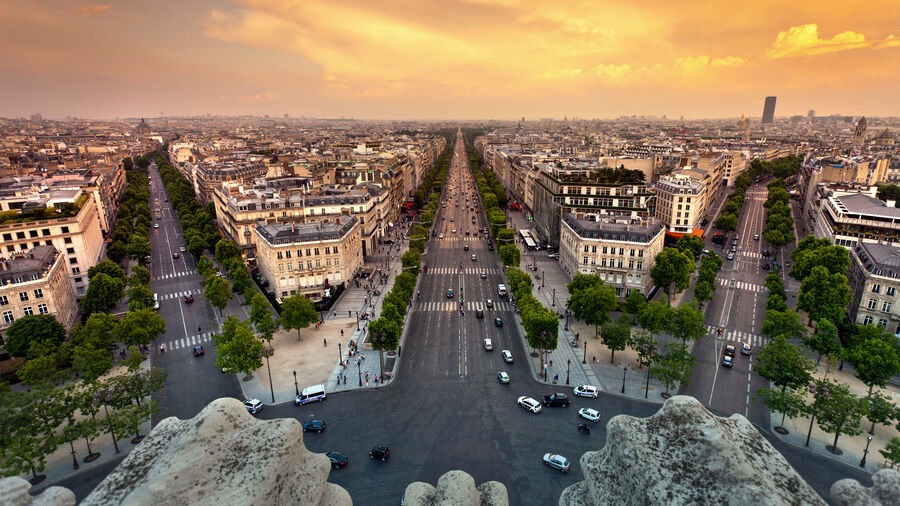
(Look through the green door long enough for your eyes to dilate.) Love him or hate him, Baron Haussmann made the Paris we see today. In the 1860s, Paris was a construction zone, with civil servant Haussmann overseeing the city's modernization. Narrow medieval lanes were widened and straightened into broad, traffic-carrying boulevards. Historic buildings were torn down. Sewers, bridges, and water systems were repaired. Haussmann blew the boulevard St. Michel through the formerly quaint Latin Quarter (as part of Emperor Napoleon III's plan to prevent revolutionaries from barricading narrow streets). The Opéra Garnier, Bois de Boulogne park, and avenues radiating from the Arc de Triomphe were all part of Haussmann's grand scheme, which touched 60 percent of the city. How did he finance it all? That's what the next government wanted to know when they canned him.
Thank God You Can Leave
- Have you seen enough dead people? To leave the cemetery, return downhill on avenue Principale and exit onto boulevard de Ménilmontant. The Père Lachaise Métro stop is one long block to the right. To find the bus #69 stop heading west to downtown, cross boulevard de Ménilmontant and walk down the right side of rue de la Roquette; the stop is four blocks down, on the right-hand side.
Other Notable Residents
Though not along our walking tour, the following folks can be found on our map in Rick Steves' Paris, as well as the €2 map you get from the florists.
Jacques-Louis David (1748–1825) — Section 56
The Neoclassical painter David chronicled the heroic Revolution and the Napoleonic Era. See his Coronation of Napoleon in the Louvre.
Théodore Géricault (1791–1824) — Section 12
Géricault was the master of painting extreme situations (shipwrecks, battles) and extreme emotions (noble sacrifice, courage, agony, insanity) with Romantic realism. See his Raft of the Medusa in the Louvre.
Eugène Delacroix (1798–1863) — Section 49
For more on this Romantic painter, see his Liberty Leading the People in the Louvre or visit the Delacroix Museum.
Jean-August-Dominique Ingres (1780–1867) — Section 23
Often considered the anti-Delacroix, Ingres was a painter of placid portraits and bathing nudes, using curved outlines and smooth-surfaced paint. Despite his deliberate distortions (see his beautifully deformed La Grande Odalisque in the Louvre), he was hailed as the champion of traditional Neoclassical balance against the furious Romantic style (see his The Source in the Orsay).
Georges Seurat (1859–1891) — Section 66
Georges spent Sunday afternoons in the park with his easel, capturing shimmering light using tiny dots of different-colored paint. See his Pointillist canvas The Circus in the Orsay.
Amadeo Modigliani (1884–1920) — Section 96, not far from Edith Piaf
Poor, tubercular, and strung out on drugs and alcohol in Paris, this young Italian painter forged a distinctive style. His portraits and nudes have African mask–like faces, and elongated necks and arms.
Marcel Proust (1871–1922) — Section 85
Some who make it through the seven volumes and 3,000 pages of Proust's autobiographical novel, Remembrance of Things Past, close the book and cry, "Brilliant!" Others get lost in the meandering, stream-of-consciousness style, and forget that the whole "Remembrance" began with the taste of a madeleine (a type of cookie) that triggered a flashback to Proust's childhood, as relived over the last 10 years of his life, during which he labored alone in his apartment on boulevard Haussmann — midway between the Arc de Triomphe and Gare de l'Est — penning his life story with reflections on Time (as we experience it, not clock time) and Memory, in long sentences.
Sarah Bernhardt (1844–1923) — Section 44
The greatest female actress of her generation, she conquered Paris and the world. Charismatic Sarah made a triumphant tour of America and Europe (1880–1881) starring in La Dame aux Camélias. No one could die onstage like Sarah, and in the final scene — when her character succumbs to tuberculosis — she had cowboys and railroad workers sniffling in the audience. Of her hundred-plus stage roles and many silent films, perhaps her most memorable role may have been playing...Hamlet (1899). Offstage, her numerous affairs and passionate, capricious personality set a standard for future divas to aspire to.
Yves Montand (1921–1991) and Simone Signoret (1921–1985) — Section 44
Yves Montand was a film actor and nightclub singer with blue-collar roots, left-wing politics, and a social conscience. Montand's career was boosted by his lover, Edith Piaf, when they appeared together at the Moulin Rouge during World War II. Yves went on to stardom throughout the world (except in America, thanks partly to a 1960 flop film with Marilyn Monroe, Let's Make Love). In 1951, he married actress Simone Signoret, whose on-screen persona was the long-suffering lover. They remain together still, despite rumors of Yves' womanizing. After their deaths, their eternal love was tested in 1998, when Yves' body was exhumed to take a DNA sample for a paternity suit (it wasn't him).
Updated for 2009. For lots more information and self-guided tours, check out our Rick Steves' Paris guidebook — or join us on one of our free-spirited tours in Paris.