Home > Plan Your Trip > Travel Tips

Daring to Sleep Cheap

Two women unpack and get ready to hit the town
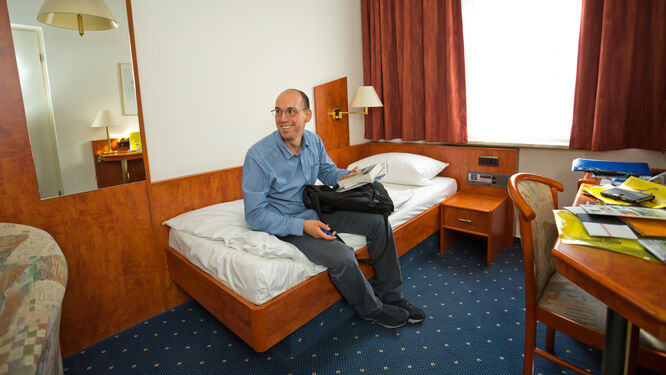
A drab little room is a great incentive to unpack quickly, run outside, and start having fun!
By Rick Steves

Hotels are the most expensive way to sleep — and, of course, the most comfortable. With a reasonable budget, I spend most of my nights in hotels — but they can rip through a tight budget like a grenade in a dollhouse.

I hear people complaining about that "$250 double in Frankfurt" or the "$400-a-night room in London." They come back from their vacations with bruised and battered pocketbooks, telling stories that scare their friends out of international travel and back to Florida or Hawaii one more time. True, you can spend $400 for a double, but I never have. That's three days' accommodations for me.

As far as I'm concerned, spending more for your hotel just builds a bigger wall between you and what you traveled so far to see. If you spend enough, you won't know where you are. Think about it. "In-ter-con-ti-nen-tal." That means the same everywhere — designed for people who deep down inside wish they weren't traveling, people spending someone else's money, people who need a strap over the toilet telling them no one's sat there yet. It's uniform sterility, a lobby full of Stay-Press Americans with tiny wheels on their hard suitcases, English menus, and lamps bolted to the tables.

Europe's small hotels and guest houses may have no room service and offer only a shower down the hall, but their staffs are more interested in seeing pictures of your children and helping you have a great time than in thinning out your wallet.

Europe is full of traditional old hotels — dingy, a bit run-down, central, friendly, safe, and government-regulated, offering good-enough-for-the-European-good-enough-for-me beds for $40–50 a night ($80–100 doubles). No matter what your favorite newspaper travel writer or travel agent says, this is hardcore Europe: fun, cheap, and easy to find.

Cheap Rooms 101

In a typical budget European hotel, a double room costs an average of $70 a night. You'll pay about $60 at a pension in Madrid, $70 at a simple guesthouse in rural Germany or a B&B on the Croatian Coast, and $90 for a two-star hotel in Paris or a private room in a Bergen pension.

A typical room in a low-end hotel has a simple bed (occasionally a springy cot, so always check); a rickety, old, wooden (or new, plastic) chair and table; a freestanding closet; a small window; old wallpaper; a good sink under a neon light; a mysterious bidet; a view of another similar room across a tall, thin courtyard; peeling plaster; and a tiled or wood floor. The light fixtures are very simple, often with a weak and sometimes even bare and dangling ceiling light bulb. Some travelers B.Y.O.B. when they travel. A higher wattage kills a lot of dinginess. Naked neon is common in the south. While non-smoking places are catching on — especially in Britain — most cheap rooms still come with ashtrays. You won't have a TV or telephone. While more and more European hotels are squeezing boat-type prefab showers and toilets into their rooms, the cheapest rooms still offer only a toilet and shower or tub down the hall, which you share with a half-dozen other rooms.

Rooms often come with a continental breakfast (usually served from about 7:30–10:00 a.m. in the breakfast room near the front desk): coffee, tea, or hot chocolate, and a roll that's firmer than your mattress. Breakfasts in northern and eastern Europe can be a bit heartier, with cereal, yogurt, and fruit.

In the lobby, there's nearly always a living room with a TV, a phone, and a person at the desk who's a good information source. You'll climb lots of stairs, as a hotel's lack of an elevator is often the only reason it can't raise its prices. You'll be given a front-door key because the desk is not staffed all night.

Cheap hotels usually have clean-enough but depressing shower rooms, with hot water normally free and constant (but occasionally available only through a coin-op meter or at certain hours). The WC has toilet paper but often has a missing, cracked, or broken lid. In some hotels, you pay $2–5 for a towel and a key to the shower room. The cheapest hotels are run by and filled with people from the Two-Thirds World.

I want to stress that there are places I find unacceptable. I don't mind dingy wallpaper, climbing stairs, and "going down the hall," but the place must be clean, central, friendly, safe, quiet enough for me to sleep well, and equipped with good beds.

The cheap hotel described above is appalling to many Americans; it's charming, colorful, or funky to others. To me, "funky" means spirited and full of character(s): a caged bird in the TV room, grandchildren in the backyard, a dog sleeping in the hall, no uniforms, singing maids, a night-shift man tearing breakfast napkins in two so they'll go farther, a handwritten neighborhood history lesson on the wall, different furniture in each room, and a willingness to buck the system when the local tourist board starts requiring shoeshine machines in the hallways. An extra $30–40 per night will buy you into cheerier wallpaper and less funkiness.

As Europe becomes more and more affluent, a powerful force is pushing hotels up in price and comfort. Land in big cities is so expensive that cheap hotels can't survive and are bought out, gutted, and turned into modern hotels. More and more Europeans are expecting what, until lately, have been considered American standards of plumbing and comfort. A great value is often a hardworking family-run place that structurally can't fit showers in every room or an elevator up its spiral staircase. Prices are regulated and, regardless of how comfy and charming it is, with no elevator and a lousy shower-to-room ratio, it is — and will stay — a cheap hotel.

To Save Money...

Think small. Larger hotels are usually pricier than small hotels or B&Bs, partly because of taxes (for example, in Britain, once a B&B exceeds a certain revenue level, it's required to pay an extra 15 percent VAT in addition to its other taxes). Hoteliers who pay high taxes pass their costs on to you.

Consider a cheap chain hotel. More and more hotel chains — offering cheap or moderately priced rooms — are springing up throughout Europe. The hotels that allow up to four people in a room are great for families. You won't find character at chain hotels, but you'll get predictable, Motel 6–type comfort. The huge Accor chain offers a range of hotels, from the cheap Formule 1 Hotels (mostly in France) to the mid-range Ibis Hotels (sterile, throughout Europe) to the pricier, cushier Mercure and Novotel Hotels (for all Accor Hotels, see www.accorhotels.com, US tel. 800-515-5679). Britain has Travelodge, Premier Travel Inn, and the orange-themed easyHotel (very basic). For Ireland, it's Jurys Doyle Hotels.

Know the exceptions. Hotels in northern Europe are pricier than those in the south, but there are exceptions. In Scandinavia, Brussels, and Berlin, fancy "business hotels" are desperate for customers in the summer and year-round on weekends, when their business customers stay away. They offer some amazing deals through the local tourist offices. The later your arrival, the better the discount.

Be a smart consumer — don't stray above your needs. Know the government ratings. A three-star hotel is not necessarily a bad value, but if I stay in a three-star hotel, I've spent $70 extra for things I don't need. You can get air-conditioning, elevators, private showers, room service, a 24-hour reception desk, and people in uniforms to carry your bags. But each of those services adds $10 to your room cost, and, before you know it, the simple $80 room is up to $150.

Avoid hotels that require you to buy meals. Many national governments regulate hotel prices according to class or rating. In order to overcome this price ceiling (especially at resorts in peak season, when demand exceeds supply), hotels often require that you buy dinner in their dining room. Breakfast normally comes with the room, but in some countries it's an expensive, kind-of-optional tack-on. One more meal (called "half board," "half pension," or demi-pension) or all three meals ("full board" or "full pension") is usually uneconomical. I prefer the freedom to explore and sample the atmosphere of restaurants in other neighborhoods.

Shop around. When going door-to-door, the first place you check is rarely the best. It's worth 20 minutes of shopping around to find the going rate before you accept a room. You'll be surprised how prices vary as you walk farther from the station or down a street strewn with B&Bs. Never judge a hotel by its exterior or lobby. Lavish interiors with shabby exteriors (blame the landlord who's stuck with rent control, not the hotel) are a cultural trait of Europe. (If there are two of you, let one watch the bags over a cup of coffee while the other runs around.)

Check the prices on the room list to find the best value. Room prices vary tremendously within a hotel according to facilities provided. Most hotels clearly display a room list, showing each room, its bed configuration, facilities, and maximum price for one and for two people. Also read the breakfast, tax, and extra-bed policies. By studying this list you'll see that, in many places, a shower is cheaper than a bath, and a double bed is cheaper than twins. In other words, a sloppy couple that prefers a shower and a double bed can pay $20 more for a bath and twins. In some cases, if you want any room for two and you say "double," they'll think you'll only take a double bed. To keep all my options open (twin and double), I ask for "a room for two people." If you want a cheap room, say it. Many hoteliers have a few un-renovated rooms without a private bathroom; they usually don't even mention these, figuring they'd be unacceptable to Americans.

See if there's a discount for a longer stay or payment in cash. If you plan to stay three or more nights at a place, or if you pay in cash rather than by credit card (saving the hotelier the credit-card company's cut and leaving them the option of not declaring the income to avoid taxes), it's worth asking if a discount is available. And if you came direct and point out that the tourist office didn't get their 10 percent, you also have a chance of talking the price down.

Do a Web search. If a hotel rents rooms at a discount through a hotel-booking website, you can guess they'd take an offer of that same rate from you if you book direct, even if it's lower than the rates posted at the hotel. (Their prices are actually being discounted even further than the cost you see online, since the hotel is paying a substantial commission to the Web service for each booking.)

If it's off-season, bargain. Prices usually rise with demand during festivals and in July and August. Off-season, try haggling. If the place is too expensive, tell them your limit; they might meet it.

Put more people in a room. Family rooms are common, and putting four in a quad is much cheaper than two doubles. Many doubles come with a small double bed and a sliver single. A third person pays very little. A family with two small children can ask for triples and bring a sleeping bag for the stowaway.

Avoid doing outside business through your hotel. Go to the bullring and get the ticket yourself. You'll learn more and save money, and you won't sit with other tourists who drown your Spanish fire with Yankee-pankee. So often, tourists are herded together — by a conspiracy of hotel managers and tour organizers — at gimmicky folk evenings featuring a medley of cheesy cultural clichés kept alive only for the tourists. You can't relive your precious Madrid nights. Do them right — on your own.

Making Advance Reservations

Feet poke out from under a down blanket
Save yourself the legwork later...shop for a room from home.

Sometimes reserving rooms in advance makes sense. If you know exactly where you want to stay each night, you can systematically set up your accommodations by following these simple steps. Even if you're not a detail person, it pays to be disciplined about this, particularly when you're traveling in high season or visiting popular spots.

1. Using a computer, build a calendar from your itinerary with general notes on top followed by a chart with dates, sights, accommodations, special notes, and reminders to keep track of loose ends. Update your itinerary throughout the process.

2. Decide from guidebook listings or Web research where you want to stay in each destination. Assemble the email addresses or fax numbers of each targeted hotel.

3. Make a template email or fax room-reservation request letter.

4. Go through your list and request rooms.

5. Follow up with telephone calls to places not responding to your email or fax.

6. Slog away until the entire trip is set up.

7. Even with firm reservations ensured by credit card, bring along your written confirmations (in case of a dispute) and call each hotel a day or two in advance to reconfirm.

Updated for 2008. For lots more tips, check out our best-selling Europe Through the Back Door travel skills guidebook.