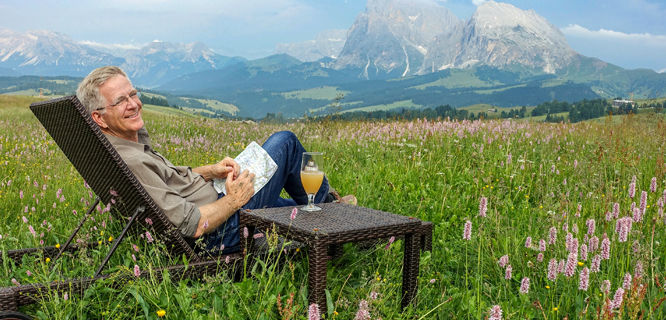
Rick Steves, America's most respected authority on European travel, empowers Americans to have European trips that are fun, affordable, and culturally broadening. In 1976, he started his business, Rick Steves' Europe, headquartered in Edmonds, Washington, near Seattle. There he produces a best-selling guidebook series, a popular public television show, a weekly public radio show, a syndicated travel column, and free travel information available through his travel center and ricksteves.com. Rick Steves' Europe also runs a successful small-group tour program taking 30,000 travelers to Europe annually.
Email Rick at [email protected], or write to him c/o 130 4th Ave N, Edmonds, WA 98020.
Short Version (71 words)
Rick Steves is a popular public television host, a best-selling guidebook author, and an outspoken activist who encourages Americans to broaden their perspectives through travel. He is the founder and owner of Rick Steves' Europe, a travel business with a small-group tour program that brings more than 30,000 people to Europe annually. Rick lives and works in his hometown of Edmonds, Washington, where his office window overlooks his old junior high school.
Medium Version (203 words)
Rick Steves is a popular public television host, a best-selling guidebook author, and an outspoken activist who encourages Americans to broaden their perspectives through travel. But above all else, Rick considers himself a teacher. He taught his first travel class at his college campus in the mid-1970s — and now, more than 40 years later, he still measures his success not by dollars earned, but by trips impacted.
Rick is the founder and owner of Rick Steves' Europe, a travel business with a small-group tour program that brings more than 30,000 people to Europe annually. Each year, the company contributes to a portfolio of climate-smart nonprofits, essentially paying a self-imposed carbon tax. He also supports and works closely with many advocacy groups and has been instrumental in the legalization of marijuana in states across the country.
Rick spends about four months a year in Europe, researching guidebooks, fine-tuning his tour program, filming his TV show, and making new discoveries for travelers. To recharge, he plays piano, relaxes at his family cabin in the Cascade mountains, and spends time with his son Andy and daughter Jackie. He lives and works in his hometown of Edmonds, Washington, where his office window overlooks his old junior high school.
Long version (355 words)
Rick Steves is a popular public television host, a best-selling guidebook author, and an outspoken activist who encourages Americans to broaden their perspectives through travel. But above all else, Rick considers himself a teacher. He taught his first travel class at his college campus in the mid-1970s — and now, more than 40 years later, he still measures his success not by dollars earned, but by trips impacted.
Widely considered America's leading authority on European travel, Rick produces a best-selling series of guidebooks and is the author of Travel as a Political Act. He is dedicated to providing all Americans with access to travel information and has made extensive resources available for free on the Rick Steves' Europe website; via the Rick Steves Audio Europe™ app; and in Rick Steves Classroom Europe™, a searchable database of short, teachable video clips.
A longtime supporter of public broadcasting, Rick produces and hosts public television and radio shows that air across the nation.
Rick is the founder and owner of Rick Steves' Europe (RSE), a travel business with more than 100 full-time employees. RSE operates a successful small-group tour program which brings more than 30,000 people to Europe annually. The company contributes annually to a portfolio of climate-smart nonprofits, essentially paying a self-imposed carbon tax.
Rick supports and works closely with many advocacy groups and organizations whose missions fit his own, including Bread for the World. He has been a member of NORML since 2003 and has been instrumental in the legalization of marijuana in states across the country. He has also provided $9 million in funding to build two neighborhood centers in his community and donated a 24-unit apartment building for homeless women and their children to his local YWCA.
Rick spends about four months a year in Europe, researching guidebooks, fine-tuning his tour program, filming his TV show, and making new discoveries for travelers. To recharge, he plays piano, relaxes at his family cabin in the Cascade mountains, and spends time with his son Andy and daughter Jackie. He lives and works in his hometown of Edmonds, Washington, where his office window overlooks his old junior high school.
Get to Know Rick
Rick Steves Wants to Save the World, One Vacation at a Time
Rick Steves Says Hold on to Your Travel Dreams
Rick Steves Takes Us on a Musical Tour of Europe
Rick's Business
Rick Steves' Europe: Rick Steves
Travel Expert Rick Steves Keeps Edmonds Staff Employed With Assignments to Help the Community
Leading a Business on the Ethical High Road for the Long Haul
Travel as a Political Act
Rick Steves on Traveling as a Political Act
Rick Steves's Plan for a Better World: More Travel
Rick Steves Gets Uncomfortable in 'Travel as a Political Act'
Climate Smart Commitment
Travel Company Self-Imposes $1 Million Carbon Tax to Offset Climate Impact
Travel Writer Rick Steves Explains Self-Imposed $1M Carbon Tax, Where that Money Is Going
In Your Travels and at Home, Channel Climate-Change Anxiety into Action
Drug Policy Reform
Rick Steves: Pot Is Now Used by Mom and Dad. And Grandma's Rubbing it on Her Elbows
Rick Steves and Weed? The Famous Travel Writer and Speaker Brings a 'European Sensibility' to Advocating for Marijuana Legalization in the U.S.
Mr. Steves Goes to Washington – to Talk Drug Policy
Rick Steves Art of Europe
New 'Rick Steves' Europe' Series Spotlights Continent's Art and Architecture
Rick Steves Wants to Turn You on to European Art
We Talk with Rick Steves About Exploringt the Art of Europe