Home > About Us > Pressroom > Social Activism > Drug Policy Reform

The Sweet Internationalism of Rick Steves

Rick Steves on the Prohibition of Marijuana

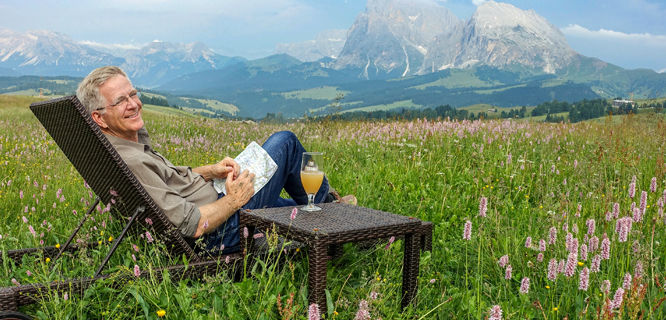
Rick Steves is a travel guide and writer who lives in Edmonds, Washington, and spends about 100 days abroad each year. His "Europe Through the Back Door" books and TV shows on PBS are familiar to millions of readers and viewers.

In 2001, Allen St. Pierre of NORML noticed Steves' name on the membership list and invited him to join the advisory board and to talk at the annual meeting.

"Every time I come home I'm reminded that I'm coming back to the land that has the shortest vacations in the rich world," Steves told NORML in 2003. "And the highest prison population. It's really quite an adjustment. There's been a mass dumbing down of our society. We've been made to see things in a simplistic, us-versus-them, Evil-empire way."

At the 2005 NORML meeting in San Francisco, Steves restated his humane views in a keynote talk, excerpted below. Steves is in his late 40s — a sandy-haired, bespectacled, intelligent, pragmatic man, so calm that he seems slightly bemused even when he's expressing outrage. His experience as a travel guide makes him especially well suited to begin guiding this country back towards sanity. Rick Steves for Secretary of State!

What Steves said to the marijuana-reform activists was implicitly critical of single issue narrowness, ostentatious patriotism, and communicating in soundbites. But the way he said it was so gentle, friendly, and respectful that nobody took offense. Here's the sweet internationalism of Rick Steves and his take on America's prohibition of marijuana:

To me travel is accelerated living. You make more friends and you learn more per day when you're away from home than you do at home. Everything becomes very vivid. When I'm in Europe for a month I can recall every meal. Can't do that when I'm at home, it's just not that vivid...

Travel really challenges truth. You're raised thinking certain truths are self-evident and God-given, and then you get over there and you realize that people do things differently. Travel rearranges your furniture. I mean, you go to Bulgaria and this means yes (shaking his head) and that means no (nodding). And you go to France and slow service means good service. Slow service is respectful service — you've got the table all night, take your time...

You go to Belgium and they dip their French fries into mayonnaise, they look at you strange if you ask for ketchup. I go to Japan and I'm in a Ryokan in the middle of the night and it's cold. They don't heat their houses. And you slip on your slippers and you put on your kimono and you shuffle down the hallway. You can see your breath, you're not looking forward to sitting on the toilet. But the seat is heated. That's a nice jolt...

Travel carbonates your life. It makes things different, it sort of refreshes your perspective and in a lot of ways, that's like marijuana, I would say.

When I started teaching I wondered if it was a noble thing to teach rich Americans to do. My image of travel when I was a kid was rich, white Americans on big cruise ships in the Caribbean throwing coins, photographing what they called 'little black kids' diving for those coins. It was a way to flaunt your affluence. Nobody thought twice about it. That's what travel was all about.

Even today that notion of travel persists. For a lot of people, travel is: see if you can eat five meals a day and still snorkel when you get into port. And that's not something I wanted to promote.  I wanted to promote thoughtful travel. In the last few years, thoughtful travel has become more important than ever for Americans.

Since 9/12 I've been more committed than ever to the notion that travel is a constructive, healthy thing to do. That's nothing new. Fourteen hundred years ago Mohamed said "Don't tell me how educated you are, tell me how much you've traveled."

Thomas Jefferson wrote, "Travel makes a person wiser, but less happy."  Mark Twain traveled, and he said "Travel is fatal to prejudice, bigotry and narrow-mindedness."

I travel and I think of it as one of the last great sources of legal adventure.

When you travel, you realize there's things to get excited about. I grew up thinking cheese was the same size as the bread — and it's orange. Then you go over there and they've got a different cheese for every day of the year.

You go into a cheese shop in Paris and it's like a festival of mold. I love hanging around with my restaurateur friends in Paris. I'm their little American bumpkin and they can help me appreciate the fine points of life. My friend takes me into the cheese shop and picks up the moldiest one. (As if taking a deep whiff) "Oh, Rick, smell this cheese it smells like zee feet of angels." Now, imagine thinking that cheese smells like zee feet of angels!  It just changes your perspective on things.

I was in Kabul, in Afghanistan. A professor sat down next to me and said, "You're an American, aren't you?" I said "Yeah." He said, "I want you to know that a third of the people on this planet eat with spoons and forks like you do, a third of the people eat with chopsticks and third of the people eat with their fingers like I do…and we're all just as civilized."  I was thankful for that. He had a little chip on his shoulder and he wanted to tell every American he could meet that he's not less civilized because he eats with his fingers.

I was in Eastern Turkey in a land that might be called Kurdistan some day and met a carver who was famous in his corner of the country. Everybody wanted a prayer niche carved by him. We visited with him, and he was so proud to be showing his work off to these American travelers. He worked as we gathered around and then, suddenly, he lifted his chisel up to the sky and declared, "A man and his chisel, the greatest factory on earth!" Wow!  There's a fulfilled guy. He may not know how to turn on a computer, but he can define his own success.

When you travel you just meet so many people. Travel is full of great interactions. A little while ago in Germany a little kid, he must have been about 5-years-old, was just staring at me. And finally his mom said, "Excuse my son, he stares at Americans.  You see, last week we were at MacDonald's eating a hamburger and he asked me 'Why do Americans have such soft bread?'" And the mother told the kid, "Because they have no teeth." I showed him my teeth.

Travel puts you in your place. I'm as inclined as the next American to brag about how well our athletes do at the Olympics, and I grew up marveling at how great we were. It was always USA on top of that Olympic medal list. Then my Dutch friend said, "Well, you've got a lot of Olympic medals, but per capita, we're doing eight times as well as you." We're not used to thinking of Olympic medals in per capita terms.

It's important to broaden your perspective and it's important to bring it home — to bring it home and share it with people. We like to bring it home with our kids. Grandma and grandpa came over when my son was about three or four years old and after table prayers I taught him to bob his arms up and down and say "Allah... Allah... Allah..." Just to freak out my dad. Sometimes you need to put people a little outside their comfort zone to share what you've learned from your travels.

One thing I've learned from my travels is how Europeans are a little more progressive than us in dealing with social problems. Every time there's a death sentence commuted in the United States, there's a light show at the Coliseum in Rome. They celebrate in Europe when we commute a death sentence in the United States... And of course when you travel in Europe you realize that there is a non-criminal approach to marijuana that could be quite inspirational to American policy makers if they would just learn about it.

When you think about taking a trip, you can take a trip with your marijuana or you can take a trip with your passport.  It's kind of fun to take a trip without having to travel. Just put me in a nice location with a National Geographic and a joint and I'm climbing Mt. Everest. That travel is really quite cheap if the dollar's too low... And you can do your actual travel and mix some appreciation of marijuana into that and it becomes a kind of super-travel…travel squared.

A lot of Americans are not edgy enough to smoke here, where it's illegal, but it's enjoyable for them to have an opportunity to enjoy some recreational use of marijuana without the paranoia that comes with doing that publicly in the United States.

First time I ever smoked was in Afghanistan.  As a kid I didn't want peer pressure to make me do something my parents said I shouldn't. In south Asia, smoking pot felt like going local. "When in Rome," you know. And when in Afghanistan, it's just something you do. The bus stops and everybody stands around and watches a goat get slaughtered while passing around the bong. 

I mean, you stand on the rooftop of your hotel and there's torchlit chariots galloping by. The lightbulbs are all breathing. People are eating soup with their hands and they don't spill a drop. Traveling on over to Nepal, you can look right into the eyes of the living virgin goddess — the Kumari Deva, you've got these slow-motion leech attacks and people are angelically clasping their hands, bowing gently toward you and saying "namestay, namestay (I salute your virtues)." You write in your journal trying to catch all this stuff and when you get home and you hardly remember where you were high and where you weren't. But when you read it, there's a certain dreaminess that comes into your journal writing that you can kind of derive, it couldn't have been that great, I must have been high.

When I teach a writer's workshop a lot of times people will ask me "What's a trick? How can I be a better travel writer?" One of the tricks of travel writing is to be able to experiment with your perspective. In that regard, smoking pot is helpful. I suppose you could even call it "a business expense." It's like how photographers experiment with light. Any good photographer's going to play around with existing light, it's a fascinating thing. Well, as a travel writer you want to experiment with different perspectives…describe a much-described thing in a new way. You become a keen observer. You realize you can try and kill flies forever on the bed in Cairo but if you just wait until they're rubbing their little front feet together, they're toast! You can get 'em when they're doing this... (rubs his hands).

When you're in Shanghai you see these skyscrapers. They're throwing up the equivalent of a skyscraper every day in Shanghai, surrounded by a sea of poverty. When you write about that, it helps to see these skyscrapers as stilettos just sticking up through the fertile soil of a billion poor Chinese.

You're looking into the eyes of Michelangelo's David and you're right there — actually seeing him sizing up the darkness of medieval superstition five hundred years ago when Florence was pulling Europe out of the Dark Ages.

I had people in Copenhagen tell me they have to arrest a couple of pot smokers every year just to maintain favored trade status with the United States of America. Bucking fierce American pressure to do otherwise, most of Europe prefers to deal with marijuana as a health issue rather than a criminal one.

It has learned that you can't legislate personal morality. It's futile. It's counter-productive. Most Europeans believe that society has to make a choice. You can tolerate alternative lifestyles or you can build more prisons. You must make a choice. In Europe they'd rather tolerate alternative lifestyles. In our society we'd rather build more prisons.

We live in a country where the hottest thing in real estate is gated communities for the wealthy and prisons for the poor. And we're oblivious. I don't know why we don't see this as a political issue, but it's a scary thing. Europeans are quick to remind me that my country has 4% of the world's population and 25% of its prisoners. That's not a good statistic.

In Holland they say "We Dutch are businessmen. If there's a problem, we deal with that person as if he's a future customer or partner.

The Dutch have so many creative ways to solve problems. You can complain about junk mail all you want. In the Netherlands they have stickers on their mailboxes that say yes or no, so they don't get junk mail unless they want it.  Americans say "We can't have pedestrian streets because then cars can't get to my shop." In Europe they have pedestrian streets which allow merchants and residents access by car with swipe cards that are used to lower the barrier. Otherwise it's traffic free. In the Netherlands 40 percent of the traffic is on two wheels. There are entire communities in Europe that are going to be wind-powered.  There's a race going on right now for that.

They deal with their problems by thinking outside the box. And as Europe unites, what they're doing gets even more impressive. It's easy to write Europe off as the "old world," but they've got a bigger economy and a bigger population than we do right now. 400 million people with 11 trillion dollar GDP and they're not spending half of their disposable income on the military, they're investing it in their own infrastructure. It's breathtaking what's going on there.

Our society is making some hard choices right now to cover our government's military needs — cutting right into people's programs that weaken our communities. In Europe they see health, education, affordable housing, and environmental protection as "vital to homeland security."

Coming home for me is always a little bit of a jolt. The first person that meets me at the airport is a dog. I can't help but think: "One nation under surveillance."

We pride ourselves on life, liberty and the pursuit of happiness, but we have the shortest vacations in the rich world and are more uptight about sex than any Western nation I've visited.

These days even my travel shows on PBS are rated for mature audiences only. David's going to be pixilated here pretty soon. TV programmers around the United States get a list of how many seconds of marble penis and canvas breast are showing in each of my episodes. Programmers can't inflict a Titian painting or a Michelangelo statue on their viewer-ship in some conservative communities without taking heat.

In so many ways we're going in the wrong direction in our society and that's why it's good for us all to get together and encourage each other and break from this huddle [the NORML meeting] and go back into our communities energized to make a difference.

Jailing people for pot in Europe would be laughable. But that's not the case here in the United States. In so many ways I believe we're living a lie.

And that's one reason why I got involved with NORML. I just don't think if you're a successful, affluent, free country you need to embrace lies to con your electorate into this or that. We just heard that the intelligence on weapons of mass destruction was mistaken. And they all pretend they didn't know...

We are routinely outvoted in the United Nations by 140 to four on environmental issues, development of the third world, the criminal court, on Cuba, on Israel. Who stands with us? Israel, the Marshall Islands, and Micronesia. I don't want my country to be this planet's rogue nation.

If there's an initiative to help solve the problems of desperately poor people, there's one country that gets in the way, the U.S.A. It's us! Three times as many people die of AIDS in Africa each day as were killed on 9/11. Offering discounted AIDS medicine to Africa violates our notion of free trade. I guess that's our prerogative. But Canada wants to give discounted medicine for AIDS to Africa, who gets in the way of it? We do. The USA actually threatened trade sanctions against Canada if they showed this kind of real compassion. That's flat out evil. If Americans knew this, if it could be communicated effectively, I think it would not be a very tough sell to get our country a little more tuned into the needs of the people on this planet.

But we are embracing these lies. We buy this stuff. "No child left behind."  "Clean skies." "I love trees." "The party of life." "Tax relief." "Death tax." All of this terminology we just embrace. They call it the "defense" department. Nobody should ever let that word go by without a challenge. It's not a "defense" department.

We spend as much as the rest of the world put together on the military and you can't get  elected without promising more. There's a mania in that regard; it's a big problem. We hear that we're for peace and we've got these 'Christian values,' but we're pounding plowshares into swords these days at a record pace. Somebody's got to just stand up and just say — you know, when Bush talks about freedom and liberty, he's talking about freedom to other people's natural resources and liberty to use their cheap labor. That's what they're talking about!

I was down in El Salvador last spring.  I just wanted to see what was going on in the developing world. They've got their struggles between the left and the right down there and the leftwing party in El Salvador was threatening to win the presidential election last year. President Bush had to send his brother Jeb down there to stand by the rightwinger and tell the Salvadorans "If you vote for the leftwing, we're going to stop remittances coming down from all the refugees working in the United States." A third of the money in El Salvador's economy is sent by relatives who work in the USA. The ad showed a poor mother reading a letter from her son in the USA saying if the leftwing politician wins, this will be your last check. So most of the people voted against their interests — for the righwinger and our president still has an ally in the president of El Salvador. That's democracy these days. 

Father Jon Sobrino, a leading Jesuit priest and professor at the top university in El Salvador, says whenever he hears the term  "democracy" these days, his bowels move. (If you're curious about what I learned down in El Salvador, check out my journal at ricksteves.com.)

One thing I'm concerned about is the mass dumbing down of our society. The stuff I've been talking about, we go "yeah, yeah, yeah," but the average person doesn't get it. Powerful forces in our society have been dumbing us down.  They would find it convenient if we all become just mindless producer-consumers.  Political initiatives against the interest of the people in general have a chance in a democracy only with a dumbed-down electorate.

The problem with marijuana is, it subverts this vision of turning Americans into mindless producer-consumers. Smoking marijuana certainly doesn't make us want to produce more and the only thing we consume more of is Cheetos.

Marijuana turns people who wouldn't otherwise be poets into poets. Think of Maslow's famous hierarchy of needs. The idea is that, with greater affluence, you slide up the hierarchy. First you get your clothes and your car and your house and then you can do more creative and fulfilling things and then, at the top, you actually get into "selfless actualization," helping other people.

It's better for our "ownership" society (another deceptive-yet-brilliant rightwing think tank term) to have barbed wire strung around Maslow's hierarchy about midway, so that we continue to consume on the bottom end, out and out and out, not realizing that we can step over the barbed wire and live more fulfilling lives. One of the reasons why, philosophically, I'm into marijuana is that it's a good way to cut that barbed wire, enabling people to be true to themselves…to define their own success.

To sell its deceitful war on marijuana, our government employs the big-lie technique. Hitler learned that you can tell a big lie over and over again, and people will eventually believe it. We've got to recognize the propaganda. When it comes to the drug war's take on marijuana, the propaganda erodes the credibility of the government, of schools, and of parents. We've got a White House that spends millions of dollars advertising in the Super Bowl trying to convince people that marijuana causes teen pregnancies. And its ads are surrounded by beer ads! Now what's causing the pregnancies?

I've got many friends who are teachers. They maintain that the DARE program, by most teachers' assessments, is somewhere between ineffectual and counterproductive. They tell stories of how, when a DARE officer visits the teachers' lounge, teachers who are free spirits — Dead Poets Society types — are cowed into silence. You can hear a pin drop. No one dares question DARE because being a little bit open-minded about creative ways to deal with drugs and children is not good for job security. As a parent, it's interesting to go to a DARE meeting at school and question it. Many parents know the case made against marijuana is damaging the necessary case DARE is trying to make against hard drugs. But fear keeps parents silent.

I believe a sad bi-product of (and perhaps an actual motivation for) our government's propaganda war on marijuana is instilling fear in parents. If we are afraid we are easier to manipulate.

At home, my wife and I have two teenage kids. Parents are taught that marijuana is a gateway drug and it's 20 times as powerful back when we enjoyed it as kids, and son on. I want to have credibility with my kids. One of the perks I get for being on the NORML advisory board is that I can invite NORML president Keith Stroup over for dinner and introduce our teenagers to a lawyer who has dedicated his life to defending an ideal rather than people with a lot of money.

My daughter just wrote a paper. She got to choose whatever topic she wanted and she chose "Why marijuana should be decriminalized." I just read the teacher's response to it two days ago. Beneath the A at the end of her paper, the teacher scribbled, "We don't all have to agree with you, but it's a good paper."

It's bad style to make Hitler parallels but not doing so is getting tougher and tougher. For goodness sakes, we've got doctors and scientists and medical experts that have to be politically correct to give our government advice. Our environmental policies, our health policies, our AIDS policies, and our prohibition on marijuana are shaped by people who are driven by ideological agendas.  I mean, tears cause AIDS now... Our government is embracing this. It's amazing to me.

I was very impressed when I read on the NORML website a bulletin the Drug Czar sent out to all the prosecuting attorneys listing 20 reasons why marijuana is the devil's weed. Each one of these points is refuted very solidly on the NORML website. But that our government would be giving this trash to prosecutors with the implication that you better be running with this sort of standard…somebody needs to speak out against this.

Travel teaches you a respect for history. We all know it's smart for a society to learn from history. Back in the 1920s, we had this experiment with Prohibition and I think by any sober assessment, all it produced was grief. It just made a lot of criminals, filled a lot of prisons, and cost our society a lot of money back. It was big government at its worst.

Today, more and more people are waking up to this prohibition that's keeping Americans who shouldn't be criminals criminals. It's congesting our prisons, diverting precious law enforcement money away from more serious drug problems, and ruining good lives. 800,000 Americans were arrested last year because of marijuana, well over 80% of them for simple possession. Our country blew seven billion dollars trying to enforce its war on marijuana. If one person is arrested for smoking pot, that's one person too many.

We need to balance our activism. I think my marijuana activism is more effective because I am also active in homelessness, schools, church, and public television and so on. People who know my commitment to issues that aren't controversial, are fascinated by my work for NORML.  

There's a nobility in our struggle that I think can be explained a little better. We must have and communicate a clear message. Have the figures on the tip of your tongue: 800,000 Americans arrested annually, well over 80% for simple possession. Seven billion dollars spent annually criminalizing marijuana.

Big government, fiscal sanity, prison congestion…this should be a conservative issue.  Talk about the European solution. Fifteen years they have been experimenting with treating marijuana as a medical concern rather than a criminal one. Even crusty, conservative law enforcement types like it this way.

We need to pre-empt the discredit. As soon as you speak out, they're going to say: "You're for children abusing drugs?" "No, we're not for children smoking pot, we're not for hard drugs, we're not for driving when you're high, none of that stuff!" We're talking responsible adult use. Nobody's talking about kids getting easy access to pot. We need to shoot off that torpedo before they torpedo us with it.

People think advocating for NORML is advocating for breaking a law. It's not. It's advocating to change a law — and that's a very fundamental difference. I'm not saying to smoke pot. I'm saying it's wrong to arrest people who want to smoke pot as mature adults, or for medical use. We're not saying break the law. I want to support NORML publicly like I support travel. I think it's a matter of freedom. I think it's recess, and we need it in this society.

For me, being high is a little like Cuba.  Any time my government says I can't go somewhere, I feel it's one of my rights to go there. My government can't tell me I can't go to Cuba. Everyone else is going to Cuba, why can't I go to Cuba?

And I don't believe my government should tell me what I can do as a responsible citizen in the privacy of my own house.

Thank you very much, and happy travels…even if you're just staying home.