Home > Plan Your Trip > Best Destinations > Italy

Italy's Hilltowns

By Dave Hoerlein

Dave, a senior guide at ETBD, has led several of our Rick Steves' Village Italy tours. Breaking away from the big cities, he and his groups have been charmed by Italy's small town magic. Here is a recap of some past highlights.


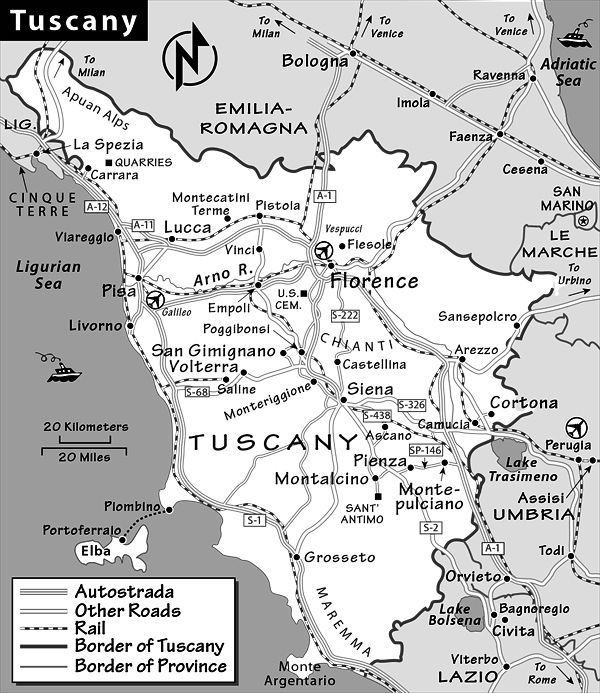
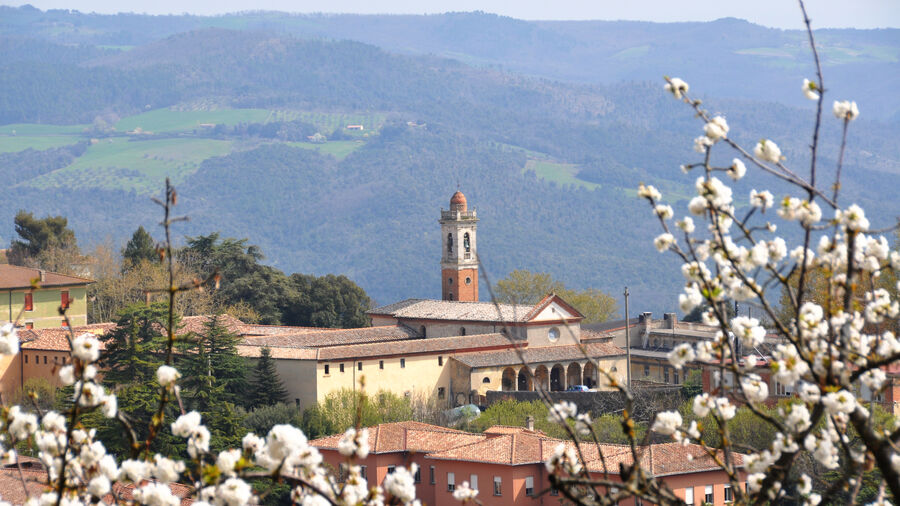
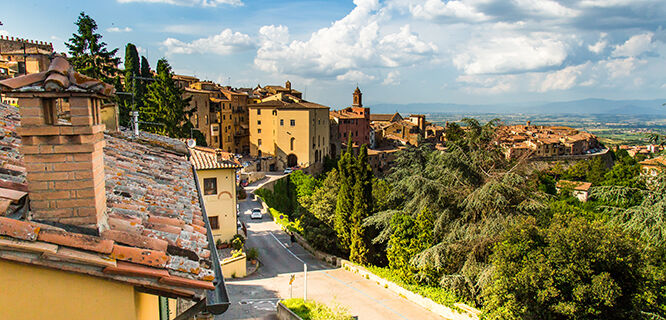
Central Italy is justly famous for its hill towns. Most tourists hit the big ones: Assisi, Siena and San Gimignano. If you want to experience more of this fascinating area, here are others to consider. There are three main regions, listed here in order of tourist popularity and accessibility: Tuscany, Umbria and Le Marche.

Tuscany is most tourist's image of Italy, with manicured hills, rustic farms, and seemingly a town clinging to every hill. Yet many who visit Tuscany, famous as the cradle of the Renaissance, never get beyond Florence. Explore the countryside and you will be rewarded. Trains and an extensive bus network make most of Tuscany reachable, but a car gives you easier access.

Landlocked Umbria, the "Green Heart of Italy" is known for Assisi, famous world wide as the home town of St. Francis. But if you're searching for the same sense of peace that Francis sought, head to nearby smaller towns.

Le Marche is much less discovered. The landscape is more wild and less manicured. Urbino and Ascoli Piceno are two highlights. A car is essential to unlocking Le Marche's charms.

Tuscany

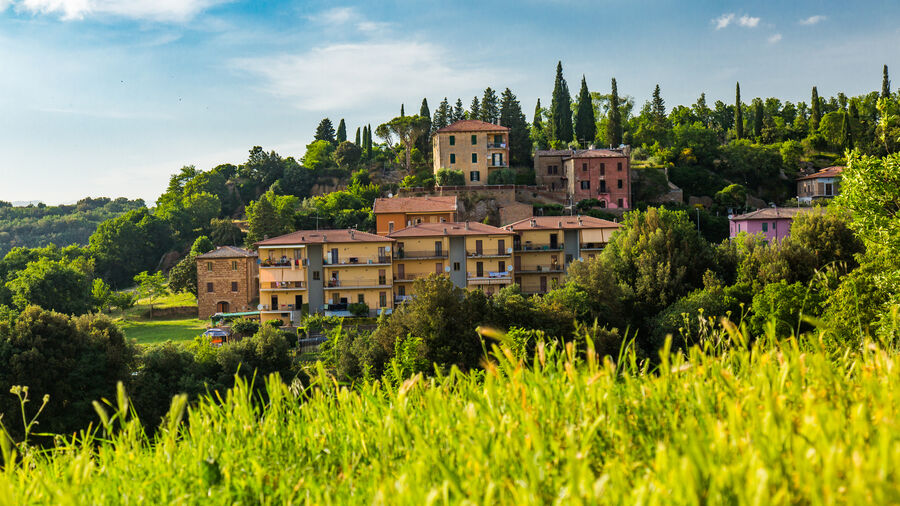
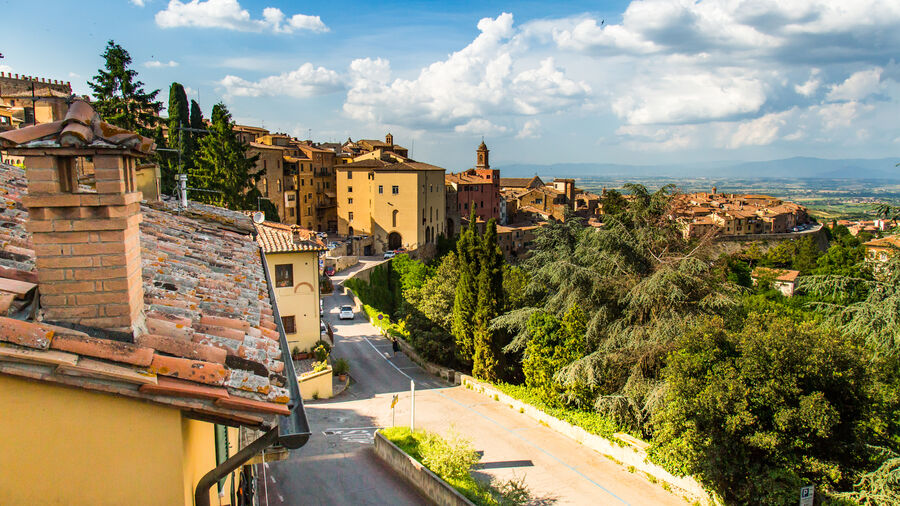
Red tile Tuscan roofs
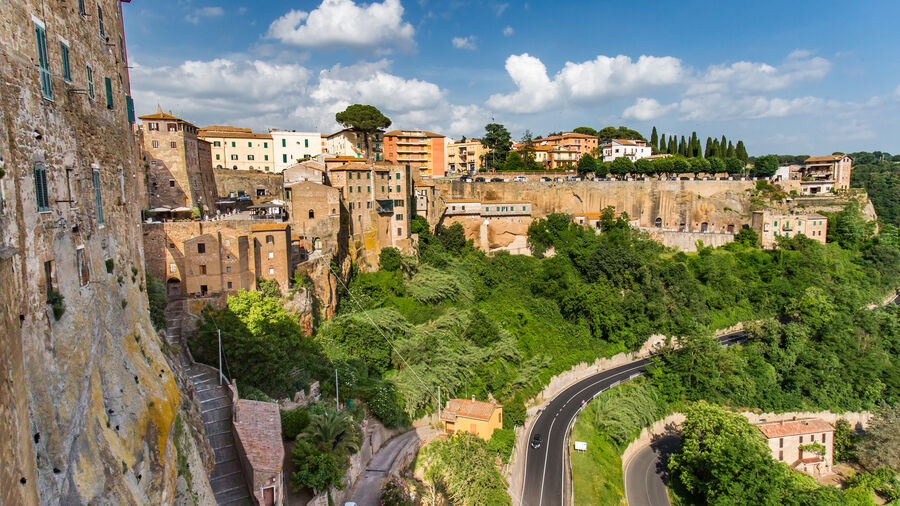
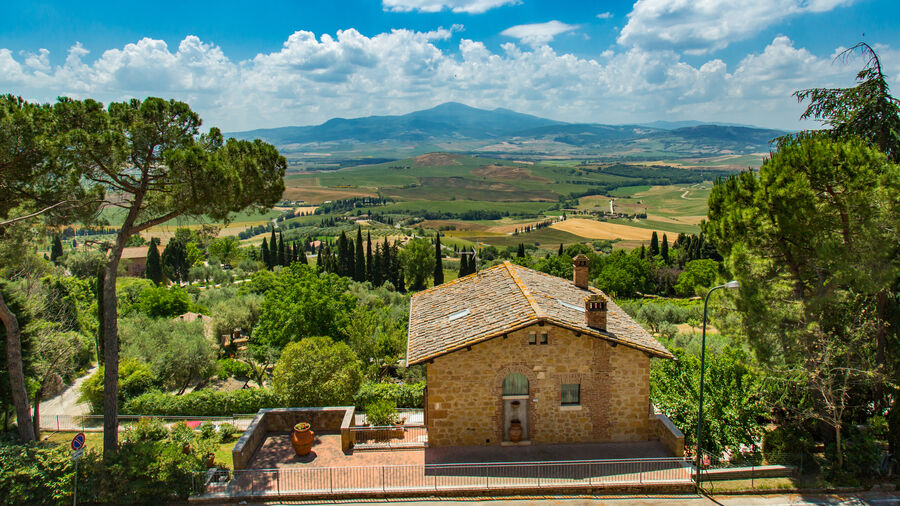
The cubist town-scape of Tuscany is a photographers' delight.
Cortona

Frances Mayes' books, such as Under the Tuscan Sun, have placed Cortona in the touristic limelight just as Peter Mayle's books popularized the Luberon region in France. But even before Mayes, Cortona was considered a classic Tuscan hill town.

The town hangs by its fingernails from the top of a mountain, with views of the surrounding landscape below. Unlike many hill towns, Cortona is worth visiting for its art alone. The Museo Diocesano has a small but interesting collection including powerful works by Signorelli and Fra Angelico. The Museo dell'Accademia Etrusca, housed in a former palace, has an eclectic collection of paintings, Etruscan artifacts and jewelry, and Egyptian mummies.

Cortona lies above the Terontola train station (5 miles away) on the Florence-to-Perugia line. Frequent buses connect the station with Piazza Garibaldi, a short walk from Cortona's highlights. Cortona's helpful TI (tourist information office) is at Via Nazionale 42 (April–Oct daily 9:00–13:00 & 15:00–19:00, shorter hours and closed Sun off-season, sells train and bus tickets, tel. 0575-630-352, www.apt.arezzo.it). There are lots of cafés for lunch, or assemble a picnic and dine al fresco. Cortona's San Marco Hostel, housed in a remodeled 13th century palace, is one of Italy's best (Via Maffei 57, tel. & fax 0575-601-392, www.cortonahostel.com).

Chiusi
A small hilltown with a view for miles
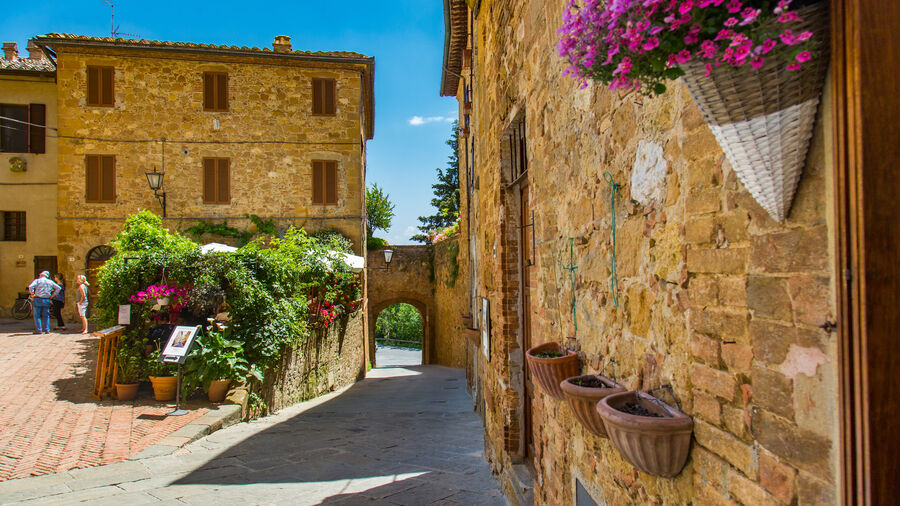
Hilltowns, clinging to their perches above the rest of the world, often require more effort to be reached.
(For Etruscan enthusiasts)

This small hill town, once one of the most important Etruscan cities, lies near the key train junction on the Florence-Rome line. Highlights include the Archeological Museum, and the Etruscan tombs just outside of town near Lago di Chiusi (€4, daily 9:00-20:00, Via Porsenna 93, tel. 0578-20177). One of the tombs is multichambered with several sarcophagi, while another, the Tomba della Scimmia (Tomb of the Monkey) has well-preserved frescoes. Visiting the tombs requires a guide, a car, and an advance reservation (€2, 2/day at 11:00 and 16:00 Tue, Thu, and Sat; 25 visitors per tour).

Troglodyte alert! The Cathedral Museum on the main square provides access to the underground labyrinth of Etruscan tunnels (dark, so bring a flashlight). The mandatory guided tour ends in a large Roman cistern, from which you can climb the church bell tower for an expansive view of the countryside (museum-€2, labyrinth-€3, combo-ticket-€4, May–Sept Fri–Sun 10:00–12:30 & 16:00–18:00, closed Mon–Thu and Oct–April, tunnel tours every 40 min during museum hours, Piazza Duomo 1, tel. 0578-226-490).

The TI is on the main square (May–Sept Tue–Sun 10:00–13:00 & 15:00–17:00, closed Mon, shorter hours off-season, tel. 0578-227-667). Trains connect Chiusi with Florence, Siena, Orvieto, and Assissi. Buses link the train station with the town center two miles away (depart every 40 min, tickets at tabacchi shop).

Montepulciano

Curving its way along a ridge, Montepulciano (mohn-tay-pull-chee-AH-noh) delights visitors with vino and views. Alternately under Sienese and Florentine rule, the city still retains its medieval contrade districts, each with a mascot and flag. The neighborhoods compete the last Sunday of August in the Bravio delle Botti, where teams of men push large wine casks uphill from Piazza Marzocco to Piazza Grande, all hoping to win a banner and bragging rights.

The city is a collage of architectural styles, but the elegant San Biagio Church, at the base of the hill, is the most impressive Renaissance building. Most ignore the architecture and focus more on the city's other creative accomplishment, the tasty Vino Nobile di Montepulciano red wine.

The action in Montepulciano centers on two streets, the steep Via di Gracciano nel Corso, and Via Ricci, but the quiet back streets are well worth a visit. The TI is near the bus station, in Piazza Don Minzoni. It books wine tours, hotels, and rooms for no fee; sells train tickets; and can book one of the town’s two taxis (Mon-Sat 9:30-12:30 & 15:00-20:00, Sun 9:30-12:30, daily until 20:00 in ¬summer, tel. 0578-757-341, www.prolocomontepulciano.it).

Note that there's a more central office that looks like a TI, but it's a privately run "Strada del Vino" (Wine Road) agency. It doesn't have city info, but provides wine-road maps and organizes wine tours in the city, and minibus winery tours farther afield (Mon–Fri 10:00–13:00 & 15:00–18:00, closed Sat–Sun, Piazza Grande, tel. 0578-717-484, www.stradavinonobile.it).

The pleasant, lively Piazza Grande is surrounded by a grab bag of architectural sights. The medieval Palazzo Comunale has a Florentine-style clock tower that you can climb for a windy, panoramic view (€1.60, daily 10:00-18:00, closed in winter). The Palazzo de' Nobili-Tarugi is a Renaissance arcaded confection, while the unfinished Duomo glumly looks on, wishing the city hadn't run out of money for the facade. Dream up a way to finish it while you enjoy a cappuccino at the café on the square.

Small and eclectic, the well-presented Civic Museum is worthwhile if only for its colorful della Robbia ceramic altarpieces (€4.20, Tue-Sat 10:00-13:00 & 15:00-18:00, Sun 10:00-18:00, closed Mon, Via Ricci 10, tel. 0578-717-300).

Down a picturesque driveway lined with cypress, the San Biagio Church — designed by Antonio da Sangallo — is Renaissance perfection. The proportions of the Greek cross plan give the building a pleasing rhythmic quality. The lone tower was supposed to have a twin, but it was never built. The soaring interior is impressive, with a high dome and lantern (daily 9:00-13:00 & 15:00-18:00). The street Via di San Biagio, leading from the church up into town, makes for an enjoyable, if challenging walk.

From Montepulciano you can connect by bus to Siena (8/day, 1.25 hrs, none on Sun), or Pienza (9/day, 30 min). All buses leave from Piazza Pietro Nenni. For those with their own wheels, route S-146 to Montalcino is particularly scenic (see "Crete Senese Drive," below). It isn't wise to drive the tiny roads inside the city, so park outside the walls, either at the bus station or at the numerous lots on the edges of town.

Montalcino
(For wine lovers)

Famous for its Brunello di Montalcino red wines, this hill town, once part of Siena's empire, is worth a visit for its enoteca, housed inside the 14th-century fortezza at the edge of town (tel. 0577-849-211, www.enotecalafortezza.it). After sampling a glass of the local vino, wander down into the heart of town at Piazza Garibaldi. The TI is just off this square in the City Hall (daily 10:00–13:00 & 14:00–17:40, closed Mon in winter, tel. & fax 0577-849-331, www.prolocomontalcino.it).

Besides the fortezza and the Brunello, Montalcino's main sight is the Civic Museum on Via Ricasoli, where you'll find art from the late Gothic/early Renaissance period. Non-wine lovers may find Montalcino a bit too focused on vino, but one sip of Brunello makes even wine skeptics believe that Bacchus was onto something. Note that the Rosso di Montalcino wine is also good at half the price. Sweet-tooths will enjoy munching Ossi di Morta ("bones of the dead"), a crunchy cookie with almonds.

From Montalcino by Bus to: Siena (6/day, 1.5 hrs, €3.20), Pienza (5/day, none on Sun, change to line #114 in Torrenieri, 1 hr plus changing time). Anyone going to Florence changes in Siena. The town bus station is on Piazza Cavour, within the town walls. Bus tickets are sold at tabacchi shops or the bar on Piazza Cavour — not on board. Check schedules at the TI or the bus station on Piazza Cavour.

Pienza
One of Tuscany's many less traveled roads
Take your time on one of Tuscany's many less traveled roads.

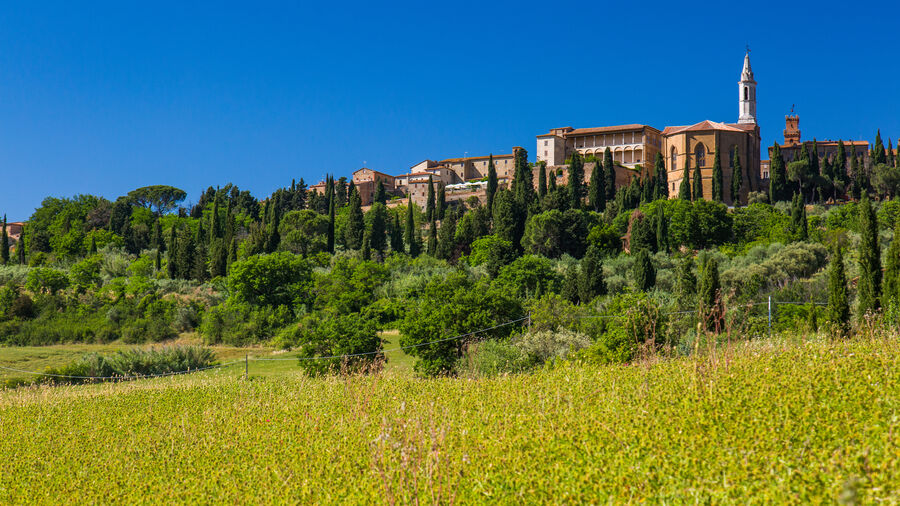
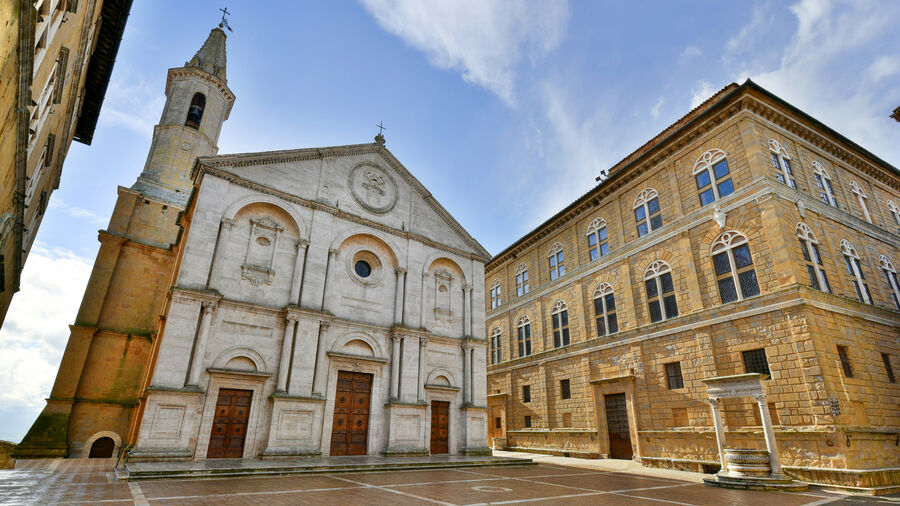
Set on a crest, surrounded by green, rolling hills, the small town of Pienza packs a lot of Renaissance punch. In the 1400s, locally born pope Pius II of the Piccolomini family decided to remodel his birthplace in the style that was all the rage: Renaissance. Propelled by papal clout, the town of Corsignano was transformed — in only five year's time — into a jewel of Renaissance architecture. It was renamed Pienza, after pope Pius. The plan was to remodel the whole town, but work ended in 1564 when both the pope and his architect, Bernardo Rossellino, died. The architectural focal point is the square Piazza Pio II, surrounded by the Duomo and pope's family residence, Palazzo Piccolomini. The culinary focal point is Pecorino cheese, a pungent sheep's cheese, which can be found at almost any shop and can be eaten fresh (fresco) or aged (secco).

The TI is 10 yards up the street from Piazza Pio II , inside the Diocesan Museum (daily 10:00–13:00 & 15:00–19:00, shorter hours Nov–March, tel. & fax 0578-749-905). Market day is Friday. A public WC is just outside the town gate on Piazza Dante Alighieri.

From Pienza by Bus to: Siena (5/day, none on Sun, 1.5 hrs), Montepulciano (9/day, 30 min). Bus tickets are sold at the bar just inside Pienza's town gate.

Crete Senese Drive

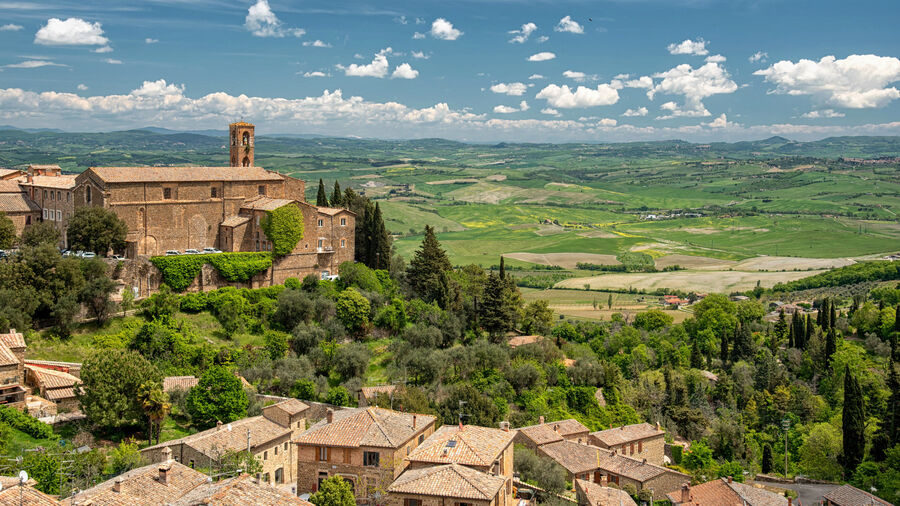
South of Siena, the hilly area known as the "Sienese Crests" is full of colorful fields and curvy, scenic roads. You'll see an endless parade of classic Tuscan scenes, rolling hills topped with medieval towns, olive groves, rustic stone farmhouses, and a skyline punctuated with cypress trees. You won't find many wineries here, since the clay soil is better for wheat and sunflowers, but you will find the pristine, panoramic Tuscan countryside that you find on calendars and postcards.

During the spring, the fields are painted in yellow and green with fava beans and broom, dotted by red poppies on the fringes. Sunflowers decorate the area during July and August, and expanses of wind-blown grass fill the landscape almost all year.

Most roads to the southeast of Siena will give you a taste of this area, but one of the most scenic stretches is the Laurentina road (Siena–Asciano–San Giovanni d'Asso, #438 on road maps; you can also take S-2 — Via Cassia — toward Rome and turn off at Asciano sign; either way allows you to easily continue to Montalcino). You'll come across plenty of turnouts for panoramic photo opportunities on this road, as well as a few roadside picnic areas.

For a break from the winding road, about 15 miles from Siena, you'll find the quaint and non-touristy village of Asciano. With a medieval town center and several interesting churches and museums, this town offers a rare look at everyday Tuscan living, and a great place for lunch (TI at Corso Matteotti 78, open Mon–Fri 10:30–13:00 & 15:00–18:00, Sat–Sun 10:30–13:00, tel. 0577-719-510). If you're in town on Saturday, gather a picnic at the outdoor market (Via Amendola, 8:00–13:00).

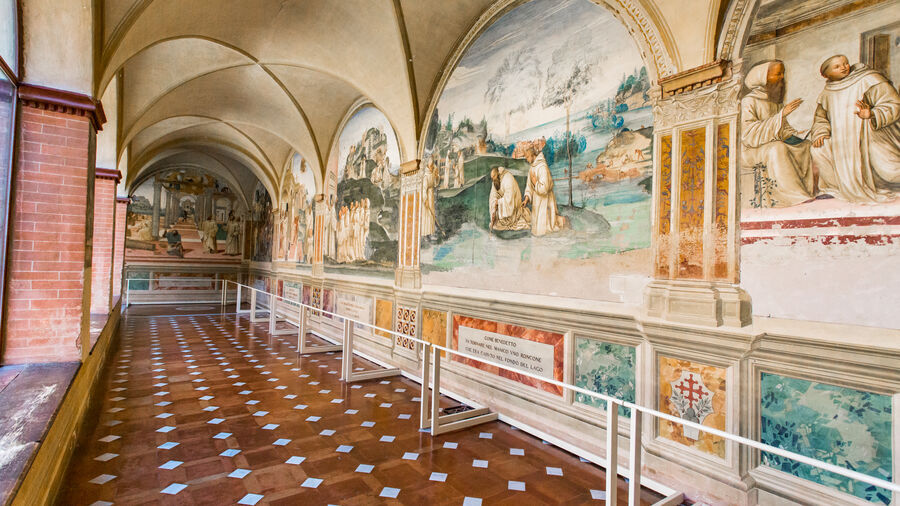
Five miles south of Asciano, the Abbey of Monte Oliveto Maggiore houses a famous fresco cycle of the life of St. Benedict, painted by Renaissance masters Sodoma and Luca Signorelli (free, daily April–Oct 9:45–12:00 & 15:15–18:00, Nov–March closes at 17:00, Gregorian chanting Sun at 11:00 and Mon–Sat at 18:15, call to confirm, tel. 0577-707-262). Once you reach the town of San Giovanni d'Asso, it's only another 12 miles southwest to Montalcino.

Another scenic drive is the lovely stretch between Montalcino and Montepulciano (S-146 on road maps). This route alternates between the grassy hills of the Crete Senese and sun-bathed vineyards of the Orcia River valley. Stop by Pienza en route.

San Galgano Monastery

Of southern Tuscany’s several evocative monasteries, San Galgano is the best. Way off the beaten track, a car is essential to getting here. St. Galgano was a 12th century saint who renounced his past as a knight to become a hermit. Lacking a cross to display, he created his own by miraculously burying his sword up to its hilt into a stone, à la King Arthur, but in reverse. After his death, a large Cistercian monastery complex grew up. Today, all you'll see is the roofless ruined abbey, and on a nearby hill, the Chapel of San Galgano with its fascinating dome and sword in the stone. The adjacent gift shop sells a little bit of everything, from wine to postcards to herbs, some of it monk-made (free, daily April–Oct 10:30–13:00 & 14:00–18:00, March 10:30–13:30 & 14:30–16:30, erratic hours Nov–Dec, closed Jan–Feb, tel. 0577-756-738). Other Tuscan monasteries worth visiting include Sant'Antimo, six miles south of Montalcino, and Monte Oliveto Maggiore, 15 miles south of Siena.

Although a bus reportedly comes here from Siena, this sight is realistically accessible only for drivers. It's just outside of Monticiano (not Montalcino), about an hour south of Siena. A warning to the queasy: These roads are curvy.

US Cemetery

The compelling sight of endless rows of white marble crosses and Stars of David recalls the heroism of the young Americans who fought so valiantly to free Italy (and ultimately Europe) from the grip of fascism. This particular cemetery is the final resting place of more than 4,000 Americans who died in the liberation of Italy during World War II. Climb the hill past the perfectly manicured grassy lawn lined with grave markers to the memorial, where maps and history of the Italian campaign detail the Allied advance (daily mid-April–Sept 8:00–18:00, Oct–mid-April 8:00–17:00; 7 miles south of Florence, off Via Cassia, which parallels the superstrada between Florence and Siena, 2 miles south of Florence Certosa exit on A-1 autostrada; tel. 055-202-0020). Buses from Florence stop just outside the cemetery.

Umbria

Gubbio's basilica of St. Ubaldo
Gubbio's medieval skyline, nestled against the slopes of Monte Ingino.
Gubbio

This handsome town climbs Monte Ingino in northeast Umbria. Tuesday is market day, when Piazza 40 Martiri (named for 40 local martyrs shot by the Nazis) bustles. Nearby, the ruins of the Roman amphitheater are perfect for a picnic. Head up Via della Repubblica to reach the main square with the imposing Palazzo dei Consoli. Farther up, Via San Gerolamo leads to the funky lift that will carry you up the hill, in two-person "baskets," for a stunning view from the top, where the Basilica of St. Ubaldo is worth a look.

The TI is at Via della Repubblica 15 (April–Sept Mon–Fri 8:30–14:00 & 15:30–18:30, Sat 9:00–13:00 & 15:30–18:30, Sun 9:30–12:30 & 15:30–18:30, Oct–March closes at 18:00 daily; tel. 075-922-0693, www.gubbio-altochiascio.umbria2000.it). Buses from Gubbio run to Perugia, Rome, and Florence.

Bevagna

This sleeper of a town south of Assisi has Roman ruins, interesting churches, and more. Locals offer their guiding services for free (usually Italian-speaking only) and are excited to show visitors their town. Get a map at the TI on Piazza Silvestri 1 (daily 9:30-13:00 & 15:00-19:00, tel. 074-236-1667) and wander. Highlights are the Roman mosaics, remains of the arena that now houses a paper-making workshop, the Romanesque church of San Silvestro, and a gem of a 19th-century theater. Bevagna has all the elements of a hill town except one: a hill. You can see the main sights easily in a couple of hours. For an overnight stay, consider the fancy Hotel Palazzo Brunamonti (Sb-€55–88, Db-€75–90, Tb-€100–155, air-con, Corso Giacomo Matteotti 79, tel. 0742-361-932, fax 0742-361-948). Buses connect Bevagna with Foligno (except on Sun).

Montefalco

Famous for its Sagrantino wine and its site (Montefalco means Falcon's Mountain), this village is dubbed the "Balcony of Umbria" for its expansive views. Intact medieval walls surround the town. The Museo Civico San Francesco displays frescoes by Gozzoli (Fra Angelico's pupil) of the Life of St. Francis. There is no TI, but the people at the museum can answer questions. A few buses a day run to Bevagna.

Spello

Umbrian hill town aficionados always include Spello on their list. Just six miles south of Assisi, this town is much less touristy than its neighbor to the north. Spello will give your legs a workout. Via Consolare goes up, up, up to the top of town. Views from the terrace of the restaurant Il Trombone will have you singing a tune (closed Tue, tel. 074-230-1006). The TI is on Piazza Giacomo Matteotti 3 (daily 9:30–12:30 & 15:30–18:30, closes at 17:30 in winter, tel. 074-230-1009). Spello is on the Perugia-Assisi-Foligno train line. Buses run to Assisi.

Le Marche

Giardini Pubblici park, with a view of Urbino
Picnicking at Urbino's Giardini Pubblici.
Urbino

Urbino is famous as the hometown of the artist Raphael and architect Bramante, yet the town owes much of its fame to the Duke of Montefeltro. This mercenary general turned Urbino into an important Renaissance center, attracting artists such as Piero della Francesca, Uccello, and Raphael's papà, Giovanni Santi.

The tiny TI is just across from the Ducal Palace (Tue–Fri 9:00–13:00 & 15:00–18:00, Mon and Sat 9:00–13:00 only, closed Sun, Piazza Duca Federico 35, tel. 0722-2613, www.urbinoculturaturismo.it).

The Ducal Palace, with more than 300 rooms, is the main course of a visit to Urbino. Highlights include great paintings such as Raphael's Portrait of a Gentlewoman (a.k.a. La Muta), the richly-paneled and inlaid wood walls of the duke's study, the vast cellars, and the Renaissance courtyard (€4, but sometimes shoots up to €8 for special exhibits, Tue-Sun 8:30-19:15, Mon 8:30-14:00, last entry one hour before closing, tel. tel. 072-232-2625).

Stop by the Oratory of St. John to see its remarkable frescoed interior. For a fabulous view, climb up to the Giardini Pubblici park, where a grassy hillside provides a panorama of Urbino and the hills of Le Marche.

A couple of good restaurants are Taverna degli Artisti (great pizzas, Via Bramante 52) and Il Coppiere (Via Santa Margherita 1), where your entire meal, including the post-dinner grappa, can involve truffles, if you like. The enoteca at the top of Via Raphael (#54) merits a stop, but the action in town is at the bustling Piazza della Repubblica, with an endless parade of students and locals.

Buses connect Urbino with Pesaro (on the Ravenna-Pescara train line (buses run hourly, 60-min trip). In Urbino, buses come and go from the Piazza Mercatale parking lot below the town, where an elevator lifts you up to the base of the Ducal Palace (or take a 5-min steep walk up Via Mazzini to Piazza della Repubblica).

Updated for 2009. For lots more information, check out our best-selling Rick Steves' Italy guidebook — or join us on one of our free-spirited tours in Italy.