Home > Plan Your Trip > Best Destinations > Switzerland

Switzerland's Scenic Rail Journeys

View from the train
By Rick Steves

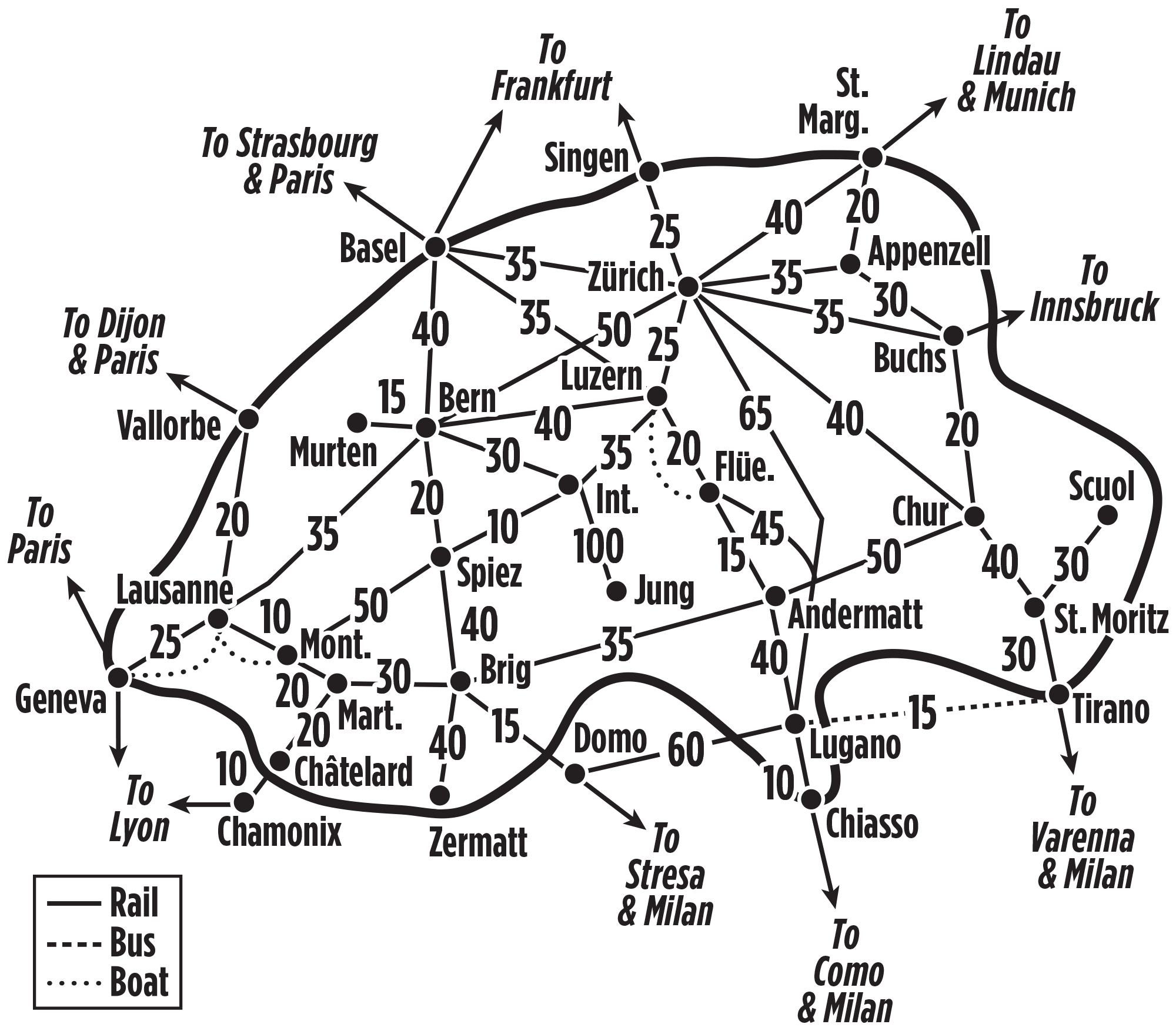
Switzerland has one of the world's best rail networks — and many of its tracks run through some of the world's best scenery. While just about any train ride in Switzerland is photogenic, four are aggressively marketed as the most spectacular: the Golden Pass, William Tell Express, Bernina Express, and Glacier Express. If you're looking for a scenic day enjoying the Alps from the window of your train, and would like to do it in one of Switzerland's unique "panorama cars" (offering huge windows that sweep halfway across the ceiling), these journeys can be great experiences. While they aren't quite as "fantastic with countless highlights" as they're advertised to be (the high lifts in ski areas like the Berner Oberland are much higher and more breathtaking), the trains are a fun way to do some sightseeing while getting from point A to point B.

This article provides you with all the logistical, nuts-and-bolts information you'll need to splice each of these journeys into your itinerary. I've also written a commentary on each route, describing the highlights in the direction that most travelers are likely to go. If you travel in the opposite direction, the same information still applies — just hold this article upside down.

This article includes information about Chur, a town that's not really worth a visit, except that it lies at the intersection of the Bernina Express and Glacier Express routes. Chur makes for a handy pit stop or overnight if connecting these trips.

Tickets

Schedules Can Change: In this article, I've listed specific departure and arrival times, but these schedules are always subject to change — it's essential to confirm the times before you travel. Timetables for most of these trains appear on the Swiss Rail website: www.rail.ch. (Also try Germany's all-Europe rail site, http://bahn.hafas.de/bin/query.exe/en; or call the Swiss Rail info line at 0900-300-3004, 1.20 SF/min.) Any train station in Switzerland can provide you with free schedules. Each scenic rail line also operates its own website, with even more details (listed in each section, below).

Buying Tickets: Tickets and reservations for all of these scenic rail lines — including those run by private rail companies — can be purchased at any train station in Switzerland. In the US, you'll pay more (about $20 per order) to get tickets and reservations through your travel agent or at www.raileurope.com. Getting your reservations before you go also limits your flexibility, as reservations made through US agents are non-changeable and nonrefundable — unlike reservations made at train stations in Europe.

Reservations: You can book these journeys as early as two months ahead, or as late as the day before (at any Swiss train station or on the various websites). The Glacier Express requires reservations. If you want to take the official tourist package for the William Tell Express or Bernina Express, reservations are also required. Reserve the Golden Pass only if you want a front-row VIP seat. To save money and maximize your flexibility, you can take standard (non-panoramic) trains on the Golden Pass, William Tell Express, and Bernina Express routes without a reservation (though the bus segment of the Bernina Express requires a reservation, it's easy to purchase from the driver on the bus). These alternatives are explained in each section below.

Eurailpass and Swiss Pass:

Two major types of railpasses can be useful in Switzerland: A Eurailpass (or Eurail Selectpass) and a Swiss Pass. (For details on all of the options, check out our Rail Guide.) These railpasses cover most of your travel on the scenic rail journeys. But seat reservations always cost extra, and some trips aren't fully covered by a railpass: Even if you have a Eurailpass or Swiss Pass, you'll pay 38 SF extra for the William Tell Express package trip. However, traveling the same route on standard trains, rather than on the designated tourist trains, is fully covered by a railpass. And on the Glacier Express, two different segments of the trip are free with a Swiss Pass, but not covered by a Eurailpass (with a Eurailpass, Disentis to Brig costs 45 SF second-class; Brig to Zermatt costs 34 SF).

When booking your ticket or buying reservations, make sure the ticket agent understands what type of pass you have (if any) and exactly what trip you're taking. Confirm that you've gotten all the reservations and other tickets you need to complete your trip. While rail agents generally know what railpasses cover, sometimes they don't — leading to frustrating run-ins with conductors who insist that you've only paid for part of your trip.

Train Types

Various types of trains, with various types of cars, run these routes. Here are some key distinctions to look out for.

Classes: Most trains have first- and second-class cars. In bigger train stations, a digital panel on the tracks indicates departure time, destination, and the composition of the train (that is, at which part of the platform you'll find the first- or second-class cars).

Panoramic vs. Standard Cars: All of the routes in this article offer special panoramic cars. On some trains — such as Golden Pass and Bernina Express — all of the cars are panoramic, so there's no need to splurge for first class. On other trains, such as Glacier Express and William Tell Express, you can choose between more expensive panoramic (first-class) and cheaper standard (second-class) cars.

Panoramic cars have huge, wrap-around windows, allowing you to see through part of the ceiling. The Golden Pass goes one better: The driver sits in a little bubble upstairs, leaving the very front of the train open for VIP seating with completely unobstructed views of what's coming up. The windows in the panoramic cars generally can't open, meaning that photographs often come with a glare, and the interior (even with air-conditioning) can heat up in sunshine.

Standard cars are typical train cars, featuring regular windows. With a smaller field of vision than the panoramic cars, these require a little more bobbing and weaving to enjoy the views. Aside from being cheaper, the chief advantage of the standard cars is that the windows generally can be opened, for cool air and photos without reflections. Passengers in panoramic cars are free to walk to the standard cars to open a window and snap a photo.

Standard vs. Tourist Trains: In many cases, standard trains operated by Swiss Rail run these same routes — more frequently, and usually less expensively (though you'll sacrifice things like fancy dining cars and souvenir keychains). Because standard trains are used by local commuters, they may stop at more stations along the route than the designed-for-tourists panoramic trains. Many travelers enjoy the flexibility of following the scenic route on standard trains, enabling them to hop off and explore a village, then hop on the next standard train that comes through — without the headache of reservations (which are almost never necessary on standard trains).

Golden Pass

The exceptionally picturesque Golden Pass train route cuts a swath diagonally across the pristine center of Switzerland, connecting Zürich with Lake Geneva. Of all the rail journeys in this article, its central location — lacing together many of Switzerland's top sights — makes the Golden Pass the one you're most likely to take.

Orientation

The Route

The Golden Pass officially runs between the cities of Zürich and Geneva, but most travelers focus on the segment between Luzern and Lake Geneva's Montreux. Better yet, hone in even more tightly — on the very best stretch, from Interlaken to Montreux.

Special panoramic cars are used between Luzern and Montreux. Because the tracks change from narrow to standard gauge to narrow again, two train changes are required (at Interlaken Ost and Zweisimmen).

Route Breakdown: The entire Golden Pass route (almost 8 hrs) is run by various companies, and involves several train changes. Here's the breakdown:

Zürich to Luzern: Standard trains, run by Swiss Rail (2/hr, 1 hr).

Luzern to Interlaken Ost: Narrow-gauge panoramic trains run by Brünig Railway (5/day, 2 hrs); also standard trains by Swiss Rail (hourly, 2 hrs).

Interlaken Ost to Zweisimmen: Direct panoramic trains run by Golden Pass (2/day, 1 hr); also standard trains run by Swiss Rail (at least hourly, 1-1.5 hrs).

Zweisimmen to Montreux: Direct, narrow-gauge panoramic trains run by Golden Pass (5/day, 2 hrs); also standard trains run by Swiss Rail (9/day, 2 hrs).

Montreux to Geneva: Standard trains, run by Swiss Rail (hourly, 1 hr).

Planning Your Time: Because it connects so many knockout Swiss destinations (Zürich, Luzern, Interlaken, and Lake Geneva) — and because it goes in both directions — the Golden Pass can be spliced into your itinerary in many different ways. I'd focus on the best stretch, using it to connect Interlaken and Lake Geneva (3 hrs total, including the lovely 2-hr segment from Zweisimmen to Montreux).

However you use it, check schedules along the way and plan your layovers strategically to maximize time on the panoramic cars. For example, if traveling from Luzern to Lake Geneva, consider taking the 8:55 panoramic train from Luzern to Interlaken Ost (arriving 10:45), then wander Interlaken and have lunch before catching the 13:25 panoramic train to Montreux (change trains in Zweisimmen at 14:23, arrive Montreux at 16:13).

Cost and Schedule

Golden Pass trip from Luzern to Montreux costs 67 SF second class; just the "best of" segment from Interlaken to Montreux is 47 SF. The entire ride is covered by a Eurailpass or Swiss Pass. Reservations, while not required, are recommended for summer midmorning departures and the super-scenic front seats (15 SF for front-row VIP seats, 7 SF for other seats in panoramic cars; more details under "Seating," below).

Special panoramic cars — some with front-row VIP seating — depart several times each day. Standard trains run from Spiez to Montreux every hour (2-hr trip, change trains in Zweisimmen). These regular regional trains show you the same scenery without the big windows

Information: Most of the route is part of the Swiss Rail network. Special panoramic trains on the Luzern–Interlaken route are run by Brünig Railway (www.bruenig.ch). Panoramic trains on the section between Zweisimmen and Montreux are operated by MOB (Montreux–Oberland Bernois; tel. 0900-245-245 within Switzerland, from elsewhere in Europe dial 00-41-840-245-245, from the US call 011-41-840-245-245, www.mob.ch). For more on the full route, see www.goldenpass.ch. An English-language guidebook describing the route is sold on the train (12 SF).

Seating: There are both standard and panoramic trains on the entire Luzern-to-Montreux route.

The lovely stretch from Zweisimmen to Montreux is covered by standard trains (9/day); trains with panoramic cars (2/day); and some special "Grande Vue" trains with both typical panoramic cars and special VIP seats (3/day May–Nov, 1/day Dec–April). On these "Grande Vue" cars, the conductor drives the train from a little domed area upstairs — leaving both the front and back of the train open for passengers. The first two rows, offering VIP seats with an unobstructed view of the pristine alpine scenery coming right at you, require a supplement of 15 SF (reserve in advance, or just grab one if available and pay the conductor on the spot). The non-supplement seats just behind the supplement seats give you a bit of the grand front view (and cheapskates have been known to grab a few free minutes up front). The panoramic cars have first- and second-class seating (with panoramic ceilings in both — no need to spring for first class, unless you want VIP seats). Cars have standard seating mixed with lounge areas with sofas, tables, and a bar.

Note that on the Luzern–Interlaken section, you'll need to choose between panoramic (first class) and non-panoramic (second class) cars.

Self-Guided Train Tour

I've described only the best and most visually exciting portion of the Golden Pass journey, the three-hour stretch from Interlaken to Lake Geneva, focusing on the crème de la crème — the two hours between Zweisimmen and Montreux (described from north to south).

As you pull out of Interlaken, the train cruises along the south bank of Lake Thun (Thunersee). "Interlaken" literally means "between the lakes" — it's situated between the big lakes of Thun and Brienz. Before long, at the town of Spiez, you'll split off and head southwest to Zweisimmen.

Leaving Zweisimmen, you'll roll through Simmental valley, famous among American farmers for its top-end cows. Big farmhouses lie scattered in the lush meadows — an indication that the farmland is good here. The large wooden buildings are typical of Bernese farm architecture: housing the barn, sheltering the crops, and storing agricultural machines, all under one huge roof. Farming is heavily subsidized in Switzerland, and farmers form the strongest economical lobby. Trying to increase their modest income, many farmers have switched to exotic crops (like melons) or animals. These days, ostriches, yaks, bison, and highland cattle have become a common sight in the Swiss Alps.

Between Saanenmoser and Schonried, the train reaches its highest point (about 4,000 feet) and stops at the famous resort town of Gstaad. Although known as a favorite hangout for famous "backpackers," such as Monaco's Princess Caroline, Liz Taylor, Roger Moore, and Michael Jackson, the town does not offer many exciting sights. In winter, the modest ski slopes are not as crowded as the flashy nightspots, as most of the skiers are more into après-ski activities. Sipping their cocktails, they eye each other and discuss the latest trends in ski gear fashion. In summer, Gstaad hosts the Swiss Open tennis, polo, and golf tournaments, as well as music festivals. Violin virtuoso Yehudi Menuhin founded the Menuhin Festival here. While it started as an opportunity for young classical musicians to show their talent, today it's known for high-quality classical concerts.

Just south of Gstaad, you say Auf Wiedersehen to the German-speaking part of Switzerland and Bonjour to French Switzerland. The mountains are jagged. In fact, many are called dents, the French word for "teeth." With the change in language, you'll also see a change in culture and architecture. French-style gray stone houses are replacing half-timbered, woody, German-style chalets. The mountain airstrips — generally made for the Swiss Air Force during World War II — are used today for sightseeing flights around the Alps. The cute village of Rougemont, with its traditional chalets, is famous among the Swiss as place where the wealthy send their girls to boarding school.

Happy cows spend their summers on the Alps, wandering freely and munching the fragrant herbs of these lush alpine meadows. The resulting milk is the secret ingredient for tasty Gruyère cheese. On steep hillsides here, the grass is still cut by hand. It dries in the summer sun, then is collected and stored in the barns to serve as cow salads through the winter.

You might consider interrupting your journey in Château d'Oex, known for its Hot-Air Ballooning Week (last week of January). Bertrand Piccard and Brian Jones took off from here on March 1, 1999, and sailed their balloon all the way around the world. Below the train station, Le Chalet restaurant gives insight on Gruyère cheese production.

South of Château d'Oex, the valley narrows to a deep gorge. Up on the hillsides, the damage of the devastating 1999 winter storm "Lothar" can still be seen. Entire forests were leveled, aggravating the already precarious avalanche situation. The trees on the steep slopes stop the snow from sliding down and burying the villages. Once the trees are gone, they don't grow back. Artificial avalanche barriers need to be erected. Landslides and floods have been relatively common in recent years — an unfortunate consequence of uncontrolled deforestation and construction of vacation homes in areas that traditionally served as pastures and forestlands.

The small lake is dammed and used for hydroelectric power. Switzerland makes good use of its Alps for production of electricity. Although it has some nuclear power plants, 60 percent of Switzerland's energy is hydroelectric. The country exports its electricity to France and Italy.

Montbovon is the place to change trains if you're going to Bulle or Gruyères. After the first tunnel, an inscription on the barn to the right welcomes the traveler in the Gruyère region: La Gruyère vous salue.

The train winds its way uphill with more curves and tunnels than before. Passing through the Jaman Tunnel, you're engulfed in nearly two miles of darkness, then you emerge in another world — leaving the feudal Middle Ages and entering the 19th-century belle époque. At the village of Les Avants, one of Switzerland's oldest winter resorts, you catch the first glimpses of Lake Geneva sprawling deep underneath you and begin a steep descent. A series of sharp bends in tunnels takes you out of the mountains and down to lake level.

The architecture has even more of a French flair now that you've entered the "Swiss Riviera." Palm trees, vines, and many sanatoriums indicate this is a warmer climate. You're surrounded by the vineyards of the Lavaux region, famous for its white wine. The view broadens to include the French Alps of Savoy across the lake, the lakeshore of the Swiss Riviera to the west, and the broad Rhône Valley to the east. As you approach Montreux — with its grand hotels — the train meanders its way intimately through private gardens.

Montreux has the only train station in Europe with three different rail gauges: regular, narrow (which you're on), and very skinny (for the Rochers de Naye train, taking sightseers to a nearby peak with views less exciting than those you've just enjoyed). From here, it's an easy train trip to Lausanne, or a quick bus ride or about a one-mile lakefront hike to Château de Chillon.

Transportation Connections

From Luzern by train to: Zürich (3/hr, 1 hr), Zürich Airport (2/hr, 1.25 hrs), Bern (hourly, 1 hr; or 2/hr with transfer in Olten, 1.5 hrs), Lugano (hourly, 3 hrs, half with change in Arth-Goldau), Chur (hourly, 2.25 hrs, change in Thalwil).

From Interlaken by train to: Lauterbrunnen (hourly, 20 min, 7 SF each way), Spiez (3/hr, 20 min), Brienz (2/hr, 20 min), Bern (2/hr, 55 min), Zürich and Zürich Airport (hourly, 2-2.25 hrs, most direct, but some with transfer in Bern, Luzern, and/or Spiez).

From Montreux by train to: Lausanne (4/hr, 25 min), Bern (2/hr, 1.5 hrs, transfer in Lausanne), Geneva (2/hr, 1 hr).

William Tell Express

The William Tell Express figures it deserves the most famous name in Switzerland. Tell exists only in legend, but his story — being forced to shoot an apple off his son's head because he refused to bow to the Hapsburg hat — helped inspire the Swiss to rebel against their Hapsburg rulers. The train route crosses the place where the first Swiss cantons pledged "all for one and one for all," the birthplace of the Confoederatio Helvetica in 1291. The trip is half by boat and half by train from Luzern to the Italian-speaking region of Ticino (the towns of Lugano or Locarno).

Don't go out of your way to do this trip. The boat ride is low-altitude and more pastoral than thrilling, and the train ride is more interesting as a lesson in Swiss engineering than impressive for its views. (Because the train cuts through the highest mountains inside the Gotthard tunnel, it only reaches 3,600 feet above sea level.)

But if you're connecting Luzern and Italian Switzerland anyway, this route is undeniably scenic. You can book the official "William Tell Express" trip, or simply buy regular tickets with none of the hoopla. I'd save money and gain flexibility by just riding the boat and train on regular departures and skip the much-promoted tourist package. Even if you don't buy the package, you can still ride the fancy panorama train (without a seat reservation) at no extra charge.

Orientation

The Route

The William Tell Express begins with a slow boat trip on Lake Luzern from the city of Luzern to Flüelen (3.5 hrs). Then a train cuts down into the Italian-speaking canton of Ticino (2 hrs). In the town of Bellinzona, you'll choose between two end points: Lugano or Locarno (I prefer Lugano).

The 3.5-hour boat trip from Luzern to Flüelen is lazy and very pretty. As the traditional steamer blows its old-time horn, you glide by idyllic lakeside resort towns and under mighty peaks. If you're in a hurry, you can get a flavor for the lake by doing a shorter round-trip cruise during your time in Luzern. Then take the train to Flüelen (1 hr from Luzern, as opposed to 3.5 hrs by boat); you'll see essentially the same scenery as the William Tell "Express" boat, but three times faster.

Whether you ride the boat or train from Luzern, in Flüelen you can join the William Tell Express panoramic train (departs Flüelen at 12:16 and 15:16). In Bellinzona, you can either transfer to a non-panoramic train to Lugano, or stay on the same train to Locarno.

Another option is to skip Flüelen entirely. Standard (non-panoramic) trains make the Luzern–Lugano trip along the same route hourly in each direction (3 hrs total).

Cost and Schedule

The value of buying the official William Tell Express tourist trip (158 SF first class, 126 SF second class) is dubious. The only things that come "extra" with this pricey package are a mediocre lunch on the boat, a reserved seat on the panoramic train, a brochure about the route, and a souvenir Swiss Army–knife keychain. Travelers using a Eurailpass or Swiss Pass pay a 38-SF reservation fee to buy this official trip — but you're better off skipping the package altogether. Your railpass already covers the entire route, including the boat (but not the lunch or the seat reservation — both of which aren't necessary anyway).

There are two official William Tell Express departures daily in each direction (running May–Oct only). Going north to south: The boat leaves Luzern at 9:20 and 11:25, docks in Flüelen where the panoramic train departs at 12:16 and 15:16, and arrives in Lugano at 14:46 and 17:46. Going south to north: The train departs Lugano at 10:12 and 12:12, meets the boat in Flüelen at 13:00 and 15:03, and arrives in Luzern at 16:20 and 18:25. As always, remember to confirm all times.

Information: The official William Tell Express departures are operated by the Lake Luzern Navigation Company (tel. 041-367-6767, www.lakelucerne.ch). For more information, see www.wilhelmtellexpress.ch.

Helpful Hints

Boat Ride: If you're doing the full William Tell Express route, board the boat at pier 1 across from the Luzern train station. Present your ticket and pick up your package deal, including a lunch voucher and information flyers. There's no real baggage check on the boat; travelers just stack their backpacks and suitcases in a corner.

Lunch: The official William Tell Express boat trip comes with a forgettable lunch.

Train Trip: On the official William Tell Express train from Flüelen, you'll find first class and the panoramic car way out on the platform in sector C. Yellow slips mark which seats are reserved. If you have no reservation, take any seat without a yellow marker.

Self-Guided Tour 

Here's what you'll see if you're doing the entire William Tell Express package. If you're just doing the train, skip down to that section.

Boat Trip

The William Tell boat trip crisscrosses Vierwaldstättersee (literally, the "Lake of Four Forest Cantons" — or simply "Lake Luzern"). The trip is popular with the older generation of locals, who eat and drink their way through the lazy route. On a sunny day, you can sit on the deck enjoying the mountain views. Survey the boat before you settle on a seat — considering sun, shade, and wind.

After two hours, you sail into the Canton of Uri and the landscape gets rougher, the slopes steeper, and the villages fewer and more rustic. This is William Tell country. The legendary Swiss national hero represents the essence of the country's spirit, still felt today: the desire for independence from foreign rule. William Tell has been a popular muse: Schiller wrote a play about him based on ancient Swiss chronicles, and Rossini set the legend to music in an 1829 opera.

Swiss patriots get excited as the boat approaches Rütli. The meadow above is the birthplace of the Swiss Confederation. In 1291, three representatives of the founding cantons met here and swore allegiance to each other, against their oppressive Hapsburg neighbors. More than 700 years later, Switzerland is still a confederation — but now it's up to 26 cantons.

Some hikers choose to disembark at Rütli and head for the mystical meadow marked by a big Swiss flag. Then they follow the Weg der Schweiz (literally "Path of Switzerland"), a trail leading around the lake. Along the way, they contemplate stone signs representing each of the 26 cantons in the order they joined the union. The canton markers are spaced according to each canton's population (the 20-mile-long trail is designed to have exactly 5 millimeters for each Swiss citizen).

Later, the boat stops at Tellskapelle. This 16th-century frescoed chapel marks another legendary spot — where William Tell jumped ship on the way to prison and swam to freedom.

The last stop is Flüelen, where the panoramic train awaits.

Train Trip

From Flüelen, the train climbs from 1,540 feet up to 3,600 feet, at the Gotthard tunnel — the primary north–south transportation route through the Alps. You enter a classic alpine world of snowcapped mountains towering above wild valleys, with narrow gorges carved by eons of angry white water. Wooden chalets, pine forests, and lush meadows dotted with munching cows complete this image of picture-perfect Central Switzerland.

The train tracks are protected from avalanches, landslides, and waterfalls by concrete galleries. Gazing out the window, you'll see some of the greatest accomplishments of Swiss road and railroad engineering. Wassen, marked by its striking chapel, is the climax for trainspotters — with more trains passing per minute than just about anywhere else. First, the chapel is on your right. Then the train loops around the tiny town, and the chapel is on your left. Your train disappears into a tunnel, and when you emerge, the same chapel is still there. The train actually spirals up the slopes. (The William Tell Express package comes with a schematic map that illustrates this.)

Göschenen (where you can transfer to Andermatt, and on to the Glacier Express) is the last stop before the 9.5-mile-long Gotthard tunnel. After 10 minutes of rocketing through darkness, you emerge in a whole different world — a different canton (Ticino, rather than Uri) and language (Italian, rather than German). Since the 13th century — long before this tunnel was built — the Gotthard Pass has been the major trade route over this part of the Alps, connecting northern and southern Europe. The trade continues to rumble under rather than over the pass. These days, heavy truck traffic brings pollution and traffic jams — but little money — to Switzerland. But an ambitious new high-speed train tunnel, currently under construction, will allow shippers to transport merchandise by train and get trucks off the roads.

Welcome to Ticino, Switzerland's botanical garden. While the weather around Lake Luzern is often iffy, Ticino feels Mediterranean — warm and southern — making it a favorite weekend destination for the Swiss. Rather than cuckoo-clock-like chalets, the houses are now plain, square, and made of stone. Instead of conifers, the forests are full of chestnut trees. You'll see vineyards, oleander, and even palm trees. And the upcoming train stops are announced in Italian now: Prossima fermata...

While life seemed almost too good in the pristine and touristic Lake Luzern region, here in the valley of Leventina, the economy is tougher. Unemployment rates are high, young folks have to commute into the cities further south for a job, houses and roads aren't as well maintained, and window boxes no longer come with so many flowers. Around the town of Biasca, you'll see industrial buildings and factories.

As you leave Biasca, notice a modern square building with pebble walls on your left-hand side. This is the information center for the new Gotthard tunnel, which will be the longest train tunnel in the world (Tue-Sun 9:00-18:00, closed Mon, tel. 091-873-0550, www.infocentro.ch).

If heading to Lugano, you may need to change trains in Bellinzona. (The official William Tell train continues to Locarno.) The train to Lugano passes the northern tip of Lake Maggiore and goes through a quiet, lush valley lined with picturesque villages and chestnut trees. Enjoy your time in Italian Switzerland!

Transportation Connections

From Luzern by Train to: Zürich (3/hr, 1 hr), Zürich Airport (2/hr, 1.25 hrs, half with change in Zürich), Bern (hourly, 1 hr; or 2/hr with transfer in Olten, 1.5 hrs), Interlaken (hourly, 2 hrs), Lausanne (hourly, 2.5 hrs; more with transfer in Olten), Appenzell (2/hr, 2.75 hrs, change in Herisau or in Zürich and Gossau), Chur (hourly, 2.25 hrs, change in Thalwil).

From Lugano by Train to: Zürich (hourly, 3 hrs, half with change in Arth-Goldau), Interlaken (hourly, 5 hrs, transfer in Luzern, Zürich, or Olten), Bern (hourly, 4 hrs, transfer in Luzern, Zürich, or Olten). From Lugano, you can continue on to the Bernina Express (below).

Bernina Express

The Bernina Express is one of the most exciting train rides through the Swiss Alps thanks to its diversity: starting with the sunny palm-tree ambience of Lugano, getting a taste of Italy along beautiful Lake Como, climbing up and over the twisting Bernina Pass, and seeing mountain towns like Pontresina before finishing up in eastern Switzerland. The little red train with panoramic cars spirals up to 7,380 feet, passing steep mountains and cliffs, glaciers, waterfalls, and a wild, rugged landscape.

Orientation

The Route

The Bernina Express combines a bus trip through Italy with a train ride up and into the mountains. The bus begins in Lugano and runs along the west side of Italy's Lake Como, eventually arriving at Tirano, where the route continues by train. From Tirano, the train crosses back into Switzerland and twists up the steep mountainside north, mastering a very steep grade on regular tracks (no cogwheels) en route to the most spectacular stretch: over the Bernina Pass. Then the train winds back down the other side, stops in mountain towns (such as Pontresina), and finally deposits you in your choice of towns: Chur, St. Moritz, or Davos.

The route can be reversed (Chur/St. Moritz/Davos to Tirano by train, then bus to Lugano). In fact, this way arguably provides an even better experience: Approaching Pontresina from the north is breathtaking, and it gets even better when the train gets to the Bernina Pass.

Planning Your Time: The trip is spectacular but long. It helps to break the journey with an overnight or two in the Pontresina area. The Bernina Express is especially enjoyable in July and August, when you can take one of the open-top yellow train cars between Tirano and St. Moritz.

If you have more time, consider taking a standard regional train along this route (rather than the official panoramic Bernina Express train). That way, you can get off as you like for hiking and exploring (see "Local Train Alternative," below).

Cost and Schedule

A one-way trip on the Bernina Express from Lugano to Chur costs 74 SF second class, 110 SF first class. If you're only going as far as Pontresina, it's cheaper (45 SF second class, 61 SF first class). The entire trip (including the bus) is covered by a Eurailpass or a Swiss Pass, though reservations cost extra.

If you do the official Bernina Express trip, seat reservations are required for both the bus and the panoramic train (9 SF for train, 12 SF for bus, buy easy-to-get bus reservation from driver as you board). Remember, you can do the same stretch on a regular train without reservations (optional seat reservation-5 SF; no such option for bus).

The bus leaves daily in summer (mid-May–mid-Oct) from outside Lugano's train station at 10:00 and heads for Tirano (facing the lake with the station at your back, walk about 100 yards to the left; bus stop has yellow sign for St. Moritz and Tirano).

At 12:45, you'll arrive in Tirano. From here, trains continue north over the mountains. All trains follow the same tracks as far as Pontresina, where they fan out to three different end points: to Chur (departs Tirano 14:15, arrives Chur 18:29), to St. Moritz (departs Tirano 14:49, arrives St. Moritz 17:11), or to Davos (departs Tirano 14:34, arrives Samedan 16:44, arrives Davos 18:19). The Davos-bound train, which runs in summer only, is the only direct panoramic train from Tirano to Samedan.

If you're doing it the other way around, here are some options: From Chur, the train leaves at 8:28 and arrives in Tirano at 12:35. From St. Moritz, the train departs at 9:40, arriving in Tirano at 11:56. From Davos, the train leaves at 8:40 and reaches Tirano at 12:19. The bus from Tirano leaves at 14:25 and arrives in Lugano at 17:30. Remember to confirm all times.

In winter (mid-Oct–mid-May), the bus service stops, but the train still runs between Tirano and Chur, and Tirano and St. Moritz, but not Tirano and Davos.

Information: The Bernina Express is operated by Rhaetian Railway (tel. 081-288-6104, fax 081-288-6105, www.rhb.ch). You can buy an English guidebook about the Bernina Express on the train or at gift shops along the way (12 SF). A recorded English commentary plays on the train's loudspeaker. Lugano bus info: tel. 081-288-5454.

Helpful Hints

Bus Trip: The Lugano–Tirano leg of the Bernina trip (through Italy) is on a bus. Make yourself comfortable — the seats recline, and the footrests, armrests, and individual fans give you more comfort than on a standard postal bus. There are no WCs or food on the bus, so buy your snacks and drinks before boarding (a convenient spot is the Apero shop at Lugano's train station, daily 6:00–22:00). The bus stops for a WC and snack break in Italy (accepts Swiss francs). Bags can be put under the bus. The bus trip is almost entirely through Italy.

Train Trip: Once you reach Tirano, you'll switch to a panoramic train. The train has five cars: one is first-class only, with panoramic windows that don't open. The other four are regular cars (with non-panoramic windows that open); two have first- and second-class seating, two are second-class only.

Topless Trains: If traveling in July or August, ask about sitting in the yellow "convertible" train cars with flip seats and no roof (they can go on the Tirano–St. Moritz tracks because there are no long tunnels). Both first- and second-class cars are panoramic, and equally good.

Local Train Alternative: The train segment of the Bernina Express can be done on a standard (non-panoramic) local train. These trains stop at all stations, allowing you to hop off and walk around in the beautiful scenery. You can get off at Poschiavo for a quick visit, or at the Bernina Pass for hiking, or at Diavolezza to do a cable-car trip. Alp Grüm and Ospizio Bernina are starting points for several great hikes. Train connections are easy and quick if you're just passing through.

Self-Guided Tour

Bus Trip

The Bernina Express bus is more scenic than relaxing. Lakes Lugano and Como are almost fjord-like, lined with little Italian getaways. For the best views, sit on the right-hand side (seat numbers don't seem to matter).

At first, the road takes you around Lake Lugano on narrow, windy roads, frequently honking its horn to warn oncoming traffic at tight passages. Leaving Lugano, you'll pass the town of Gandria (fun to visit from Lugano by boat). Shortly after Gandria, you cross the border into Italy (it's a nonevent — bus doesn't stop, no need to show passports). You may notice a change in architecture: While the Swiss love meticulously manicured gardens and painstakingly renovated houses, the Italians take things a bit easier.

Once the bus leaves Lake Lugano, the road broadens and takes you through modern Italian villages before hitting picturesque Lake Como (Lago di Como). Above the town of Menaggio are your first views of the lake. The village across the lake on the right (by the funny hump of land) is the real Bellagio (not the Las Vegas casino). At the nearby village of Dongo, the Italian fascist dictator Mussolini was captured at the end of World War II. Tunnels occasionally disrupt your views, but you can catch glimpses of the lush lakefront. In Gravedona, the street gets narrow enough to make getting the bus through a tight squeeze. Posh private villas and gardens line the street; look for the 12th-century Romanesque Church of Santa Maria del Tiglio. From here, the trip takes you to the tiny harbor town of Domaso. This area is touristy, with plenty of campgrounds, hotels, and swimming pools.

Shortly before noon, the bus stops for 15 minutes in Sorico, at the northern tip of Lake Como. You'll have a chance to use the WC and buy a snack or drink at Bar Pace (Swiss francs accepted). Check out the big photograph behind the bar — George Clooney posing with the bar's proud owner on a 2002 visit. Clooney owns a grandiose villa on Lake Como.

The bus then crosses the "Pian di Spagna" — famous for a tense standoff between Spanish and Swiss troops during the religious wars of the Counter-Reformation. The trip continues up the fertile Valtellina Valley, where some of northern Italy's white wine is produced. The sunny slopes on the left side are reserved for vineyards, the right lower slopes are for woodland, and the bottom of the valley is occupied by apple plantations. This region belonged for centuries (from 1512 until Napoleon in 1797) to Switzerland's largest canton, Graubünden. Today, this region is Italian, but many Swiss still think of the local Veltlin wine as their own.

Tirano is our next stop. In the old town, the bus passes an impressive Renaissance church (Madonna di Tirano, on the left) before arriving at the train station at 13:00. You have time for lunch and some sightseeing before hopping on the Bernina Express train (departs at 14:15 to Chur, at 14:49 to St. Moritz, at 14:34 to Davos). Or, to cram in more sightseeing, take an earlier departure on a regional train to gain time for a stop-over in the fine town of Poschiavo (described below), and catch your Bernina Express train from there later (confirm times at the Tirano station information window).

If you're interested in the Poschiavo side-trip, see below. Otherwise, skip down to the next section ("Bernina Express Train Trip, Part One").

Poschiavo

From the Poschiavo train station, walk to the main street and turn left, following the signs to Centro and the TI. Cross the river over the pedestrian bridge and continue left, then right, then left, following the Information signs. The main square, Piazza Comunale, is lined with neoclassical and neo-Gothic buildings, including an impressive Catholic church (Chiesa di San Vittore Mauro). A church stood here as early as 703, but the building has been rebuilt and renovated several times: The bell tower dates from 1202, and the Baroque front door was carved in the 1700s. Don't miss the little yellow building just before the church, with the intricate wrought-iron grills. Have a peek inside, and don't be startled by the skulls lining the walls — you're standing in front of the local ossuary.


The TI is located in the old Town Hall, below the 12th-century church tower. Pick up a map and the English translation for a short orientation walk: Go from the main square a block north and find the Church of St. Ignazio. It's ironic that this Protestant church's namesake, St. Ignatius of Loyola, was the founder of the militant Jesuit order — whose main purpose was to fight "heretic" Protestants. Notice the inscription above the central pulpit, which is fervently Protestant: Chiesa cristiana vangelica riformata da gli errori e superstizioni umane ("Christian evangelical church, reformed from human errors and superstitions").

Then it's back to the station...you've got a train to catch!

Bernina Express Train Trip, Part One: From Tirano to Pontresina

From Tirano, the train crosses the center of town before climbing up to Brusio. Here the train takes the famous circular viaduct, the only one in the world — an ingenious construction allowing the train to reach higher altitudes without the help of a cogwheel mechanism. As the train twists up, you can see the front and back cars curving in front of and behind you, riding over the viaduct.

Lay back and enjoy the most scenic part of the trip. You pass dark old pine forests with needle-and-moss-covered boulders. Chestnut forests, tobacco plantations, and vineyards contribute to the lush tableau. Wildflowers along the track include bright-orange lilies and mountain azaleas. The train slaloms up the steep mountain and offers more and more views of waterfalls, steep cliffs, and the Poschiavo valley and lake far below you.

Thirty minutes after leaving Poschiavo, and before you reach the Bernina Pass, you'll spot the first glacier, Palü Gletscher (behind the little lake of Palüsee on the left). It lies nestled between the peak Piz Varuna (11,330 feet) on the left and the eastern summit of Piz Palü on the right (12,790 feet).

The groaning of the train is a reminder that this is the only train crossing over the Alps without a tunnel. It goes right over the summit. Ospizio Bernina — at the Bernina Pass — marks the highest point of this trip (7,380 feet). You'll see the White Lake (Lago Bianco), whose color comes from the snowmelt, also called "glacier milk." A watershed sign (yellow, reading Wasserscheide) explains that this is a European continental divide: From here, rivers flow either north (towards the Inn, Danube, and finally to the Black Sea) or south (to the Adriatic Sea via the Adda and Po rivers).

Behind the White Lake, you can see the glaciers of Sassal Masone and Piz Cambrena. This mountain pass not only separates European drainage basins, but also cultures. In winter, when the train line was more susceptible to bad-weather closures, the remote Italian-speaking valley of Poschiavo was often cut off from Switzerland, and turned itself towards its southern neighbor, the valley of Veltlin (where you were just riding the bus).

The train crosses the barren landscape and descends into the Engadine valley. This part of Switzerland was discovered by tourists and convalescents at the end of the 19th century. Imagine the gorgeous skiing here in the winter, which still attracts the rich and famous. After the railroad opened this secluded valley to the world, the first hotels and sanatoriums were built (the air and sunshine supposedly helped fight various diseases). Poets found their muse in the wild, romantic landscape, while painters flocked in, attracted by the quality of the light. Keep an eye out for typical Engadine architecture — small windows set in thick walls, etched sgraffito decorations, and carved wooden doors.

The Montebello curve offers you the best views over the Morteratsch glacier on the left, with the impressive peaks in the background; from left to right: the Bellavista Range (12,770 feet), Crest Agüzza (12,690 feet), and the highest peak in the canton, Mount Bernina (13,280 feet). Mount Bernina was first climbed in 1850 by a team led by rangers from the village of Schanf. Their gear consisted only of thick woolen pants, a shirt and jacket, hobnailed shoes, and a hat with a black veil to shade them from the strong sunshine.

As you continue, the tracks are lined by more and more larch trees. The milky-white waters from Lago Bianco and the Morteratsch glacier run wild in a broad riverbed alongside the tracks, as satisfied cows chew away on the meadows and waterfalls tumble down the cliffs. From the Morteratsch station, there's a fine one-hour hike to the edge of the glacier, past posts tracking the glacier's recent retreat.

Next stop: Pontresina. This town is a good place to break the journey. Consider spending a night or two in Pontresina, exploring the quaint village of Samedan, visiting the glitzy resort of St. Moritz, and maybe doing some hiking before continuing on your way.

If you're going to St. Moritz, your train trip is nearly over (about 10 min after Pontresina). But on the way to Chur or Davos, there's more to see...

Bernina Express Train Trip Part Two: From Pontresina to Chur

Although you're leaving the glaciers behind, your trip will still lead you through magnificent mountain scenery, with steep cliffs and deep gorges.

First, you'll slide through the broad and mellow valley around Samedan, following the shortest river in Switzerland, Flazbach. On the right, look for the funicular heading up to Muottas Muragl, a viewpoint overlooking the valleys that come together in Samedan. This is also home to Europe's highest airport. It serves glider enthusiasts and the rich and famous who come to vacation in St. Moritz.

After Samedan, in Bever, the train leaves the valley and climbs to another highly spectacular leg of its journey. The section between Bever and Bergün boasts amazing engineering work. Technicians from all over the world come here to admire the diversity of spiral tunnels, looping viaducts, galleries, and bridges that span the Albula Gorge.

The train works its way up along a cheerfully splashing mountain creek, between the Arven pine and larch trees and some isolated farmhouses. The Albula tunnel, the highest subterranean alpine crossing in Europe, takes you up to 5,970 feet. This pass serves as another barrier between cultures and climate — the weather is often different on either side of the tunnel. Hikers can follow the tracks and read the information panels about the construction of the train line. The street along the tracks is closed in winter and considered a paradise for sledders. Every winter, 100,000 sled enthusiasts are attracted by this closed, windy road, giving them the ride of their life on a three-mile, downhill, car-free stretch.

From Preda, the train loops down through five spiral tunnels and two straight tunnels, crossing nine viaducts and going under two galleries — considered the most ingenious railway line ever built. It covers almost eight miles and descends more than 1,365 feet in altitude. The village of Bergün will be visible three separate times as you loop around the valley. Bergün greets you with a modern public open-air swimming pool and an onion-shaped, 17th-century "Roman tower." As the train continues winding down the pretty valley, you'll often be able to see other parts of the track below or next to you. Any track you see is one you've either already been on — or will be soon...

At Filisur, the Bernina Express route splits again. Some trains head directly to Davos (no stops en route), while others continue to Chur. I'll continue to narrate the Chur route.

After Filisur, the Chur-bound train enters a tunnel, and an announcement reminds you to ready your camera and position yourself on the left side. Just after the tunnel, you'll cross the famous Landwasser viaduct. A masterpiece of engineering, its pillars were built without scaffolding. Iron towers, which formed the center of each pillar, were built first. With the help of cranes set up atop each pillar, materials were hoisted up and the brick was laid. The 425-foot-long viaduct curves elegantly in a radius of 330 feet. Below, the wild Albula River carves the dramatic gorge; above, your train's panoramic windows allow you to see the steep and rugged cliffs looming over the tracks (a particularly beautiful stretch is right after Solis). Notice how nicely the dark limestone masonry matches the surrounding landscape (it was quarried right here).

Thusis is the commercial hub of the broad and lush Domleschg valley. The trip takes you down along the Lower Rhine River. Notice the many fortresses, castles, towers, and ruins along the river, a reminder that taxes were levied on the traders traveling this major route between northern and southern Europe. One of Switzerland's most popular mineral waters originates in Rhäzüns. The 13th-century castle above the town now belongs to a local chemical company.

Reichenau marks the confluence of the Upper and Lower Rhine. This town became wealthy from the taxes it got from the passing merchants. The 17th-century Reichenau Castle on the Lower Rhine was once used as a school, but is now privately owned.

The train follows the Rhine at the foot of Calanda Mountain to our final stop, Chur. You can catch the Glacier Express (explained below) from Chur or from St. Moritz.

Transportation Connections

From Lugano by train to: Luzern (hourly, 3 hrs), Zürich (hourly, 3 hrs, some with change in Arth-Goldau), Interlaken (hourly, 5 hrs, transfer in Luzern, Zürich, or Olten), Bern (hourly, 4 hrs, transfer in Luzern, Zürich, or Olten).

From Pontresina by train to: St. Moritz (2 trains/hr, 15 min), Samedan (hourly trains, 6 min; 2 buses/hr, 20 min), Zürich (hourly trains, 3.5 hrs, transfer in Samedan and Chur), Tirano (hourly trains, 2.5 hrs; 3 panoramic trains per day in summer).

From Chur by train to: Zürich (2/hr, 1.5 hrs), Luzern (hourly, 2.25 hrs, transfer in Thalwil), Appenzell (hourly, 2.5 hrs, 1-3 changes). To reach destinations in western Switzerland — such as Bern, Interlaken, or Lake Geneva — you'll transfer in Zürich.

Glacier Express

This most promoted of the Swiss scenic rail routes travels between Zermatt in the southwest of Switzerland and various resort towns in eastern Switzerland (St. Moritz, Chur, and Davos). If you stay on for the whole ride, you'll spend almost eight hours crossing 291 bridges, going through 91 tunnels, and reaching an altitude of 6,670 feet.

While it's an impressive and famous journey, the Glacier Express is not necessarily the be-all and end-all of Swiss rail trips. Much of the journey is down in valleys (as opposed to along the sides of cliffs), meaning that high-altitude views are a little lacking. But the stark landscape, carved by the glaciers that gave the train its name, is striking. The trip offers a dramatic way to connect eastern Switzerland with tucked-away-in-the-mountains Zermatt.

Orientation

The Route

The Glacier Express is a misnomer — it's hardly an express. Not only does it take its time (traveling at about 20 mph to make the full trip in almost 8 hours), but it also makes several stops along the way. The route cuts along the southern part of Switzerland, between St. Moritz/Chur/Davos (in the east) and Zermatt (in the west). You can ride in either direction.

Planning Your Time: The most distinctive stretch of the trip is the high-mountain pass between Disentis and Brig. If you don't want to commit to the whole eight hours, you can try to connect a trip with this segment only (about 3 hrs). Remember that you can join or leave the trip whenever you like (for example, Chur in the east and Brig in the west link conveniently into Swiss rail lines to other major destinations).

Cost and Schedule

You'll pay 133 SF for second class, or 221 SF for first class, between St. Moritz and Zermatt. The entire trip is covered by the Swiss Pass (except the reservation fee, described below). But a Eurailpass covers only part of the journey; two segments are privately run and not covered by Eurail (Disentis–Brig-45 SF second-class; Brig–Zermatt-34 SF; plus a 5-SF fee if you buy it on the train).

If you're riding the full length of the Glacier Express sans railpass, the cost is high enough to warrant a look at the Half-Fare Travel Card, which can quickly pay for itself (99 SF for 1 month).

Last year, the Glacier Express added spiffed-up panoramic first- and second-class cars, with air-conditioning and headsets for commentary. On these new "premium" trains, the second-class panoramic seating gets extremely crowded in summer — consider splurging on first-class.

In addition to your train ticket or pass, you'll have to buy a reservation. The panoramic trains require a reservation fee of 30 SF (same price for first or second class). If you're not starting or ending in St. Moritz, or if you're getting off along the way, you can choose a cheaper, non-panoramic train (reservation-15 SF, 10 SF off-season). But if you want to take a direct, nonstop train between St. Moritz and Zermatt, the pricier panoramic train is your only option.

From mid-May through mid-October, four trains run daily in each direction. Going from east to west, the train begins in either St. Moritz (departs at 9:17 and 10:02) or Davos (departs at 10:10); all trains stop in Chur along the way (two at 11:38 and one at 12:15). Going from west to east, the trains depart Zermatt at 8:58, 9:17, 9:58, and 10:17. All trains have panoramic cars. Off-season, frequency drops to one per day in each direction (east to west: departs St. Moritz at 9:02, stops in Chur at 11:15; west to east: departs Zermatt at 9:48). Official Glacier Express trains often stop running in fall (mid-Oct-mid-Dec) to allow for maintenance, but regular regional train service continues.

The train takes six hours to connect Zermatt and Chur, or eight hours for Zermatt to St. Moritz or Davos. Confirm all times before your trip.

Information: The Glacier Express is operated by Matterhorn Gotthard Bahn, based in Brig (Nordstrasse 20, tel. 027-921-4111, fax 027-921-4119, www.glacierexpress.ch or www.mgbahn.ch). There's a little recorded commentary about what you're seeing on the regular train; the headsets in the panorama cars offer more narration. For more insight, pick up a guidebook before you board, or buy the 15-SF official guide by Merian on the train.

Helpful Hints

Picking the Best Seat: It's obviously more enjoyable to sit facing front. For most of the trip — including the most dramatic stretch, between Disentis and Brig — it's also slightly preferable, if you're coming from the east, to sit on the left-hand side of the train (generally seat numbers ending in 1, 2, 3, and 8), which is the right-hand side if you're coming from the west (same seat numbers). Note that if you start in Zermatt with any of the seat numbers I've mentioned, you might begin your trip facing backwards; the car will soon change direction in Brig.

Luggage: You'll keep your luggage with you (they don't check it through). In second class, there are luggage racks above your seat. In panoramic class, slip it between the backs of the seats.

No-Show Bridges: Most promotional materials show the Glacier Express train venturing across ancient aqueducts and old stone bridges. It makes for picturesque publicity. But realize that you won't see these bridges from the train itself...because you're on them.

Eating on the Glacier Express: The train has a fancy restaurant car that offers lunch — handy if you're in for the full eight hours. For 38 SF, you get a salad (summer) or soup (winter), a main dish, and a dessert; 26 SF buys you just the main dish (drinks cost extra). Their trademark gizmo: a tilted wine glass. Since lunch is generally served when the train is going up a steep incline (11:00–13:30), these gimmicky glasses always get a laugh. Reservations are required for lunch (request when booking your ticket).

To save a few francs, it's fine to bring your own picnic. Seats in panoramic cars even come with handy tables — perfect for a grocery-store feast.

Self-Guided Train Tour

All Glacier Express trains — whether they begin in St. Moritz or Davos — go through Chur. I'll describe the route starting at Chur and heading toward Zermatt. (For details on most of the trip from St. Moritz to Chur, see "Bernina Express Train Trip, Part Two: From Pontresina to Chur.")

Just outside of Chur (near where the St. Moritz train line hits the Chur line), you'll be following the Vorderrhein Gorge, nicknamed the "Swiss Grand Canyon." It was carved by the Rhine River (though way down here in Switzerland, it's a little tyke, and not navigable). After about nine miles, the train diverges from the Rhine and enters a pastoral region called Surselva, centered on the town Ilanz. This is Romansh country, where the fourth official language of Switzerland is kept alive — barely — in communities like this one. Romansh, like French and Italian, is a Romance language — but it's more directly descended from Latin than most. From this valley (Reichenau, at roughly 2,000 feet above sea level, is the lowest altitude of the route), the big climb begins.

As you approach Disentis, the tracks begin to twist along the edge of canyon — making the scenery more dramatic (a taste of what's to come). You'll pull into Disentis, with its big 17th-century Benedictine Monastery looming in your window. Your car will jiggle as the cogwheel engine is attached. This new engine has gears that can lower to latch onto the cogs of an extra rail that has grippable teeth. At 10 percent incline (that's 100 meters of gain per kilometer, or about 500 feet per mile), conventional train wheels start to slip. The solution: a cogwheel (a.k.a. rack-and-pinion drive).

You'll work your way up the mountain alongside the baby Rhine River. Just west of Sedrun is the staging ground for the excavation of the Gotthard Base Tunnel (which will run 30 miles under the mountain from Erstfeld to Bodio when it opens — God willing — in 2015). Just past Rueras, the track steepens and the train slows to allow its gears to latch into the cog rail. After Tschamut, the last inhabited place before Oberalp Pass, you enter a long series of snow sheds — designed to protect the tracks (and trains) in case an avalanche strikes. You'll emerge from the sheds at Oberalp Pass, the literal high point of this journey (6,670 feet), and glide along the Oberalp Lake. High above you, notice the extensive network of avalanche fences — a reminder of the many generations of Swiss farmers who have learned to live on the land. The reddish streaks you might see on the snow? Believe it or not, that's sand from the Sahara Desert — caught up in high-altitude winds and carried all the way to the Swiss Alps.

As you descend from the pass, you'll travel over, then through, the modern town of Andermatt, home to a Swiss Army base. Deep below you is the 9.5-mile-long Gotthard Tunnel, which takes trains unscenically from Goschenen to Airolo. In this desolate terrain, notice the huge boulders embedded in the ground, deposited there by glaciers.

Soon after, you'll go through the 9.5-mile-long Furka Basis Tunnel. While it might seem like a view-killer, realize that this tunnel — finished in 1982 — made it possible for the Glacier Express to continue running through the winter. Cars are allowed onto the train to ride smoothly and safely between Realp and Oberwald. This is especially handy in the winter, when the road is closed.

You'll emerge into the region of Goms, with more pretty villages. The village of Fiesch/Kühboden has a cable car up to Eggishorn, boasting views of all the Alps All-Stars: Matterhorn, Mont Blanc, Eiger, Mönch, and Jungfrau.

Soon after, the train meets up with another one of Europe's great rivers, the Rhône. The baby Rhône, just a bubbly little mountain stream here (originating from the once-mighty Rhône glacier nearby), flows all the way to Marseille, France, and into the Mediterranean.

Finally, you'll arrive at Brig, an ugly industrial town with good connections to other train lines (transfer here if you're not continuing on to Zermatt). From Brig, it's 20 miles on to Zermatt and the Matterhorn, following the craggy Nikolaital Valley. Keep an eye out for vineyards — the highest in Europe. We're out of milk country, and into wine country. At Stalden, a road leads up another valley to the resort of Saas-Fee. Shortly before the village of Randa, you pass a cone of rubble left by a huge avalanche that wiped out two miles of road and track here in 1991.

At Täsch, vast parking lots mark the end of the road for drivers. From here it's train only into the traffic-free terminus of this line, Zermatt. Think about how much the terrain has changed since you started the trip: from fertile farmlands, to tundra above the tree line, to this rough and rocky terrain.

As you continue along the valley, lined with quarries, you'll begin to get your first glimpses of the unmistakable shape of the Matterhorn — a fitting exclamation point marking the end of this long journey. Zermatt — with its bunker-like, avalanche-proof train station — lies just around the bend.


Transportation Connections

From Chur by train to: Zürich (2/hr, 1.5 hrs), Luzern (hourly, 2.25 hrs, transfer in Thalwil), Appenzell (hourly, 2.5 hrs, 1-3 changes). To reach destinations in western Switzerland — such as Bern or Interlaken — you'll transfer in Zürich.

From Zermatt: Zermatt is connected to the outside world via the 80-minute train ride to Brig. Brig is also a handy place to bail out of the Glacier Express route, if you're coming from the east and not going all the way to Zermatt. If you're coming from or going to Lausanne or Montreux, you'll save time changing trains in Visp, a town between Zermatt and Brig (Zermatt-Lausanne via Visp: hourly, 3 hrs).

From Brig to: Bern (at least hourly, 1.5 hrs), Lausanne (hourly, 1.75 hrs, more with change in Sion), Interlaken (at least hourly, 1.75 hrs, transfer in Spiez), Luzern (at least hourly, 3 hrs, transfer in Bern), Zürich (at least hourly, 2.75 hrs, some with transfer in Bern).

Chur

The routes of the Glacier Express and the Bernina Express intersect in Chur — supposedly Switzerland's oldest and warmest town. It's a handy transportation hub for these two scenic train lines, and has a charming enough old town. Overall, Chur (pronounced "koor") is just a typical Swiss burg — fine for passing through, but not worth a detour. If you've got time to kill, you can wander up through the old town to two big churches (the Romanesque Cathedral and the Gothic Church of St. Martin), some remains of the medieval city wall, and the town museum (Rätisches Museum, 6 SF, no English descriptions). Follow the handy red signs pointing you to the attractions. Public WCs are next to the cathedral.

Orientation

Chur fans out over the foothills from the Rhine River. The newly renovated train station is at the bottom (north end) of the town center.

Tourist Information: The TI, in the train station, offers a free town map marked with sights, hotels, restaurants, and a convenient walking-tour route, plus a free brochure with hotel listings (Mon–Fri 7:00-20:00, Sat-Sun 8:00-18:00, tel. 081-252-1818, www.churtourismus.ch).

Arrival in Chur: To get to the old town, leave the train station and walk up Bahnhofstrasse. In two blocks, you'll reach the big roundabout at Postplatz. The old town is straight ahead.

Internet Access: The library (Kantonsbibliothek Grau¬bünden) offers 15 minutes online for free (thereafter 2 SF/15 min, Tue and Thu 9:00–17:45, Wed and Fri 9:00–18:45, Sat 9:00–15:45, closed Sun–Mon, Karlihofplatz, tel. 081-257-2828).

Sleeping

Sleep here only if you must, in order to connect to one of the scenic rail lines. These moderately priced places are in the old town, an easy 10- to 15-min walk from the train station.

Hotel Freieck has 37 clean, tasteful rooms with wood floors and fun, old-fashioned furniture, over a low-key café (Sb-90–130 SF, Db-150–190 SF, Tb-180–250 SF, prices depend on season — highest May–mid-Oct, Reichsgasse 44–50, tel. 081-255-1515, fax 081-255-1516, www.freieck.ch, hotel@freieck.ch, Stockmann family).

Hotel Restaurant Rebleuten, in a 500-year-old building, overlooks a quiet little square a block off Kornplatz. The eight small, rustic rooms have worn carpets but are plenty comfortable. The hotel is warmly run by the Stöhr family (Ss-70 SF, Sb-85 SF, Db-160 SF, Pfisterplatz 1, tel. 081-257-1357, fax 081-257-1358, www.rebleuten.ch, info@rebleuten.ch).

Hotel Franziskaner is charming, well-located, and features newly renovated and reasonably priced rooms (S-50 SF, Ss-75–85 SF, Db-110–160 SF, Untere Gasse 29, tel. 081-252-1261, fax 081-252-1279, www.franziskaner.biz, info@franziskaner.biz).

Transportation Connections

Chur is a convenient spot to catch either the Glacier Express or the Bernina Express. It also offers speedy, frequent connections to Zürich, making it an ideal junction for spicing up your trip with a scenic train.

From Chur by train to: Zürich (2/hr, 1.5 hrs), Luzern (hourly, 2.25 hrs, transfer in Thalwil), Appenzell (hourly, 2.5 hrs, 1-3 changes). To reach destinations in northern or western Switzerland — such as Bern, Interlaken, or Lake Geneva — you'll transfer in Zürich.

Updated for 2008. For lots more information, check out our best-selling Rick Steves' guidebooks — or join us on one of our free-spirited Europe tours!