Gathering Information
By Rick Steves
Those who enjoy the planning stage as part of the experience invest wisely and enjoy tremendous returns. Study before you go. This kind of homework is fun. Take advantage of the wealth of material available: guidebooks, the Internet, magazines, classes, other travelers, TV and radio shows, and tourist information offices.
Guidebooks
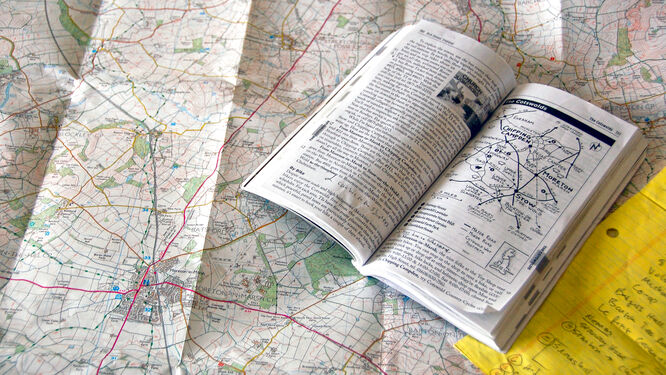
Guidebooks are $25 tools for $3,000 experiences. Many otherwise smart people base the trip of a lifetime on a borrowed copy of a three-year-old guidebook. The money they save in the bookstore is wasted the first day of their trip, searching for hotels and restaurants long since closed. As a writer of guidebooks, I am a big believer in their worth. When I visit somewhere as a rank beginner — a place like Belize or Sri Lanka — I equip myself with a good, up-to-date guidebook and expect to travel smart. I travel like an old pro, not because I'm a super traveler, but because I have reliable information and I use it. I'm a connoisseur of guidebooks. My trip is my child. I love her. And I give her the best tutors money can buy.
Too many people are penny-wise and pound-foolish when it comes to information. I see them every year, stranded on street corners in Paris, hemorrhaging money. It's cascading off of them in €100 notes. These vacations are disasters. Tourists with no information run out of money, fly home early, and hate the French. With a good guidebook, you can come into Paris for your first time, go anywhere in town for less than $2 on the subway, enjoy a memorable bistro lunch for $15, and pay $120 for a double room in a friendly hotel (with a singing maid) on a pedestrian-only street a few blocks from the Eiffel Tower — so French that when you step outside in the morning, you feel you must have been a poodle in a previous life. All you need is a good guidebook.
Before buying a book, study it. How old is the information? The cheapest books are often the oldest — no bargain. Who wrote it? What's the author's experience? Does the book work for you — or for the tourist industry? Does it specialize in hard opinions — or superlatives? For whom is it written? Is it readable? It should have personality without chattiness and information without fluff.
Don't believe everything you read. The power of the printed word is scary. Most books are peppered with information that is flat-out wrong. Incredibly enough, even this book may have an error. Many "writers" succumb to the temptation to write guidebooks based on hearsay, travel brochures, other books, and wishful thinking. A writer met at the airport by an official from the national tourist board learns tips that are handy only for others who are met at the airport by an official from the national tourist board.
Europe is always changing, and guidebooks begin to yellow even before they're printed. It's essential to travel with the most up-to-date information in print. Most guidebooks get an update every two or three years, but a handful of titles (like most of mine) are actually updated in person each year. The rule of thumb: If the year is not printed on the cover, the guidebook is not updated annually (and you'll have to check the copyright information page — usually just inside the front or back cover — to see when it was most recently updated). When I'm choosing a guidebook for a trip, the publication date is usually the single most important factor in which one I buy.
While travel information is what keeps you afloat, too much information can sink the ship. I buy several guidebooks for each country I visit, rip them up, and staple the pertinent chapters together into my own personalized hybrid guidebook. To rip a book neatly, bend it over to break the spine, score it with a utility knife, and pull chapters out with the gummy edge intact — or just butcher and staple. Bring only the applicable pages. There's no point in carrying 120 pages of information on Scandinavia to dinner in Barcelona. When I finish seeing a country, I give my stapled-together chapter on that area to another traveler or leave it in my last hotel's lounge.
You can buy guidebooks at any major bookstore. But most large cities have at least one good bookstore that specializes in travel, with knowledgeable salespeople and a great selection. Ask around or search the Internet to find one near you.
Travel Literature
Consider some trip-related recreational reading. A book on the court of Louis XIV brings Versailles to life. Books such as James Michener's Poland or Iberia (for Spain and Portugal), Irving Stone's The Greek Treasure for Greece and Turkey, William Wordsworth's poems for England's Lake District, and Leon Uris' Trinity for Ireland are real trip bonuses. After reading Stone's The Agony and the Ecstasy, you'll visit dear friends in Florence — who lived there 500 years ago. Personal accounts are fun and vivid, such as Notes from a Small Island by Bill Bryson (on Britain), Peter Mayle's Provence books (on himself), and the Travelers' Tales series (on Ireland, France, Paris, Provence, Italy, Tuscany, Spain, Prague, Greece, and Turkey).
Maps
European travelers have needed good maps since the days of Alexander the Great. But with so many choices, it's hard to know where to start.
Maps and atlases are sold at European gas stations, bookshops, newsstands, and tourist shops. The only reason to buy a map before your trip is for general planning purposes. Once you get to Europe, compare maps side by side. Many travelers prefer Michelin maps, but other quality European brands include Hallwag, Freytag Berndt, Marco Polo, AA (Britain's AAA-type automobile club), and Kod & Kam. The Michelin 705 Europe map provides an excellent overall view of Europe. Many guidebook publishers (including Rough Guides, Lonely Planet, Let's Go, and Rick Steves) are now making maps or combination map-guidebooks. For example, my series of European planning maps are designed to be used with my guidebooks.
Here are some tips for choosing and using a map:
- Decide the scope of the map you need. Your main decision when choosing a map is its purpose. Do you want an overview map or a map of a specific region or city? Are you driving? Bicycling? Walking? Traveling by rail?
- Understand the scale. European maps indicate their scale with a ratio (such as 1:100,000). The lower the second number on the ratio, the more detailed the map. A 1:100,000 scale means that one centimeter on the map equals 100,000 centimeters (or one kilometer) in real life. A basic all-Europe map, such as the Michelin 705, has a scale of 1:3,000,000 — perfectly fine for overall route planning. But if you're exploring a specific region by car, you need something more detailed (such as 1:200,000). If you're biking, you could use even more detail (1:100,000 or 1:50,000). Obviously, the more detailed a map is, the more information it can show — but some overachiever maps are so crammed with detail that they become hard to read. Figure out the level of detail you need and purchase accordingly.
- Drivers require first-class maps. The free maps you sometimes get from your car-rental company usually don't cut it. Drivers need detail, especially when focusing on a specific region. I like Michelin maps (various scales, about $11 each, cheaper in Europe). But the cost for these maps can add up, so consider the popular and relatively inexpensive Michelin road atlases for each country (1:200,000, about $22 each with good city maps and detailed indexes). Though they can be heavy, atlases are compact, a good value, and easier for drivers to use than big fold-out maps. Sometimes the best regional maps are available locally. For example, if you're exploring your roots in the Norwegian fjord country, Cappelens 1:200,000 maps are detailed enough to help you find Grandpa Ole's farm.
- Cyclists and walkers also need highly detailed maps. Maps at 1:200,000 scale may not show cyclists the off-the-beaten roads. Maps that have even more detail, at 1:100,000 or 1:50,000 (good for walkers), are more helpful but harder to find. Consider OS Ordnance Survey (Britain), Michelin (throughout Europe), IGN's Blue series (good for France), Touring Club Italiano (Italy), and Die Generalkarte (Germany). Elevation gain and loss is a major concern for those traveling by two wheels or two feet. Make sure the map shows general elevation gain with contour lines and/or indicates the steepness of roads (sometimes with small Vs on the road). You'll be outdoors most of the time; maps are rarely waterproof, so keep yours in a plastic pouch.
- Train travelers can get by with less-detailed maps. By train, you can usually wing it with the map that comes free with your railpass, though some more detailed rail-line maps are available.
- Smart sightseers use city maps. For an extended stay in a sprawling city, I make a point of buying a good city map immediately upon arrival. While guidebooks come with black-and-white (and sometimes color) maps of big cities, they're generally small, and intended only to give you an overview of the place. A detailed, fold-out map can save you endless time and frustration. You can often get a decent map free at the local tourist office. Many city maps sacrifice important town-center detail by trying to show the entire city (including the suburbs, where you probably won't go). If choosing a city sightseeing map, make sure the city center is detailed enough, since that's where you'll be spending most of your time.
- Look for clarity and durability. Choose a map that's clear and easy to read. Check to see that the map has crisp lines that don't bleed into one another. Size is another important factor: The bigger the map, the more chance for detail — but the harder it is to use and refold. Also consider durability. A map you plan on using for your entire five-week trip should hold up to constant folding and unfolding (not to mention a few raindrops). A cardboard or plastic cover on the map will help it last longer, but it adds weight.
- Learn the legend. Spend half a traffic jam studying the key. Each map has a legend that indicates navigational as well as sightseeing information, such as types of roads, scenic routes and towns, ruined castles, hostels, mountain huts, viewpoints, and so on. Good maps even include such specific details as tolls and opening schedules of remote mountain roads. When estimating how long a trip will take, figure you'll average 100 kilometers per hour on expressways (about the same as going 60 mph back home). Determining how much ground you can cover off the freeway is a crapshoot. I use a trick an Irish bus driver taught me: Figure a minute for every kilometer (covering 90 km will take you about an hour and a half). Double that for slow, curvy roads (such as in Italy's Dolomites or on the Amalfi Coast). Normally, the more digits the road number has, the smaller it is. In Britain, M-1 is a freeway, A-34 is a major road, and B-4081 is a secondary road. Roads are labeled on many maps with both national and European designations — for example, the same expressway from Madrid to Sevilla may be labeled N-IV, E-5, or both. As road numbers change, it's often best to navigate by town names.es.
Talk with Other Travelers
Both in Europe and here at home, travelers love to share the lessons they've learned. Learn from other tourists. Firsthand, fresh information can be good stuff. Keep in mind, however, that all assessments of a place's touristic merit are a product of that person's personality and experiences there. It could have rained on her parade, he could have shared an elevator with the town jerk, or she may have been sick in "that lousy, overrated city." Or he might have fallen in love in that "wonderful" village. Every year, I find travelers hell-bent on following miserable travel advice from friends at home. Except for those found my books, treat opinions as opinions.
Take advantage of every opportunity (such as train or bus rides, or online discussion boards such as the Graffiti Wall) to swap information with travelers you meet from other parts of the English-speaking world. This is particularly important when traveling beyond Western Europe.
The Internet
The Internet is filled with free online travel talk. Various Web sites offer global weather reports, news, travel advice, visa information, and flight- and hotel-reservation services. Vagabonds between trips hang out in travel forums. To get started, check out my favorite links.
Classes
The more you understand a subject, the longer it stays interesting. Those with no background in medieval architecture are the first to get "cathedraled out." Whether you like it or not, you'll be spending lots of time browsing through historic buildings and museums. Those who take trip-related classes beforehand have more fun sightseeing in Europe.
Art history is probably the most valuable course for the prospective tourist. Don't go to Europe — especially Italy or Greece — without at least having read something on art and architecture.
If you live in the Seattle area, join us for one of the free classes we offer at my Travel Center every Saturday.
Travel Videos and DVDs
My series Rick Steves' Europe (with 70 episodes now airing on more than 300 public television stations throughout the United States) takes a fresh look at well-loved destinations and introduces new favorites.
Three of my TV episodes are actually a "how to travel" miniseries. This 90-minute "Travel Skills Special" covers my most important travel tips, filmed on location at my favorite European destinations. Rick Steves' Europe: The Making Of takes you behind the scenes as my crew and I shape our own travel challenges and surprises into a finished show.
To get in the Christmas spirit, check out Rick Steves' European Christmas, a 60-minute look at how seven different European cultures celebrate the holidays.
Video clips of my shows — or "vodcasts" — are also available for free on iTunes, where you can download them to watch on your computer or iPod (www.itunes.com). For more information on my shows, check out my television homepage.
Travel with Rick Steves on Public Radio and Podcast
My weekly hour-long radio show, Travel with Rick Steves, is broadcast by a growing number of stations around the country, including public radio, satellite radio, and as an on-demand podcast. It's a great opportunity to hear a wide variety of experts explain what tickles their travel fancy. My guests — who pack their interviews with practical travel tips — have included guidebook writers, local tour guides, a French philosopher, and even the Princess of Norway. The show also provides a venue for our enthusiastic and well-traveled community of listening Road Scholars to ask questions and share tips. For a list of radio stations carrying the show, the latest on upcoming topics, and details on how to join in the conversation yourself, see www.ricksteves.com/radio.
On my website, more than three years' worth of archived shows cover a wide range of destinations and travel topics. From France to the Four Corners, from Tuscany to Tanzania, from Dubrovnik to Dubai, from Germany to the Galapagos Islands — plus tips on French food, Italian wine, romance on the road, overcoming the fear of flying, and lots more — there's information for any itinerary. Pick and choose from the interviews, download them for free as podcasts, then listen to them on your MP3 player as you prepare for your trip...or as you travel.
Rick Steves Audio Tours
At most major European museums, you can rent audioguides that offer a dry headphone commentary on the great works of art. If you prefer your art-history information in a light, easy-to-digest style, consider my new free audio tours — just like the ones I give to my tour groups. These guided MP3 walking tours are available at www.ricksteves.com/audiotours. Download the tours to your MP3 player (such as an iPod) before you go, take them with you to France, and let me lead you through the Louvre, Orsay, Versailles, and the historic core of Paris. More audio tours — including some for Italy's top sights — are coming soon.
At most major European museums, you can rent audioguides that offer a dry headphone commentary on the great works of art. If you prefer your art-history information in a light, easy-to-digest style, consider my new free audio tours — just like the ones I give to my tour groups. These guided MP3 walking tours are available here. Download the tours to your MP3 player (like an iPod) before you go, take them with you to France, and let me lead you through the Louvre, Orsay, Versailles, and the historic core of Paris.
Tourist Information Offices
Tourism is an important part of Europe's economy. Just about every European city has a tourist information office (abbreviated as TI in my books) located downtown and loaded with maps and advice. This is my essential first stop upon arrival in any town. But you don't need to wait until you get to Europe. Each European country has its own official tourism website — a great first stop when you begin researching your trip. Many of these sites are packed with practical information, suggested itineraries, interactive maps, colorful photos, and free downloads of vacation planning kits or brochures. Most also allow you to order printed materials by snail mail. For an extensive listing of tourist boards, see www.towd.com.
In addition, nearly every European country has a national tourist office in the United States with a healthy promotional budget. Switzerland, for instance, figures you'll be doing the Alps, but you've yet to decide if they'll be French, Swiss, or Austrian Alps. They are happy to send you a free package of promotional information to put you in a Swiss Alps frame of mind. Use the form on their website, send an email, or call the office of each country you plan to visit. Ask for specific information to get more than the general packet. If you want to sleep in a castle on the Rhine, river-raft in France, or hut-hop across Slovenia, there's a free brochure for you. Ask for an English-language schedule of upcoming events and for maps of the country and various cities you'll be visiting. I find it's best to get answers to specific questions by telephone.
See our list of European national tourist offices, which includes contact information.
Updated for 2008. For lots more tips, check out our best-selling Europe Through the Back Door travel skills guidebook.