
Cart Help
Home > Railpasses

Plan Your Rail Trip

Rail route maps

Rick on a train in the Cinque Terre
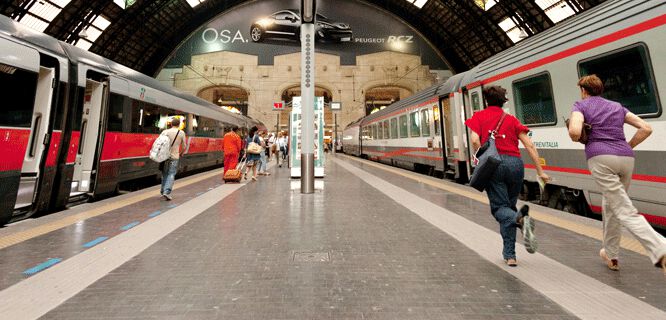
Europe's trains can even take you from big cities...to off the beaten track.

Through this link, you can Request Printable Rail Maps for our favorite places in Europe.  We'll quickly e-mail you connections to download ten regional maps (you'll need Acrobat Reader to view and print).  While these maps don't show every rail line or stop, they'll help you plan a trip to destinations covered in Rick Steves' guidebooks.  If you don't find your town on a map, you can check that it has rail service by searching for a schedule on Deutsche Bahn's website

Quick and dirty itinerary planning

Ever wonder how some speedy travelers can prioritize their sightseeing when they're on a tightly squeezed schedule? And stay relaxed? Wonder no more. Here's a simple itinerary-building spreadsheet, excerpted from "Rick Steves' Europe Through the Back Door." Start with the basic sights we've listed in the "3 Days" column. If you can add more days, keep adding sights to the right. In some cases, the plan assumes you'll take a night train. In 14 days, you should be able to cover everything in that row without stressing yourself out too badly. So according to this chart, the best week in Britain would be spread between London, Bath, Cambridge, and the Cotswolds.


3 days 5 days 7 days 10 days 14 days
Europe Forget it. London,
Paris
Amsterdam Rhineland,
Swiss Alps
Rome,
Venice
Britain London Bath Cambridge, Cotswolds
York Edinburgh,
N. Wales
Ireland Not worth it Dublin, Dingle Peninsula Galway, Burren Kinsale and south coast Belfast, Antrim Coast, Aran Islands
France Paris,
Versailles
Loire,
Chartres
Normandy Arles,
Nice, Riviera
Chamonix,
Burgundy
Germany Rhine,
Munich
Romantic
Road, Rothenburg
Bavarian
sights
Berlin Black Forest, Mosel, Köln
Austria Salzburg,
Vienna
Danube
Valley, slow down
Hallstatt Innsbruck, Hall, more Alps
Switzerland Bern and
the Berner
Oberland
French
Switzerland, Murten
Luzern, Appenzell
Zermatt and scenic rail trips Lugano, Zurich
Italy Rome Florence,
Venice
Italian
Riviera
Siena, hill towns Milan and
Lake Como
Scandinavia Copenhagen, side trips Oslo
Stockholm "Norway in a Nutshell," Bergen Helsinki,
Tallinn
Spain & Portugal Madrid,
Toledo
Lisbon Barcelona Andalucia, Sevilla
Algarve
Eastern Europe Prague Budapest Krakow, Auschwitz Slovenia, Cesky Krumlov Dalmatian Coast, Dubrovnik

Back to topTrain schedules: breaking the code

Schedule and route planning is easier than ever on the Internet. For all of Europe, including small towns and international connections, try the Deutsche Bahn's website. You can print just the schedules you need.  Tips for using it are below.

The Thomas Cook European Rail Timetable (all train lines, some ferries, and lots of confusing footnotes; 550 pages; published monthly) can be delivered from Europe for £15 postpaid. See www.thomascookpublishing.com or call 011-44-1733-4164-77.

Sample Train Schedule
Train schedules are sign language masterpieces. For example, at 11:55 a.m. on "workdays" a Thalys train leaves the Paris North station, arriving in The Hague at 3:58 p.m. It requires seat reservations, has a dining car, and has us changing trains en route at the Brussels Midi station. The train departing at 11:16 p.m. includes couchette bunks, and arrives at The Hague at 7:09 the next morning with no train change. (Excerpted from the 90-page Eurail timetable booklet, which is included with railpass purchases.)

You can always find train schedules at any station in Europe. They come in many forms: posters (with departures on yellow, arrivals on white), airport-type departure schedules that flip up and list the next eight or ten departures, handy pocket-sized schedules for popular routes, and computer kiosks (spreading quickly across Europe).

Personnel at the train station information window can confirm your plans. Once aboard, you'll find that many express trains are littered with route programs that describe everything about that train.

Learn to use the 24-hour clock used in European train timetables. After 12:00 noon, the Europeans keep going — 13:00, 14:00, and so on. To convert to the 12-hour clock, subtract 12 and add p.m. (16:00 is 4 p.m.).

Any schedule includes information on both directions between destinations (Dijon to Paris and Paris to Dijon) and has a section explaining the many exceptions to the rules. An "X" in a box means you'll have to change trains, an "R" in a box means reservations are required for that departure, crossed silverware means a dining car, crossed hammers indicate that the train goes only on workdays (daily except Sundays and holidays), a cross means the train goes only on Sundays and holidays, and a picture of a little bed means the train has sleeping compartments, which come in "couchette" and "sleeper" varieties.

The example on this page shows departure times in the left column and arrival times on the right. Most timetables also include the arrival and departure times for any required train changes.


Tips for Finding Train Schedules on the Deutsche Bahn website:

Follow this link to the Deutsche Bahn website: http://bahn.hafas.de/bin/query.exe/en.

Start and destination: Enter just the two city names, unless you know the name of the station you want.

Required fields: Only the "From" and "To" fields are required before you can click on "Search Connections." Date, Time, Means of Transport, and other fields are all optional.

Spelling: Use the local European spelling of town names. (You'll find these in a good map or guidebook of Europe.) Here are some examples:

Choosing a station: The Deutsche Bahn system may ask you to re-select a station from a list of options. Keep in mind:

a. If the city is listed again (without station name), re-select that choice.

b. You do not always have to make the right choice. Sometimes the DB will make a correction before providing the schedule. In other cases, the schedule will include a connection by train, bus, or subway from the "wrong" station to the main station.

c. Main stations are often called "central," "terminus," "bahnhof," or "hauptbahnhof (hbf)."

d. A very long list probably includes bus stops in the same town. Back up to the query page and type any city "hbf."

Pricing: The DB website provides ticket prices within Germany and for some international trips that originate in Germany. If the system brings up a "Pricing" section, simply fill in any age and click the "Continue" button. Most tourists will not have a Bahn Card or Rail Plus discount.

More schedules:  The overview will show you three departures around the time you entered.  Click the links for "Earlier" or "Later" to see more departures (up to a dozen on one page).

More detail: At the bottom of the schedule results, you'll find buttons to access more detail. The first level includes location and times for any change of train. Further links on the Detail page allow you to see major stops along the way.

Date of travel: Schedules change seasonally around June 10, Sept. 10, and Dec. 10 (though changes are often small). The DB website posts updates as soon as they are available. Even if your trip is several months in the future, this is still the best planning tool. You can enter an earlier date for a fairly accurate idea of the schedule.

Footnotes: "Compulsory reservation" means what it says, while "Please reserve" is recommended but optional. "International supplement" notes do not apply with railpasses.

Alternate routes: This system shows the most direct and practical routes between two points. To design your own detour, add a "Via" (midpoint) city on the query screen.

Coverage: The DB website is the most complete resource for train schedules throughout Europe. If your destination is not covered (and if you spelled it correctly), that's a good sign that it doesn't have train service. For a comprehensive list of each country's railway sites, go to www.railfaneurope.net.

Printing: Once you've found the schedules and level of detail your want, click the link for "Print View" to get a more easily printed page.

New Query: The "New Query" button brings you to a fresh starting page. Use the "Change" button to change a few features of your original request.


Ferry schedules

Our new favorite, www.aferry.to links to most international ferry websites.  Dan Youra's page at www.youra.com may also be useful.


Back to topTransportation costs for ten great trips

Looking for a place to start? Here is a quick analysis of transportation options for my favorite two- or three-week itineraries as described in my guidebook for that country or region (all rates are approximate and subject to change; all are per person for two traveling together; driving options include taxes, CDW, gas, and some parking in big cities).

Three Weeks in Europe

Route: Amsterdam Rhineland Romantic Road Tirol Venice Florence Rome Italian Riviera Swiss Alps Beaune Paris.

For this plan, let your dreams rather than the cost dictate your choice:

Three Weeks in Great Britain

Route: London Bath Cardiff Cotswolds North Wales Windermere Oban Edinburgh Durham York Cambridge London.

Three Weeks in France

Route: Paris Normandy Brittany Loire Carcassonne Provence Alps Burgundy Alsace Paris.

Three Weeks in Scandinavia

Route: Copenhagen Kalmar Stockholm Helsinki Stockholm Oslo fjords Bergen Århus Ærø Copenhagen.

Three Weeks in Italy

Route: Milan Cinque Terre Florence Siena Rome Naples Paestum Venice Dolomites Como Milan.

Three Weeks in Germany & Austria

Route: Frankfurt Rhine Black Forest Reutte Hallstatt Vienna Salzburg Munich Rothenburg Nürnberg Dresden Berlin.

Two Weeks in Switzerland

Route: Zurich Appenzell Luzern Lugano Pontresina Zermatt Lausanne Berner Oberland Zurich.

Three Weeks in Ireland

Route: Dublin by train to Kilkenny, train to Waterford, train and bus to Kinsale, bus to Kenmare, bus to Dingle, bus to Galway, bus to Westport, bus to Derry, train to Portrush, train to Belfast, train to Dublin.

Three Weeks in Spain & Portugal

Route: Madrid by train to Salamanca, train to Coimbra, train to Lisbon, train to Algarve, bus to Seville, bus to Gibraltar, bus to Nerja, bus to Granada, train to Toledo, train to Madrid.

Three Weeks in Eastern Europe

Route: Prague Krakow Eger Budapest Ljubljana Bled Zagreb Plitvice by bus Split by bus Korcula by boatDubrovnik by boat.

All destinations mentioned here are covered in Rick Steves' guidebooks, available at your local bookstore or from Rick Steves' Travel Store.


Back to topFine-tune your itinerary with a one-on-one planning session

Planning your dream trip should never turn into a nightmare.  But if the complexities of railpass features, sightseeing priorities, and even packing are stressing you out, we can help.  We've been there — lots of times.  If you have a lot of questions and/or a complex trip to plan, consider scheduling a personalized, in-depth trip consultation with one of our experienced travel advisors.  See our Trip Consulting page for the details.