

Andalucía: The Best of Southern Spain
Join Rick as he weaves Andalucía's rich mix of culture, cuisine, history, and natural wonders into a 60-minute special. The hour includes the major cities of Sevilla, Córdoba, and Granada; flamenco, sherry, and horses; dramatic white-washed hill towns; and fun in the Costa del Sol sun — plus a dash of Britain in Gibraltar.
Content: Segments from three half-hour episodes of Rick Steves' Europe: 605 Granada, Córdoba, and Spain's Costa del Sol, 606 Andalucía, Gibraltar, and Tangier, and 313 Sevilla — woven together with additional footage. Length: 55 minutes. Release 2010.
Promotional Tool Kit
Program Descriptions
RICK STEVES ANDALUCíA: THE BEST OF SOUTHERN SPAIN (
RSAS, 1/60, TV-G, Stereo, CC)
Andalucía: The Best of Southern Spain [53 words]
Join Rick as he weaves Andalucía's rich mix of culture, cuisine, history, and natural wonders into a 60-minute special. The hour includes the major cities of Sevilla, Córdoba, and Granada; flamenco, sherry, and horses; dramatic white-washed hill towns; and fun in the Costa del Sol sun — plus a dash of Britain in Gibraltar.
Andalucía: The Best of Southern Spain [83 words]
For many travelers, the quintessence of Spain is found here — Andalucía. The fascinating sights, sounds, and experiences of Southern Spain are shaped by waves of history.
Rick Steves' Andalucía: The Best of Southern Spain weaves the region's rich mix of culture, cuisine, history, and natural wonders into a 60-minute special. The hour includes the major cites of Sevilla, Córdoba, and Granada; flamenco, sherry, and horses; dramatic white-washed hilltowns; and fun in the Costa del Sol sun — plus a dash of Britain in Gibraltar.
Promotional Media
Click on the images to view the full-sized JPGs. Right-click on the download link to save the image.



Script
This special was compiled from footage from three half-hour episodes of Rick Steves' Europe: "Andalucía, Gibraltar, and Tangier," "Granada, Córdoba, and Spain's Costa del Sol," and "Sevilla." See the Travel Details accordion for each of those episodes for recommendations highlighted in bold in the script below.
Hi, I'm Rick Steves. For many travelers, the quintessence of Spain is found here — Andalucía. The sounds, sights, and experiences of southern Spain are shaped by waves of history.
In this hour-long special we'll enjoy the classic Andalusian experiences in the classic Andalusian places — dazzling Moorish palaces, fiery Gypsy musicians, sunny laid-back beaches, a never-to-forget paella feast, whitewashed hill towns, somber religious processions followed by flamboyant flamenco revelry, a mighty rock drilled through with history and overrun with mischievous monkeys, weeping virgins, and the ultimate spring fair, with pretty dancers and graceful horsemen. Andalucía is a vibrant sangria of civilizations. It's a lifestyle, it's proud...and for many it's the south coast of their travel dreams.
In southwest Europe is Spain. And in the far south of Spain is Andalucía. We start in Jerez, zip over to Granada, enjoy Nerja on the Costa del Sol, explore Córdoba, and check out Ronda. Then, after side-tripping into Gibraltar, we finish in Sevilla.
Andalucía's heritage is alive in today's culture, and it expresses itself in iconic themes. The town of Jerez is famous for three of them: dazzling horses, velvety sherry, and a spring fair that brings out the entire community for a week-long party.
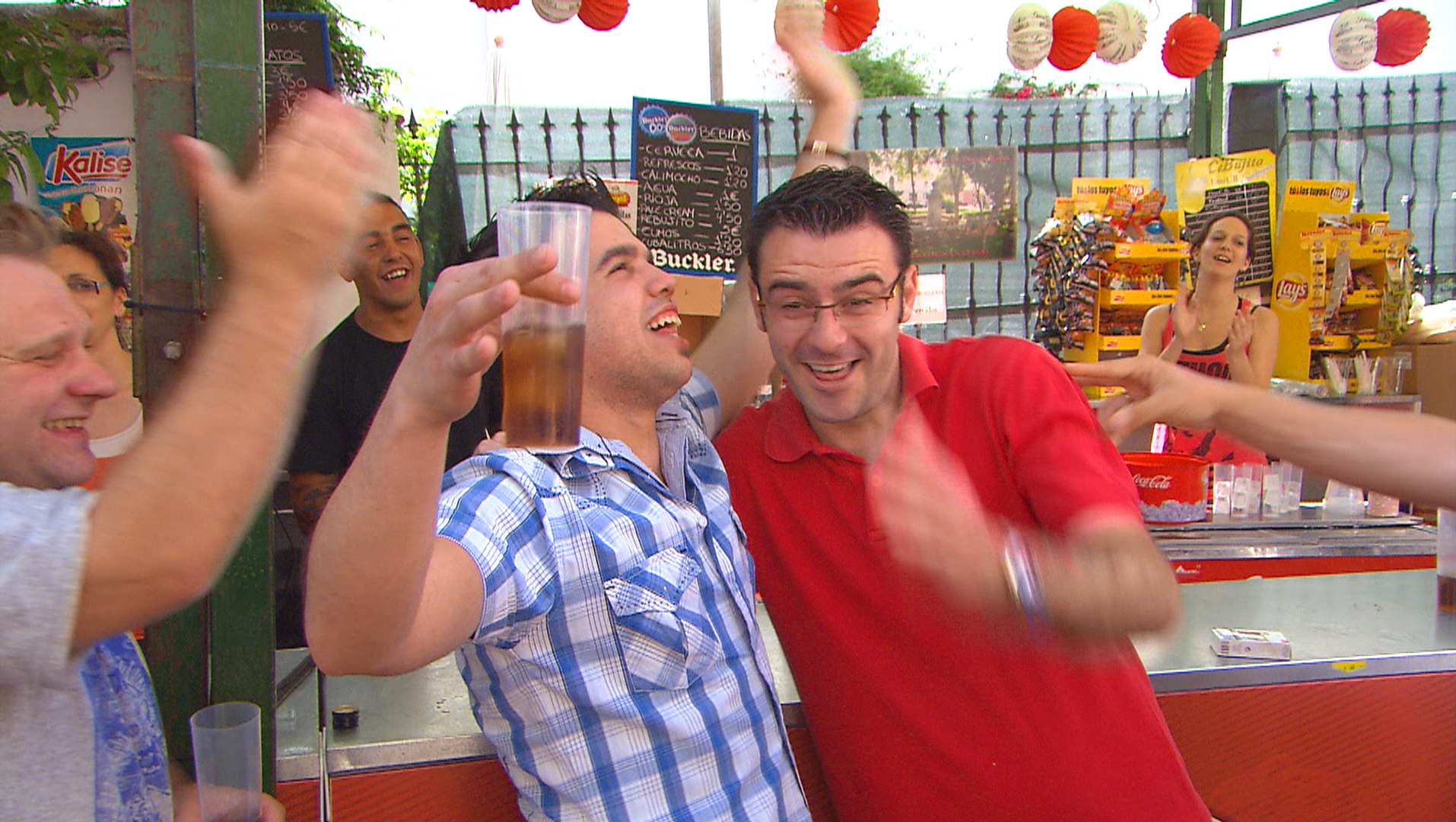
Originally a horse fair, when the sherry producers joined in, it got really big. Today, the Jerez Fair is a vast collection of over 200 casetas (or tents) — each owned by a family or local business who host parties until late into the night. For locals, the fair, which takes please early each May, kicks off the summer season.
During the day, the fair grounds are jangling with fancy carriages. It's all about fine Andalusian horses...and the proud traditions they represent. Women, dressed in their peacock finery, seem ready to break into dance at the click of a castanet.
Just down the street, the Royal Andalusian School of Equestrian Art provides a foundation for this culture of horses. Performances pack its arena several times a week.
This is exquisite horsemanship. The stern riders and their obedient steeds perform to the delight of both tourists and horse aficionados.
The riders cue the horses with the slightest of commands, whether verbal or with body movements. The horses are bred and trained to be balanced and focused — both physically and mentally. The equestrian school functions like a university, open to students from around the world.
And all over Jerez, sherry bodegas welcome visitors. Just around the corner from the horse school, the venerable Sandeman Winery has been producing sherry since 1790.
Tours explain how the stacked barrels are part of the production process. In a time-honored tradition, new wine is blended with aged wine, which is then fortified with alcohol.
The vintner shares his product with a passion and finesse that mirrors the richness of the sherry tradition. And the crowd-pleasing finale of every tour is a chance to enjoy the finished sherry.
Throughout the countryside of Spain sherry is advertised with huge billboards...or bullboards in this case. This big bull is the icon of another sherry producer. Next is a major stop in any Andalucían visit, Granada.
Sprawling at the foot of the snow-capped Sierra Mountains, Granada is a thriving city of about 300,000 people. Visitors focus on its old center, where life has a gentility that belies its illustrious past.
Once the grandest city in Spain, its power ebbed and glory faded. It was appreciated mostly by Romantic Age artists and poets. Today, it has a Deep South feel — a relaxed vibe that seems typical of once-powerful places now past their prime. In the cool of the early evening, the community comes out and celebrates life on stately yet inviting plazas.
The story of Granada is all about the Islamic Moors. In the year 711, these North African Muslims crossed the Strait of Gibraltar and quickly conquered the Iberian Peninsula, eventually converting most of its inhabitants. Throughout the Middle Ages — for over 700 years — Spain was a predominantly Muslim society, living under Muslim rule.
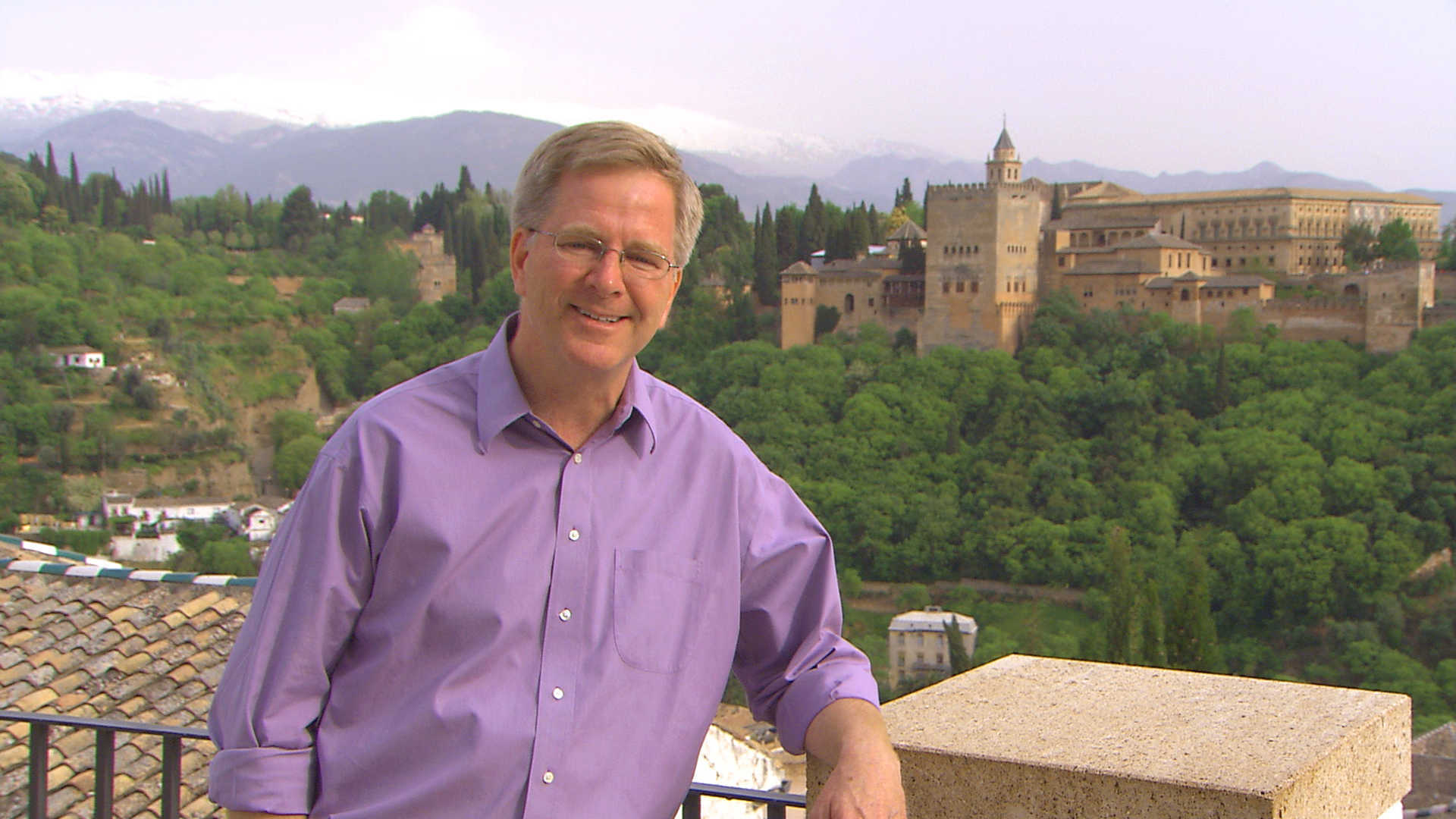
And that age shapes today's sightseeing agenda. Granada's dominant sight is the Alhambra, the last and greatest Moorish palace. Nowhere else does the splendor of that civilization, Al-Andalus, shine so brightly.
For two centuries, until 1492, Granada reigned as the capital of a dwindling Moorish empire. As Christian forces pushed the Moors further and further south, this palace was the last hurrah of a sophisticated civilization.
While the rest of Europe slumbered through much of the Middle Ages, the Moorish civilization was wide awake. The math necessary to construct this palace would have dazzled Europeans of that age.
The Moors made great gains in engineering, medicine, and even classical Greek studies. In fact, some of the great thinking of ancient Greece had been forgotten by Europe, but was absorbed into Islam, and actually given back to Europe via scholars here in Spain.
The culture of the Moors was exquisite...artfully combining both design and aesthetics.
Facing a reflecting pond, the Hall of the Ambassadors was the throne room. It was here that the sultan, seated Oz-like, received foreign emissaries. Its wooden ceiling illustrates a command of geometry. With 8,000 pieces inlaid like a giant jigsaw puzzle, it symbolizes the complexity of Allah's infinite universe.
Arabic calligraphy, mostly poems and verses of praise from the Quran, is everywhere. Muslims avoid making images of living creatures — that's God's work. But decorating with religious messages is fine. One phrase — "only God is victorious" — is repeated 9,000 times throughout the Alhambra.
Like the sultan, we can escape from the palace into what was the most perfect Arabian garden in Andalucía. This royal summer retreat, lush and bursting with water, was the closest thing on earth to the Quran's description of heaven. In fact, its name — the Generalife — meant essentially that: the Garden of Paradise.
Water — so rare and precious in most of the Islamic world — was the purest symbol of life. Whether providing for its 2,000 thirsty residents, masking secret conversations, or just flowing playfully, water was integral to the space the Alhambra created.
For centuries, Europe struggled to push the Moors back into Africa. This campaign was called the Reconquista. Finally, in 1492, the Moors were defeated. The victorious Christian forces established their rule with gusto here in this last Muslim stronghold.
This victory helped provide the foundation for Spain's Golden Age. Within a generation, Spain's king, Charles V, was the most powerful man in the world.
After the re-conquest, Charles built this Renaissance palace incongruously right in the middle of the Alhambra grounds. It's what conquering civilizations do: build their palace atop their foe's palace. This circle-in-a-square structure was the finest Renaissance palace in all of Spain.
And back downtown, Granada's cathedral facade — also built shortly after the re-conquest — declares triumph as well. In fact, its design is based on a triumphal arch, and it was built over a destroyed mosque.
The adjacent Royal Chapel is Granada's top Christian sight. This fine building provided a fitting resting place for Queen Isabella of Castile and King Ferdinand of Aragon, who ruled during the final Reconquista victory. Spaniards consider this couple the first great Spanish royals.
When these two married, they combined their huge kingdoms. And by merging Aragon and Castile, they founded what became modern Spain. With this powerful new realm, Spanish royalty were able to finance many great explorers — including Columbus — and establish Spain's Golden Age.
The royal tombs are Renaissance in style. The portraits of Isabella and Ferdinand are vital and realistic. They seem to celebrate the humanistic spirit of the Renaissance, and with it, a promising future for Spain.
The gilded altar is all about that Christian triumph: Christ triumphs over sin...and Christendom triumphs over Islam. In fact, reliefs show the eventual forced conversion of Granada's Moors shortly after the Reconquista.
For a time near the end of its Moorish period, Granada was the grandest city in all of Spain. But eventually, with the tumult that came with the change from Muslim to Christian rule, the city lost its power and settled into a long slumber. Today's Granada is a delightful mix of both its Moorish and its Christian past.
The silk market, or Alcaicería, was originally across the street from the main mosque, so today it stands across from the main church. Filled with precious goods — salt, silver, spices, and silk — it was protected within 10 fortified gates.
Today, while a tourist trap housed in a modern reconstruction, this colorful mesh of shopping lanes and overpriced trinkets is fun to explore.
You'll invariably meet persistent Gypsy women pushing their fragrant sprigs and palm reading, and then demanding payment. You can consider them aggressive and annoying...or you can zip up your valuables and have a fun and spirited give-and-take.
A handy minibus service loops from downtown through Spain's best old Moorish quarter, the Albayzín. Increasingly around Europe, minibuses wind locals through narrow lanes of old quarters. Tourists can hop on for a cheap and scenic joyride.
The Albayzín, with flowery patios and shady lanes, is a delight. Exploring these labyrinthine back lanes and inviting neighborhood squares, you feel the Arab heritage that permeates so much of Andalucía. Enjoy a drink on a no-name square...savor the lazy tempo of Granada life.
An alternative community of young people — nicknamed pie de negro, or black feet, for their basic earthiness — hangs out in the Albayzín.
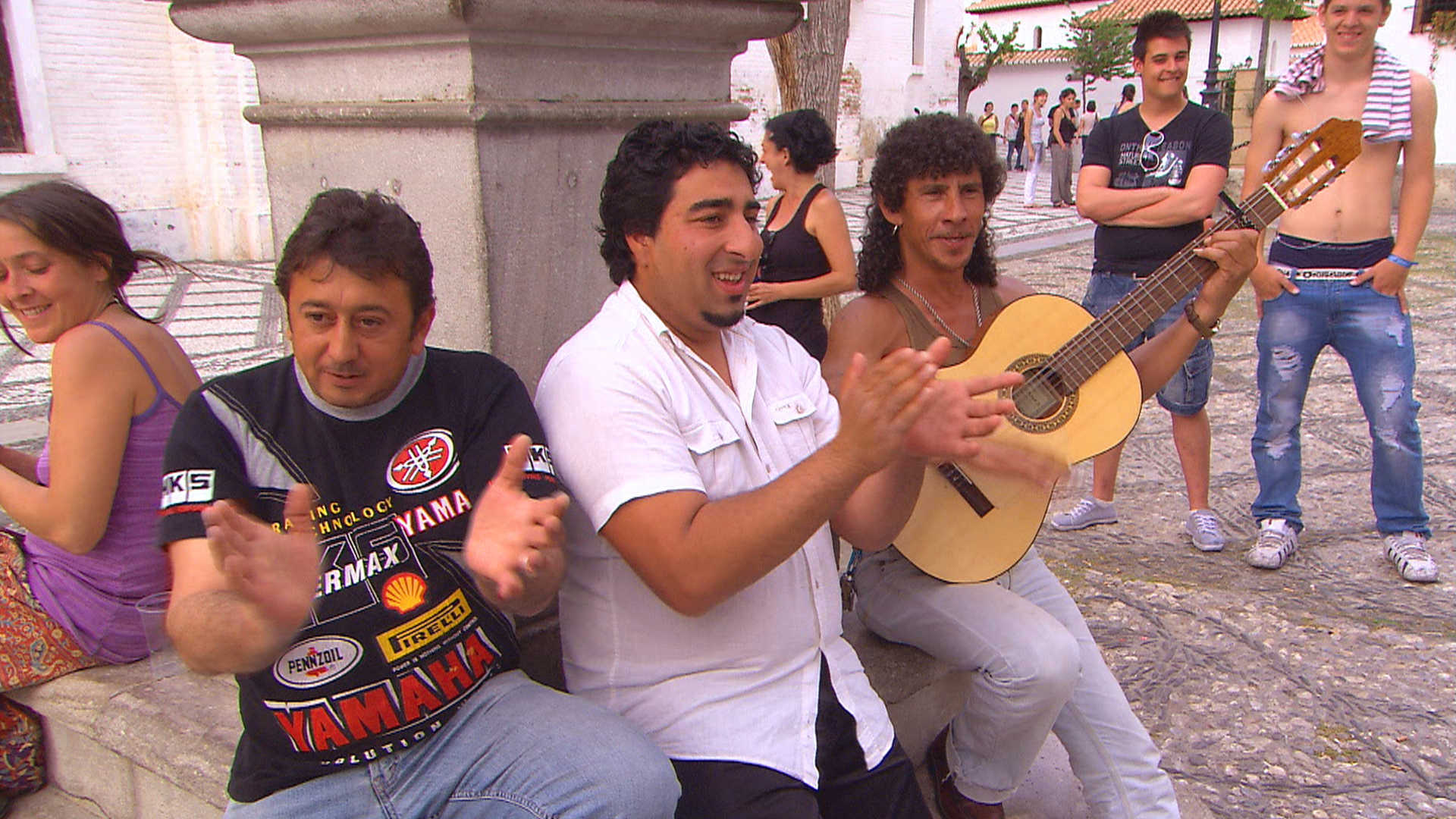
And Granada is home to tens of thousands of Gypsies, or Roma people. While their nomadic culture makes traditional employment a challenge, one vocation in which they excel is music.
In the evening, in the hilly Sacromonte district, Gypsy families entertain tourists with colorful folkloric shows. These intimate concerts are performed in the very caves that once housed Granada's Gypsy community.
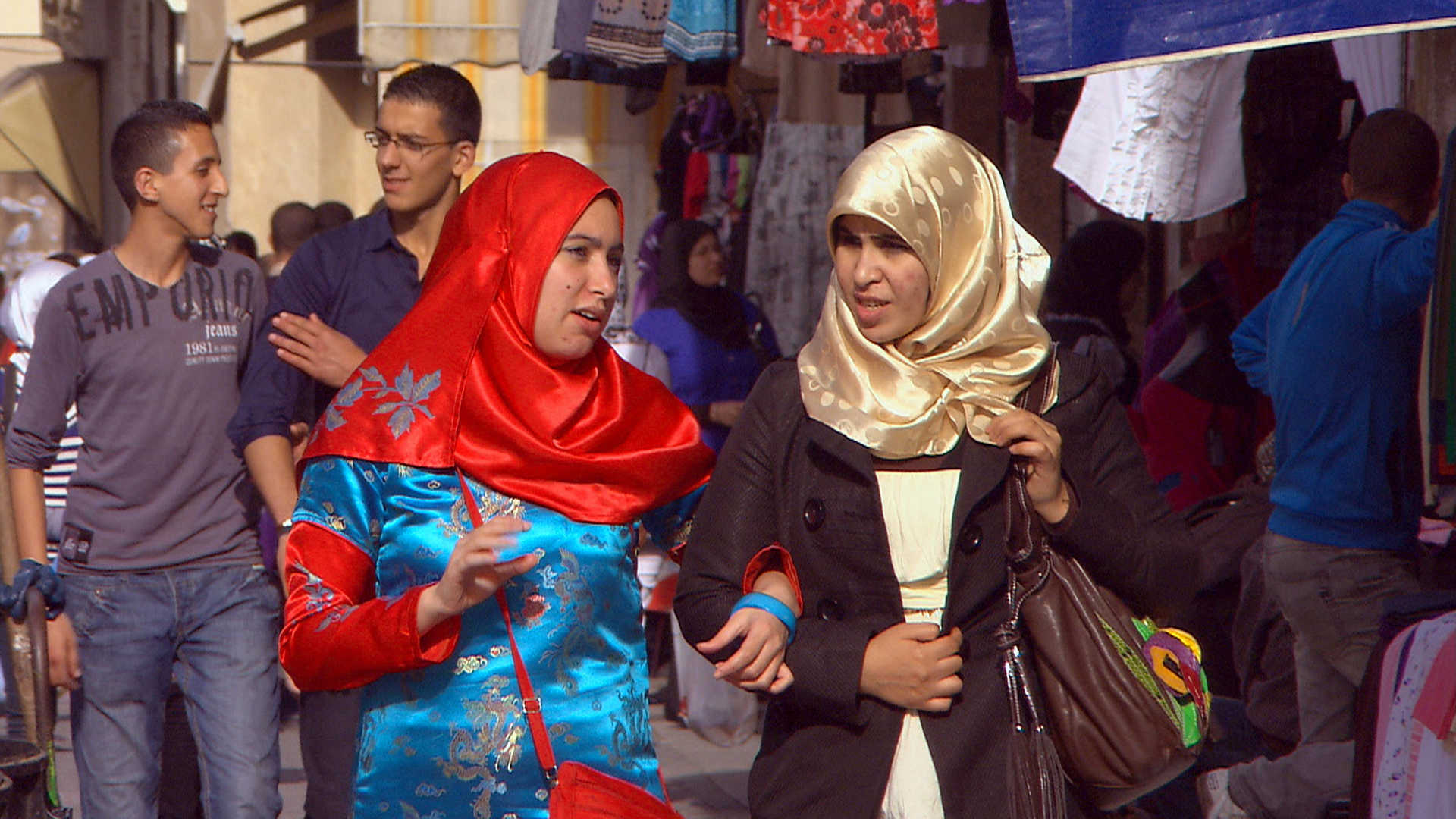
Along with Gypsies and hippies, tolerant Granada has a sizable Muslim population. A modern mosque, built in 2003, fits in with the local architecture and comes with a live call to prayer. The muezzin cries "God is great" from the minaret without amplification...as non-Muslim neighbors insisted.
There are about 700,000 Muslims in Spain, and that includes nearly 10 percent of Granada's residents.
To learn more, we're joined by Malik Basso, a member of Granada's Muslim community.
Rick: Would you say most of the Spanish Muslims are immigrant neighbors coming over from Africa for better jobs?
Malik: Yes — Moroccans, Algerians, Turks, Pakistanis. But of course, there is the recent phenomenon of Spanish Muslims as well.
Rick: You're Spanish?
Malik: Yes. I'm from Barcelona.
Rick: So tell me a little bit about this mosque.
Malik: Well, it was the first mosque built in Granada after the Reconquista. So, for 500 years, this was the first purpose-built mosque in Granada. It was promoted by a lot of people who were native Spanish Muslims, born and raised in Spain, although it caters for all the Muslims.
Rick: So, how has the process been with community relations?
Malik: Well, some people were fearful at first, you know...the effect of the media and such. But 10 years later, here we are. And some of our most vocal opponents are now our best friends, because they appreciate what we are doing and who we are.
The mosque stands next to one of Europe's most romantic viewpoints. From the St. Nicolás Terrace, as the sun sets, locals and visitors alike enjoy both a historical backdrop and a convivial moment.
To extend the magic, grab a prime table at one of the several historic Albayzín manor houses — called carmens — for dinner. You'll pay a bit more, but I can't think of a better way to cap your visit to Granada.
From Granada, it's a two-hour drive over the mountains and down into Europe's fun-in-the-sun headquarters: the Costa del Sol.
I find this strip of Mediterranean coastline generally overbuilt and very commercialized. Málaga, the major city of the coast, is a good place to pass through. And almost anything even resembling a quaint fishing village is long gone — replaced by timeshare condos and golf courses.
The big draw is the beaches. There are plenty of hotels, and sun worshippers enjoy themselves in spite of the congestion and lack of charm or local culture.
Nearly every country from Europe's drizzly north tucks an expatriate community somewhere along this coast. They don't want to leave their culture...just their weather.
My favorite Costa del Sol stop is the resort town of Nerja. While capitalizing on the holiday culture, Nerja has retained some of its charm. The church fronts the square, which fronts the beach...and everybody's out strolling, eventually winding up on the proud Balcony of Europe terrace.
This bluff, jutting jauntily into the sea, overlooks miles of coastline. A castle occupied this spot for centuries.
Nerja's castle was part of a 16th-century lookout system. After Reconquista forces drove out the Muslim...oh, that's right. You don't come to the Costa del Sol for history; you come for fun in the sun...and relaxation.
And relax is what countless expat residents do. Nerja's expats are mostly British. Like many along this coast, they actually try not to integrate. They enjoy their English TV and radio, and many barely learn a word of Spanish.
Nerja has several well-equipped beaches. The one just below town retains its fishing-village charm. Fishermen do their thing, while the tourists do theirs. The humble cottage evokes a bygone day. Spaniards love their little beach restaurants.
A short hike takes us to a broader beach that appeals to different tastes. While it's packed through the summer, we're here in May, when the heat and crowds are just right.
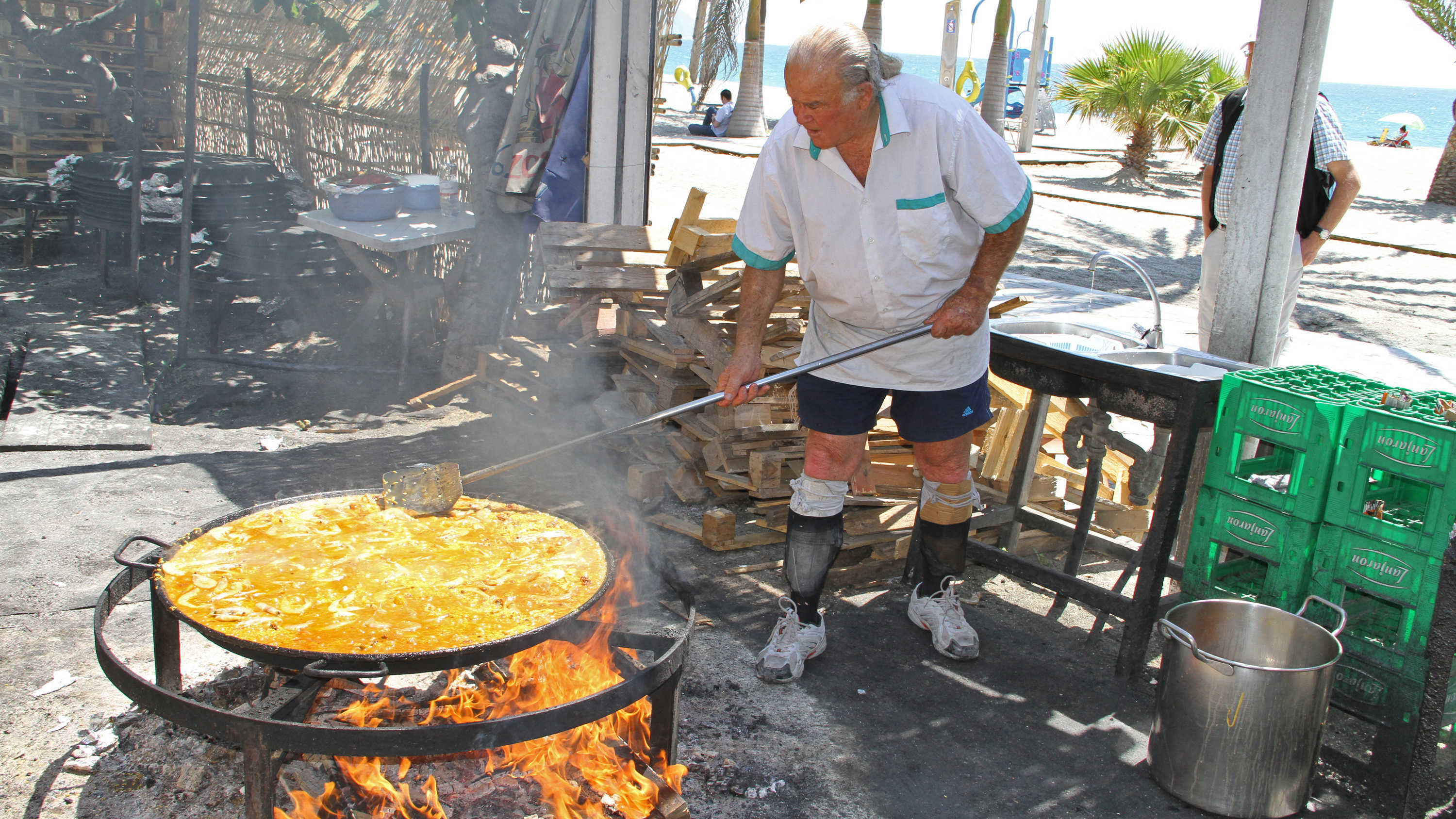
Ayo's place is famous for its beachside all-you-can-eat paella feast. For 30 years, he's been cooking up this classic Spanish specialty.
To create this culinary work of art, start with some junk pallets for fuel, and slip on your handmade heat shields. Then, fry up as many pieces of chicken as can fit in the pan. Add just a pinch of garlic and about a week's-pay worth of saffron. When the chicken is golden-brown, add about a dozen skinned tomatoes and as many red and green peppers as you can stand chopping. Stir everything with a clean shovel. Now add a laundry bin of arborio rice, and just a dash of smoked, sweet pimentos. Stir briskly until the rice has become coated with the oils and spices. Add a few gallons of stock, and bring to a boil. Add another pallet if necessary. Mix in a boatload of fresh, whole shrimp.
When the rice is done, remove — remembering to lift with your knees — and let set for 10 minutes. Now you could just stare at the pretty colors and textures, but I recommend eating it for the full experience. Dish out servings daintily, and garnish with a wedge of lemon. Feeds 48 hungry vacationers. Adjust recipe measurements accordingly.
A 100-mile drive back inland takes us to the city of Córdoba. While Granada was the last Moorish capital, the capital through the glory days of Muslim rule was Córdoba.
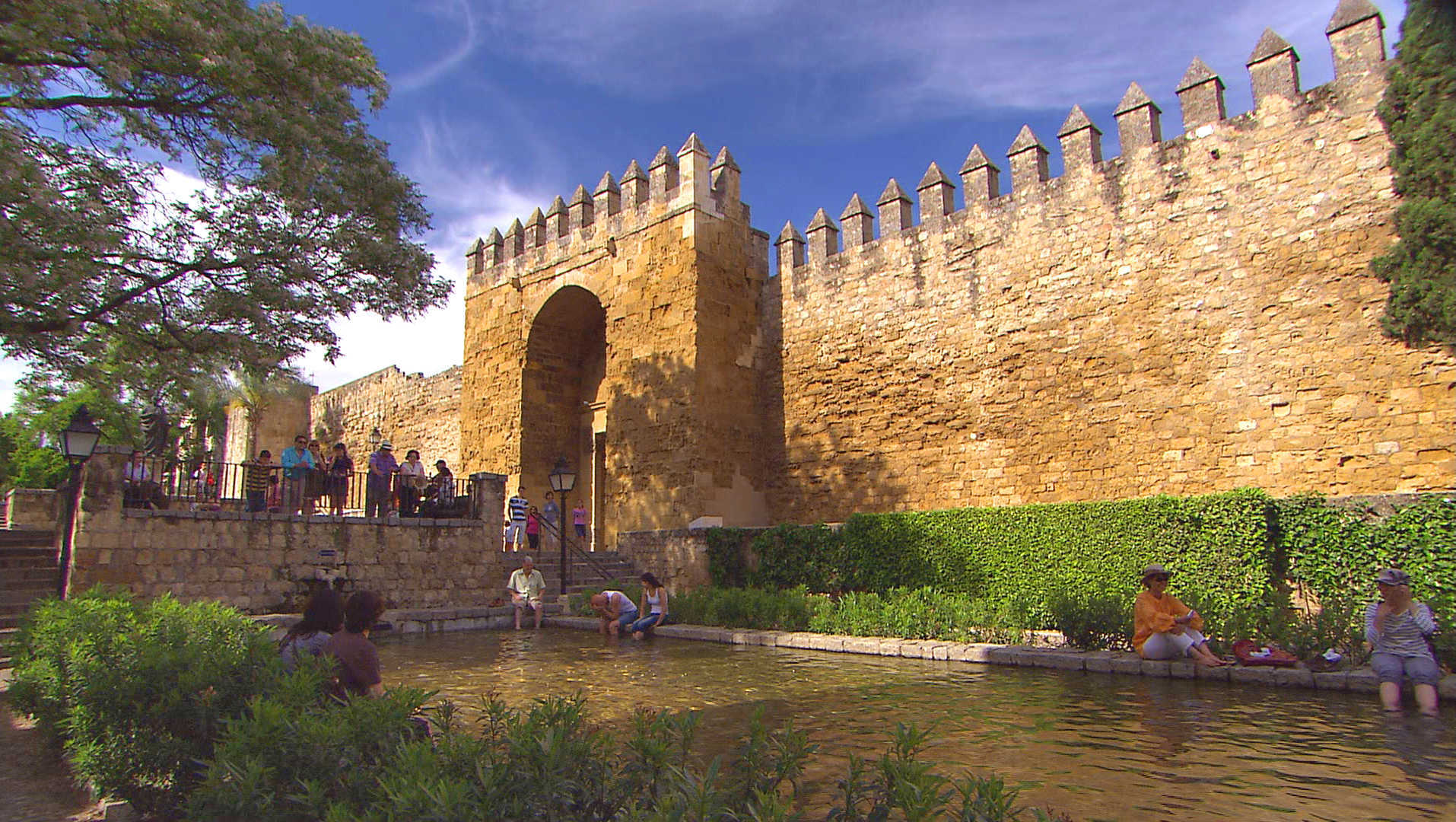
Tucked into a bend of its river, Córdoba has a glorious past. While its old wall evokes a tough history, its elegant cityscape and convivial squares show a modern pride. As is typical of Andalucía, it's a people-friendly city, filled with energy and color.
Córdoba's centerpiece is a massive former mosque — or, in Spanish, Mezquita. This huge rectangle dominates the tangled medieval town that surrounds it.
Grand gates lead to the courtyard. It was here, when this was a mosque, that worshippers would gather to wash before prayer, as directed by Muslim law.
Entering, you step into a forest of delicate columns and graceful arches dating from over 1,000 years ago.
At its zenith, this mosque was the center of Western Islam and the heart of a cultural capital that rivaled Baghdad and Constantinople. A wonder of the medieval world, it's remarkably well-preserved, giving today's visitors a chance to appreciate Islamic Córdoba in its 10th-century prime.
The columns and arches seem to recede to infinity, as if reflecting the immensity and complexity of God's creation.
The mihrab — the focal point of worship in a mosque — was built in the mid-10th century. It's richly mosaicked with 3,000 pounds of tiny, multicolored glass-and-enamel cubes.
A painting in the adjacent treasury takes us back to 1236, when Christians conquered the city and everything changed. Here we see the Spanish king accepting the keys to Córdoba's fortified gate from the vanquished Muslims.
According to legend, one morning Muslims said their last prayers in the great mosque. That afternoon, the Christians set up their portable road altar and celebrated the first Mass in what would later become this glorious cathedral.
As if planting a cross into its religious heart, this grand cathedral was built in the middle of the mosque. Taking two centuries to complete, the cathedral is a glorious mix of Gothic, Renaissance, and Baroque styles.
A statue actually called "St. James the Moor-Slayer" stands next to the altar. Sword raised as usual, James is busy conquering Muslims.
Other art is less provocative. The Baroque-era choir stalls are made of New World mahogany. With exquisite carving, it's considered one of the masterpieces of 18th-century Andalusian Baroque.
And, towering over the former mosque, a bell tower makes it clear: This huge edifice now houses a place of Christian worship.
In the 10th century, when a minaret stood where the bell tower stands today, Córdoba was arguably Europe's greatest city. It was the cultural capital, with over ten times the population of Paris. Imagine the city, with paved streets, lit at night by oil lamps, piped-in running water, hundreds of mosques, palaces, and public baths.
It was a city of poets and scholars. While things changed later, the Golden Age of Al-Andalus, as this society was called, was marked by a remarkable spirit of tolerance and cooperation among all religions.
To learn more, I'm joined by my friend and fellow tour guide, Isabel Martinez.
Rick: So Jews, Christians, and Muslims, all living together peacefully here?
Isabel: Yes, certainly. It worked out during certain times, especially during the 10th century.
Rick: Three different cultures, together.
Isabel: Well, that's what most of the people think. But I think it's more correct to say it was one culture with three religions, because at the end, all the people here talked Arabian language, cooked the same dishes, and wore the same clothes.
Rick: OK, one culture, three religions.
Isabel: Exactly.
Rick: How Andalus.
Isabel: It was magic time.
Córdoba's narrow, flower-bedecked lanes invite exploration. With Isabel's help, a simple stroll becomes meaningful.
Isabel: Notice how nice and fresh these little streets are, Rick?
Rick: Yes.
Isabel: Its narrowness and whitewashed walls. Natural air-conditioning.
Rick: It feels cool.
Isabel: It's brilliant.
Isabel: So this beautiful shutter reminds us of the times when the women were hidden from public. Muslim Córdoba had hundreds of mosques, but most of them were destroyed. But some minarets survived as church bell towers.
Rick: So this was a minaret first, and now it's a bell tower for that church.
Isabel: Yeah, exactly.
Córdoba's characteristic patios have functioned like outdoor living rooms since ancient Roman times. They're quiet, an oasis from the heat, and filled with flowers. Locals decorate them with pride. In fact, each year, many compete and open their patios to the public.
And here, as throughout Andalucía, festivals fill the calendar. We're here for the Festival of the Crosses, where each neighborhood parties around its own cross made of carnations. Church bells ring not only a call to prayer, but a call to fiesta.
Neighbors pack the squares for a community party. This barrio entered for the first time this year. They won...and they've been reveling ever since.
Major squares host bigger events. I find experiencing traditional flamenco culture celebrated by and for the locals beats any tourist show.
Here in Andalucía, revelry and religiosity seem to go hand-in-hand, as the same passion and energy is put into long, sober religious processions, which clog the city's narrow streets. Trumpets blare a fanfare, children carry candles, and everyone runs to the streets to be a part of the procession.
Many of these same locals will party on squares until late into the night. Others will sit down to a classic Andalusian dinner.
Isabel has invited us to Bodegas Campos — a historic and venerable house of eating — for our own festival of Andalusian specialties.
And here in Andalucía, no special meal starts without the porcine gold standard, jamón ibérico.
Isabel: This is a special jamón.
Rick: Jamón.
Isabel: Jamón ibérico.
Rick: Why does it taste so good, the jamón ibérico?
Isabel: Because the pig lived outside.
Rick: Okay so he's running around…
Isabel: It lives in the countryside. It's free.
After the jamón ibérico, the plates just keep on coming. This place specializes in traditional Andalusian fare — rustic food that originated with the peasantry. And a few dishes that have a Moorish influence. But if there is one common denominator to all the food, it's…
Isabel: Olive oil.
Rick: Olive oil.
Isabel: Definitely!
The finale, definitely for carnivores only, is pork from the Iberian black pig, and — what could be more Spanish? — bull's tail.
Rick: We've had nine different plates.
Isabel: Yeah, we love eating — and we love sitting around the table for hours.
Rick: It's living well.
Isabel: Yes, that's Andalusian lifestyle.
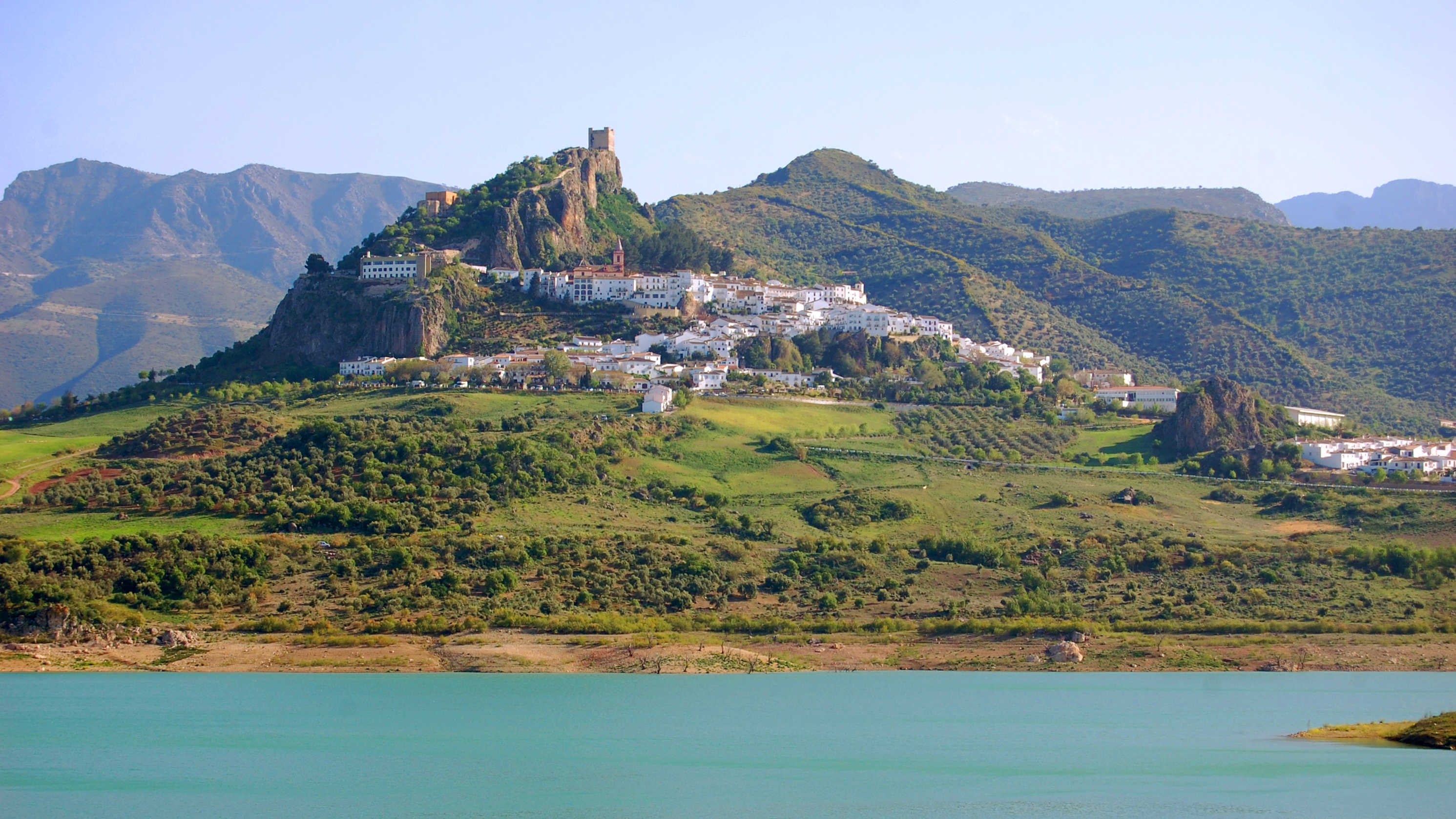
A two-hour drive west takes us into Andalucía's mountainous interior, where the Route of the Pueblos Blancos laces together a characteristic string of whitewashed hill towns. Whether crouching in a ravine or perched atop a hill, each town — painted white to stay cool in scorching summers — has a personality and a story of its own.
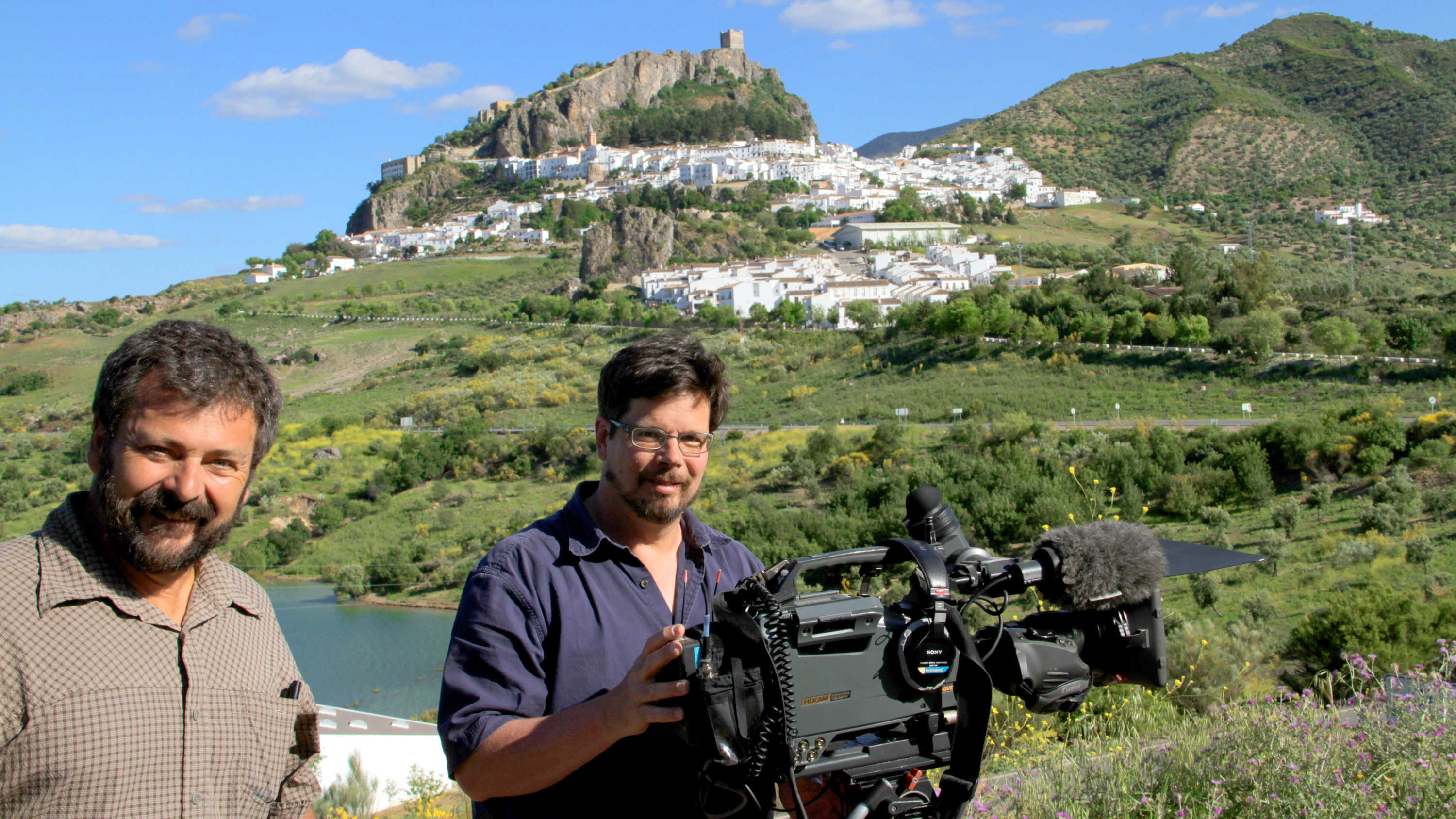
Zahara, set under its imposing castle, was a Moorish stronghold in the 13th century. Its breathtaking perch was typical of towns that had to play hard-to-get during that centuries-long struggle by Christian forces to push the Moors south and reconquer this part of Europe. And in the Reconquista, Zahara was a strategic prize.
Today Zahara is a delight to explore. The tour's quick — a church, a plaza, a few sleepy restaurants, and a grand view.
The dramatic road linking the towns cuts through the Sierra de Grazalema Natural Park. This park is famed throughout Spain for its lush and rugged mountain scenery.
The queen of the white towns is Arcos de la Frontera. Arcos smothers its hilltop, tumbling down its back like the train of a wedding dress. The old center is a delight to explore. Viewpoint-hop all the way through town. The people of Arcos boast that only they see the backs of the birds as they fly. Feel the wind funnel through the narrow streets as cars inch around tight corners.
Driving is tricky. It's a one-way system — if you miss your hotel, you'll circle all the way around again. Under the castle and facing the church is the town's main square, which once doubled as a bullring.
Towns like Arcos, with "de la Frontera" in their names, were established on the "frontier," that was on the front line during the centuries-long fight to take back Spain from the Muslims. As the Moors were slowly pushed back into North Africa, the towns, while no longer of any strategic importance, kept "on the frontier" in their names.
The main church is a reminder of that reconquest. After Christian forces retook Arcos it was the same old story — the mosque was demolished, and a church was built on its ruins.
Another short drive takes us to the biggest whitewashed town on the route...Ronda, with nearly 40,000 people. While crowded with day-tripping tourists from the nearby Costa del Sol, early and late in the day locals retake their streets and squares.
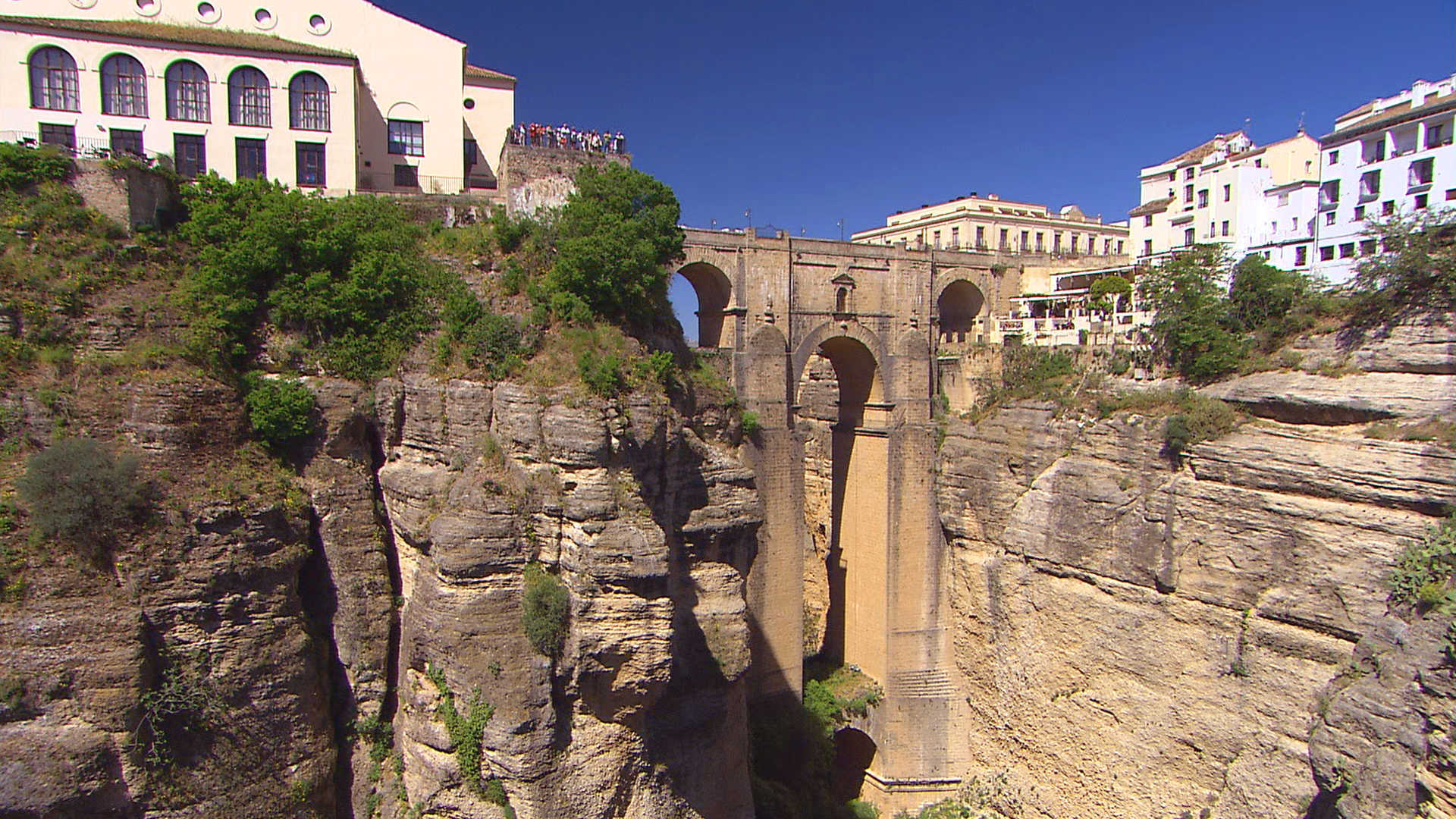
Ronda is famous for its gorge-straddling setting. Its breath-taking perch, while visually dramatic today, was practical and vital when it was built. For the Moors, it provided a tough bastion, one of the last to be conquered by the Spaniards in 1485.
The ravine divides Ronda into its old Moorish town and the relatively modern new town, which was built after the Christian reconquest. The two towns were connected by this bridge in the late 1700s.
Part of the joy of Ronda lies in exploring the twisted lanes of its Moorish quarter. As you wander among its beautiful balconies and exuberant flowerpots, each corner reveals a yet another surprise.
This cliffside mansion [House of the Moorish King] comes with a belle époque garden. And from the garden an evocative staircase leads to the floor of the gorge. It was dug seven centuries ago by the Moors to access water. Imagine Christian slaves hauling water in leather bags up these stairs...all day long. The landing where the staircase finally hits the river marks a legendary turning point in Ronda's history.
In 1485 Reconquista forces took control of this — the city's water source — and within 10 days, thirsty Ronda above surrendered.
At the base of town is the old bridge, some surviving bits of the old Moorish city walls, and the remains of what was for centuries the main gate to the walled city.
Back when Ronda was a fortified town under Muslim rule, you entered from here. And according to Moorish custom, before entering you'd wash and pray. That's why there was a public bath and mosque just outside the gate.
I stay right in the old-town action. Hotel San Gabriel has great character: It's well run, with inviting public rooms, and bedrooms that make you feel quite noble.
And, just over the bridge, the newer town, while more stately, has equally inviting streets and plazas. Strolling the streets, you feel a strong sense of community, where everyone seems to know everyone.
While I generally go for the rustic old bars, tonight a local friend's taking me to a modern one. Tragatapas puts a contemporary spin on traditional tapas. We're just eating our way through the entire list of daily specials. Sure, you'll find your olives and ham but you'll also enjoy asparagus snowed in with manchego cheese, delicate cod-cheek sandwiches, and spicy pulled pork. One basic rule is the same everywhere: If you want a chance to mingle with locals, grab a stool at the bar.
Ronda is near and dear to Spaniards as the birthplace of modern bullfighting. It has the first great Spanish bullring — built in 1785. Visitors can imagine confronting the bull as it thunders into the ring. The arena's columns corral the action, creating a kind of Neoclassical theater.
Bullfighting originated as a kind of military training — refined knights fighting the noble beast on horseback. It evolved to the spectacle that survives to this day. While controversial to many for its brutality, aficionados insist bullfighting is not a sport...it's an art form.
And the museum of bullfighting celebrates this tradition. Matadors, in their suits of light, were heartthrobs. Etchings by the great Spanish painter Goya show that he was clearly an enthusiast.
The museum feels like a shrine Pedro Romero. In the 18th century, Romero established the rules of modern bullfighting.
After Ronda, we wind out of the Andalusian Mountains, and leave Spain for a visit to England's famed Rock of Gibraltar.
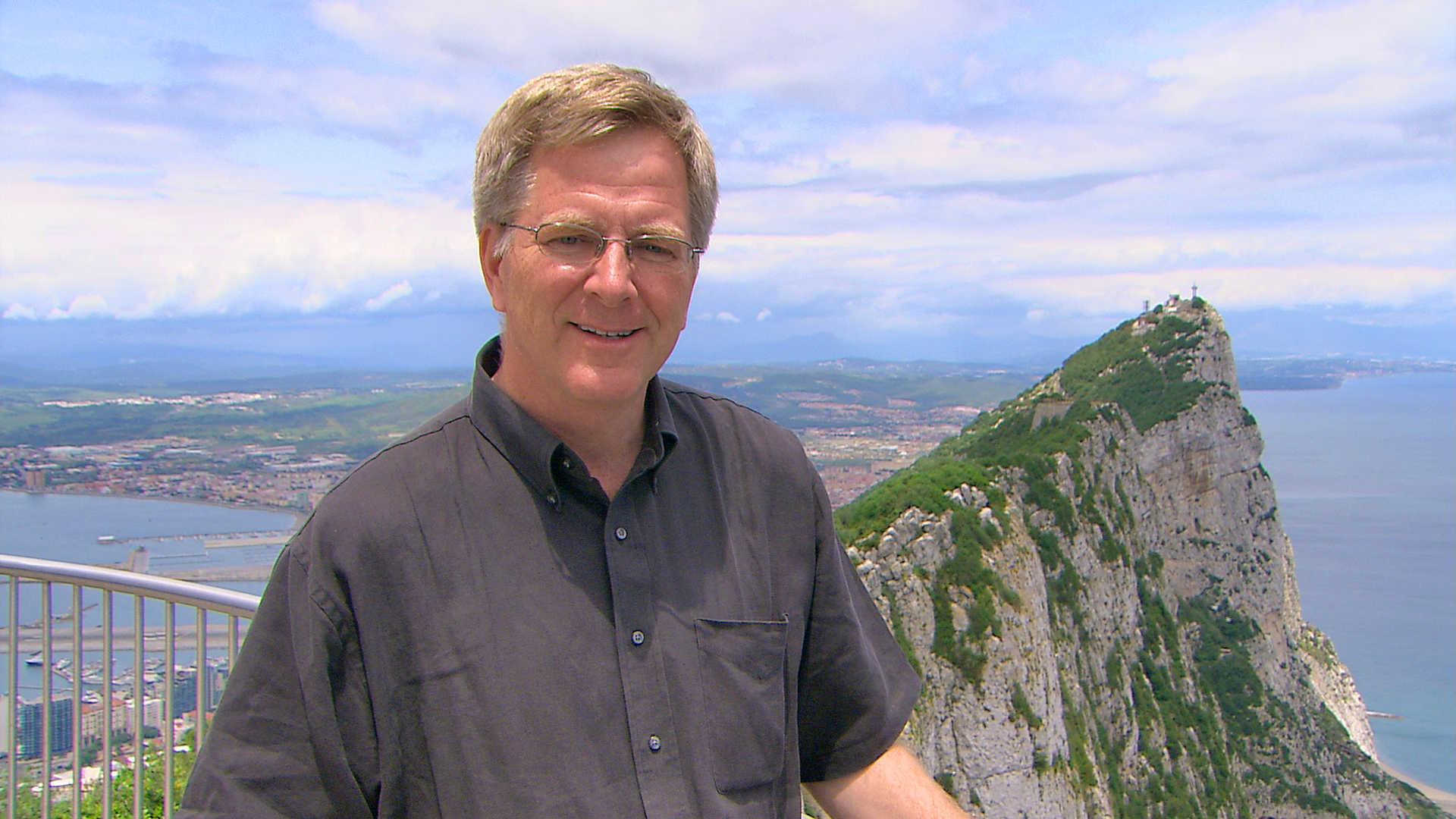
Gibraltar stands like a fortress, the gateway to the Mediterranean. A stubborn little piece of old England, it's one of the last bits of a British empire that at one time controlled a quarter of the planet. The rock itself seems to represent stability and power.
And, as if to remind visitors that they left Spain and entered the United Kingdom, international flights land on this airstrip, which runs along the border. Car traffic has to stop for each plane. Still, entering Gibraltar is far easier today than back when Franco blockaded this border. From the late 1960s until the '80s the only way in was by sea or air. Now you just have to wait for the plane to taxi by and Bob's your uncle.
The sea once reached these ramparts. Modern development grows into the harbor and today half the city is built upon reclaimed land. Gibraltar's old town is long and skinny, with one main street. Gibraltarians are a proud bunch. Remaining steadfastly loyal to Britain, its 30,000 residents vote overwhelmingly to continue as a self-governing British dependency. Within a generation the economy has gone from one dominated by the military to one based on tourism.
But it's much more than sunburnt Brits on holiday. Gibraltar is a crossroads community — with a jumble of Muslims, Jews, Hindus, and Italians joining the English and all crowded together at the base of this mighty rock.
With its strategic setting, Gibraltar has an illustrious military history and remnants of its martial past are everywhere. The rock is honeycombed with tunnels. Many were blasted out by the Brits in Napoleonic times. During World War II, Britain drilled 30 more miles of tunnels.
The Hundred Ton Gun is one of many cannon that both protected Gibraltar and controlled shipping in the strait.
A cable car whisks visitors from downtown to the rock's 1400-foot summit. From the "Top of the Rock" Spain's Costa del Sol arcs eastward. And 15 miles across the hazy Strait of Gibraltar, the shores of Morocco beckon.
These cliffs and those over in Africa created what ancient societies in the Mediterranean world called the Pillars of Hercules. For centuries, they were the foreboding gateway to the unknown.
Descending the Rock, whether you like or not, you'll meet the famous Apes of Gibraltar. Two hundred of these mischief makers entertain tourists. And with all the visitors...they're bold and they get their way.
Rick: Yeah you can have it, you can have it, you can…
Rick: Here on the Rock of Gibraltar the locals are very friendly, but give them your apples.
Legend has it that as long as these apes are here, the British will stay in Gibraltar.
Sweeping north from this southernmost tip of Europe, in a couple hours we're in my vote for the most exciting single city to experience in Andalucía. Seville, or Sevilla as they say here, is the most populist city in Andulucía, and packed with sightseeing fun.
Walking its streets, you're immersed in a flamboyant city of larger than life lovers like Carmen and Don Juan, where bullfighting is still politically correct, and where little girls still dream of growing up to become flamenco dancers. Sevilla has soul and a contagious love of life.
Sevilla was Europe’s gateway to the New World in the 16th century. It flourished during the Age of Discovery. The explorers Christopher Columbus, Ferdinand Magellan, and Amerigo Vespucci all sailed from right here.
The Golden Tower was the starting and ending point for trade with the New World. For centuries part of the city’s fortifications, it came with a heavy chain draped across the river to protect the harbor. In the 16th century, Sevilla’s Golden Age was powered by New World riches.
In the 17th century, all that money made the city an important center of arts and culture. In the 18th century — as its harbor silted up and the Spanish empire crumbled — Sevilla’s power faded. And in the 19th century, the once-powerful-now-quaint Sevilla became an important stop on the Romantic-era “Grand Tour of Europe.”
In the 20th century, 1992 to be exact, Sevilla hosted a World’s Fair that left the city with today’s striking 21st-century infrastructure: dramatic bridges, a sleek new train system, and even a new airport. Today, with 700,000 people, it’s Spain’s fourth-largest city…an exuberant Andalusian capital.
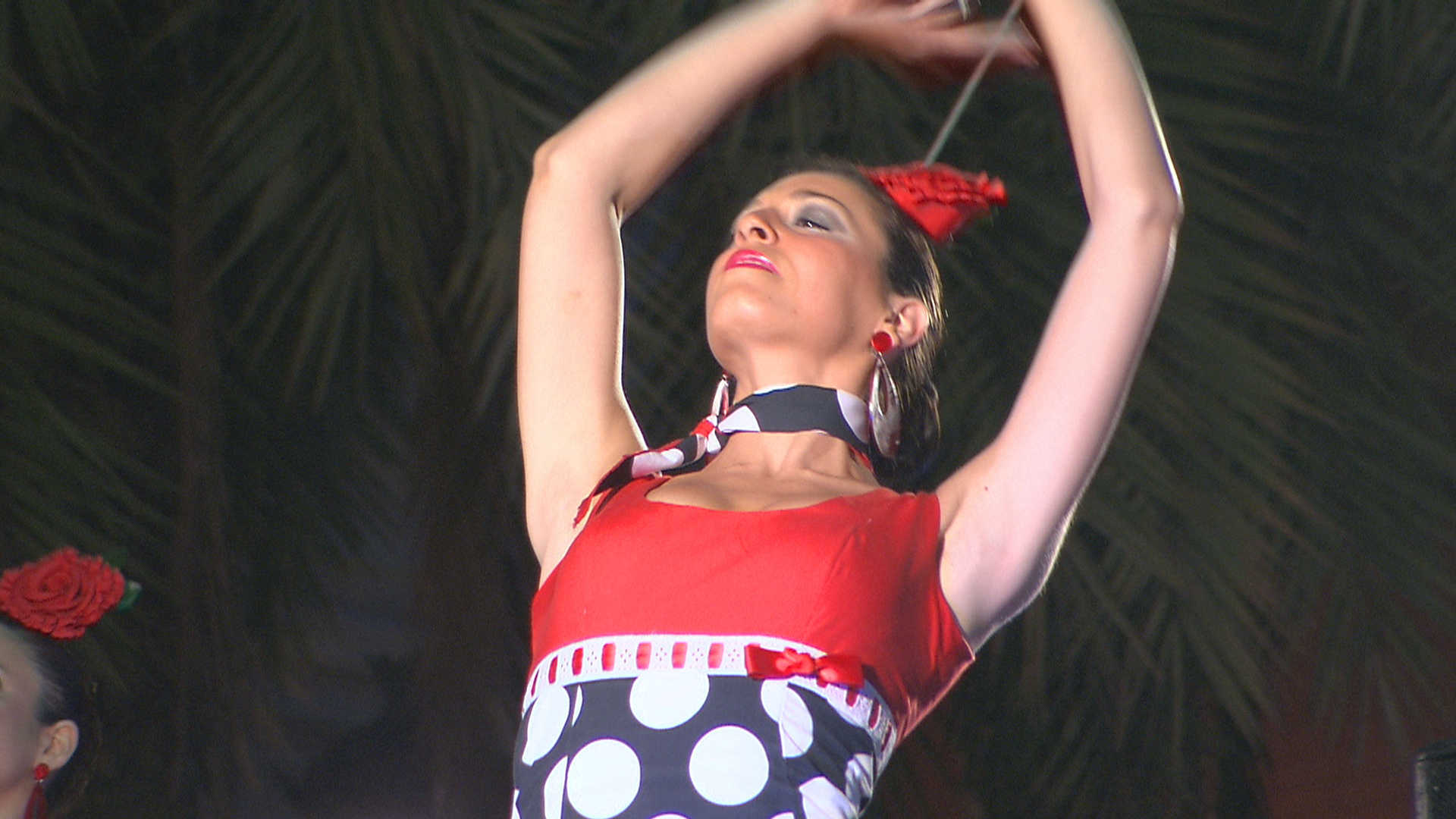
But the charm of Sevilla is best enjoyed in its traditions — like flamenco. Spaniards consider Andalucía the home of flamenco. While impromptu flamenco still erupts spontaneously in Old World bars, most tourists attend a show like this. The men do most of the machine-gun footwork. The women concentrate on graceful turns and a smooth, dramatic step. Flamenco guitarists, with their lightning-fast finger-roll strums, are among the best in the world. The intricate rhythms are set by castanets and hand-clapping. In the raspy-voiced wails of the singers you’ll hear echoes of the Muslim call to prayer — an evocative reminder of centuries of Moorish rule.
The town square is Plaza Nueva. It honors King Ferdinand III, fondly remembered for freeing Sevilla from the Moors in the 13th century. From here, wander into Sevilla’s pedestrian-zone shopping center — which Spaniards prefer to the suburban mall. This is the place for traditional Spanish fashions. But I wouldn’t know my Manchego from my mantilla without a little local help.
My friend and local tour guide, Concepción Delgado, has agreed to be my personal shopper.
Rick: So there are all these traditional things to buy…isn’t it just for tourists that they sell these?
Concepción: No way. These are for locals. We love our things. We have preserved our traditions for centuries.
Rick: So these traditions are healthy?
Concepción: Completely. This one of my favorite shops. Buenos días.
Rick: Hola.
Concepción: Now let me show you the three most traditional accessories that women wear in Spain. Shawls, mantillas, and fans. Starting with the shawls that you can see here. A big display of beautiful colors and embroideries, which are very practical for us, too. We would use them as accessories, but they also have a function, which is warming you when you’re cold.
This is what we wear on top of the beautiful, nice flamenco dresses to attend to the April Feria. On top of the flamenco dress you cannot wear a simple coat, you have to wear something more distinguished, which is a shawl. You can leave it like that…it’s more sexy.
Here we’ve got the mantilla. The mantilla is another accessory, which can be in two colors: white or black. It’s always combined with this comb, which is incorporated in the mantilla like this… and then we wear that on our heads. The white one is for only the Feria, for the festival in April when women wear them to attend the bullfights.
Let’s have a look at the fans now. As you can see, very different colors, different materials, but they are mostly made in wood. Remember that Sevilla gets very hot during the summer and women, old ladies, use them when they attend services. Very old churches are not air-conditioned. They are cooling themselves like this. Sometimes you hardly hear the priest. Just [thumping]. That’s all around you.
In the old days, there was a language with fans which is disappearing, but in the love game it was very useful too. For example, if you were looking at someone that you weren’t very interested in…you can go away because I don’t like you much. But if you were really interested, that movement would tell him something, don’t you think? Anyway, the most common movement for a fan is…
As we've seen elsewhere, the Moors left a distinct mark on Andalusian culture. Like Granada has its Alhambra, and Córdoba has its Mezquita, Sevilla has its Alcázar. Built more than 600 years ago, this magnificent building still functions as a royal palace.
The Alcázar provides a thought-provoking glimpse of a graceful Moorish world that might have survived its Christian conquerors — but didn’t.
What you see today is a 14th-century rebuild — done in Mudéjar style. This was a Moorish style done by Moorish craftsmen but for Christian rulers after the reconquest.
This became the king’s palace. Its centerpiece was the elegantly proportioned Court of the Maidens. It was decorated Mudéjar below, and Renaissance above. The king hired Muslim workers to give Moorish elegance to what was a stark fortress. They built what’s considered the finest Mudéjar building in all of Spain.
The intimate Dolls’ Court was the king’s living quarters. Imagine the royal family lounging around a reflecting pool in this courtyard.
Once again we see sacred verses in intricately carved Arabic script. But the decor here is clearly Christian. You’ll see animals, buildings, and kings that you wouldn’t normally find in religious Muslim art, which forbids images.
A century or so later — just after Columbus’ New World discoveries — Queen Isabel built a more European style wing to the palace. Anticipating a big business in plunder and trade, she built this to administer Spain’s New World ventures. The chapel is dedicated to Santa Maria de los Buenos Aires. St. Mary of the Good Winds was the patron saint of navigators and a favorite of Columbus.
This altar painting dates from shortly after Columbus died and features what’s considered the first and most accurate portrait of the great explorer, on the left. It’s also thought to be the first painting of Indians done in Europe. The Virgin’s cape seems to protect everyone under it — even the Indians.
Like the palace, the gardens reflect a mix of cultures. The intimate geometric Moorish gardens lead to the later much more expansive back yard of Spanish kings. The gardens are full of tropical flowers, cool fountains, and — in the summer — hot tourists. I’m thankful we’re here in late April…beating the brutal heat of the Andalucían summer.
The Moors were relatively tolerant of other religions. During their rule, Christians, Jews, and Muslims shared the city peacefully. After the Christian reconquest, Sevilla’s thriving Jewish community was concentrated here…in the Barrio Santa Cruz. Today, only a few peaceful squares surrounded by a tangled web of alleys survives from the days when this was Sevilla’s Jewish Quarter.
Explore, wander among lanes too narrow for cars, whitewashed houses corralling peaceful squares, and wrought-iron latticework. Regardless of who lived here, the design of the neighborhood seems to have one goal — stay cool. The narrow streets — some with buildings so close they’re called “kissing lanes” — were designed to maximize shade.
Homes faced an inner courtyard offering a welcome refuge from the bustle and summer heat. The Moors gave Andalucía its characteristic glazed tiles...with only geometric patterns. In later centuries, Christians decorated their tiles with livelier scenes. Either way, the tiles kept buildings cooler. Residents here winter upstairs and move down to the cooler courtyard level in the summer.
Concepción: These orange trees are great for shade. They never lose their leaves.
Rick: Refreshing too, on a hot day.
Concepcion: Well, not to eat. These are sour orange trees. We just use them for vitamins, perfume, or that kind of marmalade the British like...
Rick: Oh, that bitter English marmalade, yeah…
Concepción: …it’s made with our oranges.
The Santa Cruz neighborhood comes with a timeless beauty…savor the simple elegance of Sevilla.
The delicate charms of Santa Cruz are just a few steps from Sevilla’s immense cathedral. It’s the third-largest church in Europe (after St. Peter’s in the Vatican, and St. Paul’s in London) and the largest Gothic church anywhere.
When they ripped down the mosque that stood on this site in 1401, the Reconquista Christians bragged, “We’ll build a cathedral so huge that anyone who sees it will take us for madmen.”
You could fit a soccer field in here. Everything is supersized. The towering main altarpiece is covered in gold leaf. Constructed in the 1480s, it’s composed of hundreds of figures. It tells the story of the life of Jesus in 40 scenes from his birth to his resurrection.
The choir — an enclosure within the cathedral for more intimate services — surrounds a spinnable music rack. It held giant hymnals — large enough for all to chant from in an age when there weren’t enough for everyone.
In the transept, four pallbearers carry the tomb of Christopher Columbus. They represent the four medieval kingdoms that became Spain: Aragon, Navarre, Castile, and León — each identified by their team shirts.
Columbus even traveled a lot after he died. He was buried first in Sevilla, then moved to Santo Domingo, then to Cuba, and after Cuba earned its independence from Spain around 1900, he sailed all the way back here to Sevilla. Is he really in there? Sevillanos like to think so.
All that survives of Moorish Sevilla’s main mosque is its courtyard of orange trees and a towering minaret. The tower offers a brief recap of the city’s history — sitting on a Roman foundation, a long Moorish period capped by the Christian age.
The Moors built its spiraling ramp to accommodate a rider on horseback — somebody climbed this tower five times a day to call Sevilla’s Muslims to prayer.
Today, tourists gallop up for fine city views. And the former minaret functions as the cathedral’s bell tower. It’s topped with a bronze weathervane — a statue that symbolizes the triumph of faith.
Perhaps the most famous of religious icons in this very religious city — the Virgin of Macarena — can be found in the nearby Basílica de la Macarena. Grab a pew and study the Weeping Virgin. She’s a 17th-century doll — complete with articulated arms, and human hair — she’s even dressed with underclothes. With crystal teardrops her beautiful expression — halfway between ecstasy and sorrow — touches pilgrims.
Sevilla’s Semana Santa, or Holy Week celebrations, are the most magnificent in Spain. During the week leading up to Easter, the city is packed with pilgrims witnessing grand processions carrying elaborate floats through the streets.
The two most impressive floats of the festivities are parked behind the altar.
The biggest float, slathered in gold leaf, shows the sentencing of Christ. Pontius Pilate is about to wash his hands. His wife cries as a man reads the death sentence.
While pious Sevillan women wail in the streets, relays of 48 men carry this three-ton float on the backs of their necks — only their feet show from under these drapes — as they shuffle through the streets from about midnight until 2:00 in the afternoon each Good Friday.
This float, with the Weeping Virgin from this church’s altar placed regally in the center, is the hit of the parade. It’s festooned with wax flowers and candelabra. It seems fragile — all silver and candles. Locals explain it’s “strong enough to support the roof while delicate enough to quiver in the soft night breeze.”
Rick: Have you actually seen this one going through the streets?
Concepción: The Queen of the City you mean?
Rick: Yes.
Concepción: Of course. She even wears her crown and that day she looks absolutely beautiful. When she goes through the streets people get crazy. They can’t explain all those emotions and they clap or they cry or they throw petals from balconies.
Rick: What’s so special about this particular Mary?
Concepción: She knows everything about us because we have been telling her our problems for centuries. Her name is “hope,” which is what we all need.
With all this religiosity, it’s no surprise that Sevilla is also famous for letting loose in vibrant festivals — and we’re here for the biggest of all: the April Fair.
For seven days each April it seems much of Sevilla is packed into its vast fairgrounds. The fair feels friendly, spontaneous…very real. The Andalusian passion for horses, flamenco…and sherry is clear. Riders are ramrod straight, colorfully clad señoritas ride sidesaddle, and everyone’s drinking sherry spritzers. Women sport outlandish dresses that would look clownish all alone but somehow brilliant here en masse.
As in spring fairs throughout Andalucía, countless casetas line the lanes. In these private party tents Andalusians Andalucians of all stripes let their hair down. To get in, you need to know someone in the group — or make friends quickly.
Concepción’s well connected…and as a friend of a friend, we’re in.
Woman: My caseta.
Rick: My caseta. This is your caseta?
Woman: Esta la caseta.
Because of the exclusivity, it has a real family-affair feeling. Everyone seems to know everyone in what seems like a thousand wedding parties being celebrated all at the same time.
It’s time to say “adiós” to Concepción, Sevilla, and to Andulucía, where the celebration seems to go on and on.
From hill towns to horses, and from inviting beaches to lavish feasts...from historic mosques to glorious churches, and from religious passion to flamenco fiestas, you come away inspired to embrace life with a little more vigor.
Andalucía is a particularly proud and passionate culture...in touch with its heritage and enthusiastic about sharing it all. I’m Rick Steves. Until next time, keep on travelin'. Adiós.
Credits:
Fascinating sights, sounds and experiences of southern Spain ooh hoo [laugh].
Spain was the predominantly Muslim society living under Muslim rule.
Don’t poke him with it; he’ll kill you.
Hi I’m Rick Steves back with more of the best of Europe. This time...