

A Walk Across Prague
By Rick Steves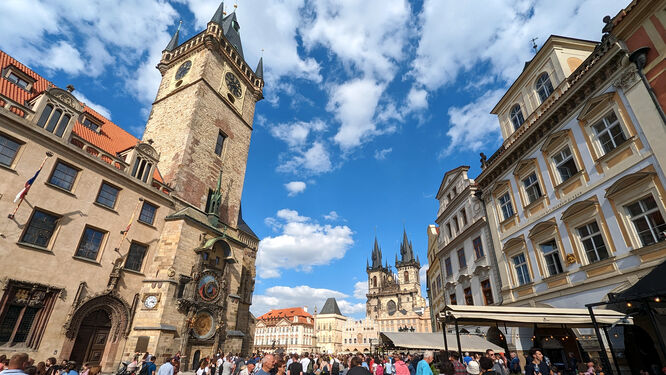
Known as the "Golden City of 100 Spires," Prague boasts a fairytale medieval Old Town, historic churches and synagogues, and perhaps Europe's largest castle. A good way to introduce yourself to the city, its layered past, and its resilient people is with a walk across town, starting on lively, urban Wenceslas Square, weaving through the atmospheric Old Town, and ending at the picturesque Charles Bridge.
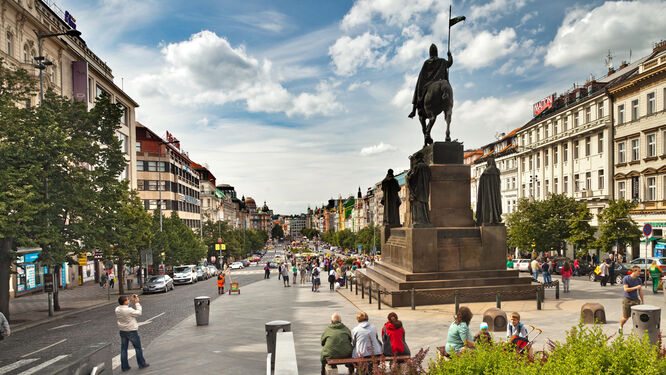
Huge Wenceslas Square, lined with great buildings, has been center stage for much of modern Czech history. It's named for King Wenceslas, the "good king" of Christmas-carol fame, sitting astride the big equestrian statue at the top of the boulevard-like square. The statue is a popular meeting point among locals, who like to say, "I'll meet you under the horse's tail."
The creation of the Czechoslovak state was celebrated here in 1918. An inspiring memorial commemorates Jan Palach and Jan Zajíc, two college students who set themselves on fire in 1969 to protest the Soviet Union's invasion of the Czech Republic the year before. Twenty years later, giant crowds converged on the square, jingling their key chains and chanting, "It's time to go now!" in the lead-up to the peaceful overthrow of the communist government.
The Czech people have a rousing enthusiasm for blowing raspberries in the face of authority — once voting to name a fictional comedic character, Jára Cimrman, as their "Greatest Czech of All Time." From the 14th-century rebel Jan Hus (who challenged Church corruption roughly a century before Martin Luther) to the flashes of revolt that sparked the 1989 Velvet Revolution against communism, the Czechs have maintained a healthy disrespect for those who would tell them how to live their lives. (Remembering the mediocre jobs the communists assigned them, Czechs quipped, "They pretended to pay us; we pretended to work.")
From the bottom of Wenceslas Square, it's a short walk down skinny Melantrichova street to Prague's quaint, compact Old Town. On the way you'll pass the wonderful open-air Havelská Market, a thriving display of traditional-though-touristy Czech culture. Here you can browse for handcrafts, or snack on a vegetable or piece of fruit — merchants (often the farmers themselves) are happy to sell you just one.
A couple of blocks from the market is the Old Town Square, surrounded by gloriously colorful buildings in a diversity of architectural styles: Gothic, Renaissance, Baroque, Rococo, and Art Nouveau. Chief among them is the towering Gothic Týn Church, topped by fanciful spires.
At the center of the massive square, two monuments face off: the reformer Jan Hus and a Bernini-inspired Virgin Mary. The original statue of Mary, erected in 1652, honored the Virgin as the city's protector during the Thirty Years' War. But by the early 20th century, nationalist Czechs saw this Mary as a symbol of their oppressors, the militantly Catholic Habsburgs. Cue installation of the Jan Hus memorial, with Jan's eyes defiantly locked on Mary. After the declaration of independence in 1918, a rebellious mob tore down the "Habsburg" Virgin — to the dismay of many in this mainly Catholic country. It wasn't until 2020 that a replica was placed on her original spot, sparking controversy and conversation.
A short detour up the uniquely tree-lined Parizska ("Paris") street leads to the poignant Jewish Quarter, with museums, synagogues, and cemeteries. For me, this is one of the most powerful collection of Jewish sights in Europe.
Parizka ends at a bluff that once sported a 50-foot-tall stone statue of Stalin. Torn down in 1962, it was replaced in 1991 by a giant ticking metronome, its concrete base now favored by skateboarders who love to film themselves "skating at the Stalin."
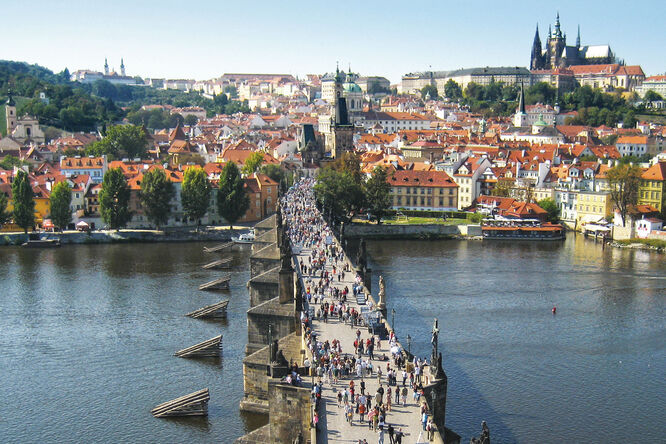
Back at the Old Town Square, Karlova street zigzags down to the river to one of my favorite places for a stroll — the Charles Bridge. Under the communists, this pedestrian-only bridge crossing the Vltava River was empty, its big Gothic towers and statues of saints coated in black soot. Today it's a celebration of life, with a festival of gleaming statues, artists, and musicians all along its length.
Across the bridge is the charming Lesser Town, and beyond that, the Castle Quarter, topped by the massive, must-see Prague Castle. A visit to the castle complex, with its quarter-mile stretch of churches, courtyards, and palaces spanning a thousand years of Czech history, can fill the better part of a day.
The mythical founder of Prague — the beautiful princess Libuse — named her city "Praha" ("threshold"). The Czechs have always been at a crossroads of Europe — between the Slavic and Germanic worlds, between Catholicism and Protestantism, and between Cold War East and West. Despite these strong external influences, the Czechs have retained their distinct culture…and their enviable ability to find humor in life's challenges.