Home > Plan Your Trip > Best Destinations > General Europe

Rick's Off-Beat Europe

Brussels' Manneken-Pis, a statue of a young boy urinating
This lad's got great aim.
By Rick Steves

No one planning a trip to Europe needs to be reminded to see Big Ben and the Leaning Tower of Pisa. But did you know that you can visit a pyramid in Rome, ski without snow near Edinburgh, or explore the sewers of Paris? It's the offbeat sights that are often the most memorable part of a trip. Here are a few that I've especially enjoyed writing home about.

TV and the Downfall of Tea

London's Bramah Tea and Coffee Museum is a hit with aficionados of the brown brews. This small museum passionately tells the story of each drink. The owner, Mr. Bramah, who comes from a big tea family, wants the world to know how the advent of commercial television, with breaks too short to brew a proper pot of tea, required a faster hot drink. In came the horrible English instant coffee. The tea industry countered with finely chopped leaves in tea bags, and the stuff's gone downhill ever since.

Belgium's Little Squirt

Brussels' Manneken-Pis, a statue of a young boy urinating, is the irreverent mascot of this great Belgian city. You'll find this little squirt three blocks off the main square, La Grand Place. He'll probably be aiming through some clever outfit. By tradition, costumes for the lad are sent to Brussels from around the world. Go figure. Cases displaying scores of these colorful get-ups are on display in Brussels' City Museum.

Czech Bones

Kutna Hora's ossuary, an hour by train from Prague, is decorated with the bones of 40,000 people, many of them plague victims. The monks who stacked these bones 400 years ago wanted viewers to remember that the earthly church is a community of both the living and the dead. Later bone-stackers were more into design than theology — creating, for instance, a chandelier made with every bone in the human body.

Frankfurt's Red Light Towers

Near Frankfurt's central station, people killing time between trains can visit one of 20 "Eros Towers" — each a five-story brothel filled with hookers. Frankfurt's prostitutes, who are legal and taxed, note that business varies with the theme of the trade show at the nearby convention center. While Frankfurt's annual auto show is boom time, they complain that the world's largest annual book fair is a complete bust. (No, I'm not a customer. Beware, drug addicts and pushy barkers make this neighborhood feel unsafe after dark.)

Paris' Plantée Park
No space is wasted in Paris.

Europe's Skinniest Park

Paris' two-mile-long Promenade Plantée Park is a narrow garden walk on a viaduct once used for train tracks. The elevated park, which cuts through lots of modern condos, gives a fun peek into the work-a-day lives of Parisians today. Staircases lead to the street level where artsy, off-beat shops (whose rent is subsidized by the city government) fill the viaduct's arches. The park runs from place de la Bastille, along avenue Daumesnil to Saint-Mandé.

Skiing in Edinburgh

If you'd rather be skiing, the Midlothian Ski Centre, just outside Edinburgh, has a hill with a chairlift, two slopes, a jump slope, and rentable skis, boots, and poles. While you're actually skiing over what seems like a million toothbrushes, it feels like snow skiing on a slushy day. Beware: Local doctors are used to treating an ailment called "Hillend Thumb" — digits dislocated when people fall and get tangled in the brush.

Salzburg's Super-Soaker Garden

Salzburg's 17th-century Hellbrunn Castle offers another way to get soaked — this time with your street clothes on. The attractions here are a garden full of clever trick fountains and the sadistic joy the tour guide gets from soaking tourists. At the touch of a button, paths (and pedestrians) get doused and benches turn into fountains. It's silly fun, especially with kids on a sunny day.

The Tide Went Out and Never Came Back

Holland is twice as big today as it was 300 years ago. How? By "reclaiming" land from the sea using dikes and windmill-powered pumps. During the process, many tiny islands — home to traditional fishing villages — were stranded high and dry in the middle of Dutch farmland. The fishing village of Schotlan, once on an island in the Zuider Sea, is one such village. The village has a now-useless lighthouse, and you can walk right up to a buoy that once bobbed in the harbor. A bent and rusty propeller from a WWII English bomber ornaments the village square…a reminder that when farmers first tilled their new soil, they uncovered more than just muck and mollusks.

Rome's Pyramid in Testaccio
Avoid the tension in the Middle East! Go to Rome!

A Roman Pyramid

Rome has an unusual cluster of sights in the colorful Testaccio neighborhood. For starters, you don't need to go to Eygpt to see an ancient pyramid. Standing 90 feet tall, Rome's pyramid was built in 12 B.C. as a tomb for the Roman Gaius Cestius, after the Cleopatra and Mark Antony scandal brought exotic Egyptian styles into vogue. Later the pyramid was incorporated into Rome's city wall (free, viewable any time, Metro: Piramide).

Rome's Dead Protestants

Behind the pyramid, you can wander through Rome's Protestant Cemetery. Non-Catholic foreigners who died in Rome (as many 19th-century Romantics — such as poets Shelley and Keats — were inclined to do) had to be buried somewhere. Back then the Vatican forbade any mention of heaven on those wispy Protestant tombstones. Still, it's a peaceful and evocative walk. At the edge of the cemetery, next to the pyramid, you'll find Matilde Talli's Cat Hospice. Volunteers use donations to care for these "Guardians of the Departed" who "provide loyal companionship to the dead."

Rome's Fake Dome

Rome's Church of St. Ignazio is a riot of Baroque illusions. As you walk into the church, admire the dome. Keeping your eyes on the dome, walk under and past it. It's false. The flat roof has been skillfully painted to look like a dome. When the church was built, a nearby monastery didn't want its light blocked by a huge dome. (Free, open daily 7:00-12:30 & 15:00-19:15.)

Surfing and Skinny Dipping in Downtown Munich

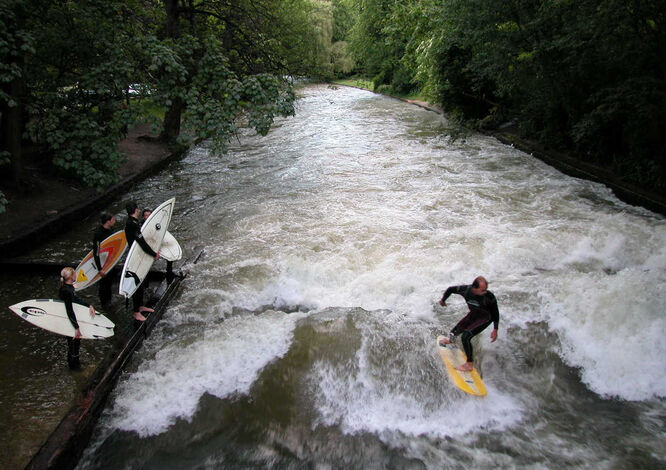
Munich's Central Park, the Englischer Garten, offers a variety of offbeat things to explore. Up to 300,000 locals commune with nature here on a hot summer day…many of them buck naked. Nudism, denoted by the code letters "F.K.K.," is perfectly legal and widely practiced here — quite a spectacle to most Americans (they're the ones riding their bikes into the river and trees). If nudity isn't your cup of tea, spend some time watching the surfers take advantage of the unusually strong current under the bridge just past the Haus der Kunst.

Royally München' in Munich

When Bavaria's kings called out for dinner, they called the Alois Dallmayr Delicatessen. This regal deli became famous for its exotic and luxurious food items: tropical fruits, seafood, chocolates, fine wines, and coffee. Catering to royal and aristocratic tastes (and budgets), it's still the choice of Munich's old rich. Today, Dallmayr is most famous for its coffee, dispensed from fine hand-painted Nymphenburg porcelain jugs. (Dienerstrasse 14, behind New Town Hall.)

A Swiss Urban River Promenade

In Bern, Switzerland, join the local merchants, students, and carp in a lunchtime float down the Aare River. The Bernese, proud of their health and clean river, have a wet tradition. On hot summer days, they hike upstream and float back down to the excellent (and free) riverside baths and pools (Aarebad) just below the Parliament building. While the locals make it look easy, this can be dangerous — the current is swift. If you miss the last pole, you're history. If the river is a bit much, you're welcome to enjoy just the pools, and watch this fast-flowing spectacle from the sidelines.

Rick holds on for his life in the Aare River.

Underground Bruges

One of Bruges' newest buildings (1992), the Crowne Plaza Hotel sits atop the ruins of the town's oldest structures. Around 900, when Viking ships regularly docked here to rape, pillage, and plunder, Baldwin Iron Arm built a fort to protect his Flemish people. In 950, the fort was converted into St. Donatian's church, which became one of the city's largest. Ask politely at the hotel's reception desk to see the ruins of the fort and the church, and head downstairs. You'll find old stone walls and display cases showing the bonanza of objects found when excavators uncovered a town water hole with the refuse of a thousand years of habitation: pottery, animal skulls, rosary beads, dice, coins, keys, thimbles, pipes, spoons, and Delftware. (Right across from the City Hall on Burg Square.)

Paris' Historic Sewers

In Paris, the Sewer Tour takes you along a few hundred yards of an underground water tunnel, lined with interesting displays, well-described in English, explaining the evolution of the world's longest sewer system. Flush hard: if you lined up Paris' sewers they would reach beyond Istanbul. (€4, May-Sept Sat-Wed 11:00-17:00, Oct-April 11:00-16:00, closed Thu-Fri, located where Pont de l'Alma greets the Left Bank, Mo: Alma-Marceau). Knowing that Paris, home of the stately Louvre, offers sewer tours makes this grand city seem less intimidating and more human.

Anywhere in Europe, the offbeat sights are a fun way to punctuate your serious museum-going.

Updated for 2008. For lots more information, check out our best-selling Rick Steves' guidebooks — or join us on one of our free-spirited Europe tours!