
Historic Paris Walk
Part 2: The Left Bank and Sainte-Chapelle
By Rick Steves
The Left Bank
Left Bank Booksellers
The Rive Gauche, or the Left Bank of the Seine — "left" if you were floating downstream — still has many of the twisting lanes and narrow buildings of medieval times. The Right Bank is more modern and business-oriented, with wide boulevards and stressed Parisians in suits. Here along the riverbank, the "big business" is secondhand books, displayed in the green metal stalls on the parapet. These literary entrepreneurs pride themselves on their easygoing style. With flexible hours and virtually no overhead, they run their businesses as they have since medieval times.
When you reach the bridge (pont au Double) that crosses over in front of Notre-Dame, veer to the left across the street to a small park (place Viviani; fill your water bottle from fountain on left).
Angle across the square and pass by Paris' oldest inhabitant — an acacia tree nicknamed Robinier, after the guy who planted it in 1602 — that may once have shaded Louis XIV, the Sun King. Just beyond the tree you'll find the small rough-stone church of St. Julien-le-Pauvre.
Medieval Paris (1000–1400)
Picture Paris in 1250, when the church of St. Julien-le-Pauvre was still new. Notre-Dame was nearly done (so they thought), Sainte-Chapelle had just opened, the university was expanding human knowledge, and Paris was fast becoming a prosperous industrial and commercial center. The area around the church gives you some of the medieval feel. The building next to St. Julien is half-timbered and whitewashed in the medieval style. Looking along nearby rue Galande, you'll see a few old houses leaning every which way. (La Guillotine Pub at #52 sports an authentic guillotine from 1792 on its wall.) In medieval days, people were piled on top of each other, building at all angles, as they scrambled for this prime real estate near the main commercial artery of the day — the Seine. The smell of fish competed with the smell of neighbors in this knot of humanity.
Narrow dirt (or mud) streets sloped from here down into the mucky Seine, until modern quays and embankments cleaned that up. Many Latin Quarter lanes were named for their businesses or crafts. The rue de la Bûcherie, (or, "butcher street," just around the corner, in the direction of the river), was where butchers slaughtered livestock. The blood and guts drained into the Seine and out of town.
Return to the river and turn left on rue de la Bûcherie. At #37, drop into the...
Shakespeare and Company Bookstore
In addition to hosting butchers and fishmongers, the Left Bank has been home to scholars, philosophers, and poets since medieval times. This funky bookstore — a reincarnation of the original shop from the 1920s — has picked up the literary torch. Sylvia Beach, an American with a passion for free thinking, opened Shakespeare and Company for the post-WWI Lost Generation, who came to Paris to find themselves. American writers flocked here for the cheap rent, fleeing the uptight, Prohibition-era United States. Beach's bookstore was famous as a meeting place for Paris' literary expatriate elite. Ernest Hemingway borrowed books from here regularly. James Joyce struggled to find a publisher for his now-classic novel Ulysses — until Sylvia Beach published it. George Bernard Shaw, Gertrude Stein, and Ezra Pound also got their English fix here.
Today, the bookstore carries on that literary tradition. Struggling writers are given free accommodations upstairs in tiny rooms with views of Notre-Dame. Downstairs, travelers enjoy a great selection of used English books.
Notice the green water fountain (1900) in front of the bookstore, one of the many in Paris donated by the English philanthropist Sir Richard Wallace. The hooks below the caryatids once held metal mugs for drinking the water.
Continue to rue du Petit-Pont (which becomes rue St. Jacques). This bustling north–south boulevard was the Romans' busiest boulevard 2,000 years ago, with chariots racing in and out of the city. (Romaniacs can view remains from the third-century baths, along with a fine medieval collection, at the nearby Cluny Museum, located near the corner of boulevards St. Michel and St. Germain)
Walking away from the river for one block, turn right at the Gothic church of St. Séverin and walk into the Latin Quarter.
St. Séverin
Don't ask me why, but it took a century longer to build this church than Notre-Dame. This is Flamboyant, or "flame-like," Gothic, and you can see the short, prickly spires meant to make this building flicker in the eyes of the faithful. The church gives us a close-up look at gargoyles. This weird, winged species of flying mammal, now extinct, used to swoop down on unwary peasants, occasionally carrying off small children in their beaks. Today, they're most impressive in thunderstorms, when they vomit rain.
At #22 rue St. Séverin, you'll find the skinniest house in Paris, two windows wide. Rue St. Séverin leads right through...
The Latin Quarter
While it may look more like the Greek Quarter today (cheap gyros abound), this area is the Latin Quarter, named for the language you'd have heard on these streets if you walked them in the Middle Ages. The University of Paris (founded 1215), one of the leading educational institutions of medieval Europe, was (and still is) nearby.
A thousand years ago, the "crude" or vernacular local languages were sophisticated enough to communicate basic human needs, but if you wanted to get philosophical, the language of choice was Latin. The class of educated elite of medieval Europe transcended nations and borders. From Sicily to Sweden, they spoke and corresponded in Latin. Now the most Latin thing about this area is the beat you may hear coming from some of the subterranean jazz clubs.
Along rue St. Séverin, you can still see the shadow of the medieval sewer system. The street slopes into a central channel of bricks. In the days before plumbing and toilets, when people still went to the river or neighborhood wells for their water, flushing meant throwing it out the window. At certain times of day, maids on the fourth floor would holler, "Garde de l'eau!" ("Watch out for the water!") and heave it into the streets, where it would eventually wash down into the Seine.
As you wander, remember that before Napoleon III commissioned Baron Haussmann to modernize the city with grand boulevards (19th century), Paris was just like this — a medieval tangle. The ethnic feel of this area is nothing new — it's been a melting pot and university district for almost 800 years.
Keep wandering straight, and you'll come to...
Boulevard St-Michel
Busy boulevard St. Michel (or "boul' Miche") is famous as the main artery for Paris' café and artsy scene, culminating a block away (to the left), where it intersects boulevard St. Germain. Although nowadays you're more likely to find pantyhose at 30 percent off, there are still many cafés, boutiques, and bohemian haunts nearby.
The Sorbonne — the University of Paris' humanities department — is also close, if you want to make a detour, though entry is not allowed for visitors. (Turn left on boulevard St. Michel and walk two blocks south. Gaze at the dome from the place de la Sorbonne courtyard.) Originally founded as a theological school, the Sorbonne began attracting more students and famous professors — such as St. Thomas Aquinas and Peter Abélard — as its prestige grew. By the time the school expanded to include other subjects, it had a reputation for bold new ideas. Nonconformity is a tradition here, and Paris remains a world center for new intellectual trends.
Cross boulevard St. Michel. Just ahead is...
Place St. André-des-Arts
This tree-filled square is lined with cafés. In Paris, most serious thinking goes on in cafés. For centuries, these have been social watering holes, where you can get a warm place to sit and stimulating conversation for the price of a cup of coffee. Every great French writer — from Voltaire and Jean-Jacques Rousseau to Jean-Paul Sartre and Jacques Derrida — had a favorite haunt.
Paris honors its writers. If you visit the Panthéon — a few blocks up boulevard St. Michel and to the left — you will find French writers (Voltaire, Victor Hugo, Emile Zola, and Rousseau), inventors (Louis Braille), and scientists (including Marie and Pierre Curie) buried in a setting usually reserved for warriors and politicians.
Adjoining this square toward the river is the triangular place St. Michel, with a Métro stop and a statue of St. Michael killing a devil. Note: If you were to continue west along rue St. André-des-Arts, you'd find more Left Bank action.
Place St. Michel
You're standing at the traditional core of the Left Bank's artsy, liberal, hippie, bohemian district of poets, philosophers, and winos. Nearby, you'll find international eateries, far-out bookshops, street singers, pale girls in black berets, jazz clubs, and — these days — tourists. Small cinemas show avant-garde films, almost always in the version originale (v.o.). For colorful wandering and café-sitting, afternoons and evenings are best. In the morning, it feels sleepy. The Latin Quarter stays up late and sleeps in.
In less-commercial times, place St. Michel was a gathering point for the city's malcontents and misfits. In 1830, 1848, and again in 1871, the citizens took the streets from the government troops, set up barricades Les Miz–style, and fought against royalist oppression. In World War II, the locals rose up against their Nazi oppressors (read the plaques under the dragons at the foot of the St. Michel fountain).
And in the spring of 1968, a time of social upheaval all over the world, young students battled riot batons and tear gas, took over the square, and declared it an independent state. Factory workers followed their call to arms and went on strike, toppling the de Gaulle government and forcing change. Eventually, the students were pacified, the university was reformed, and the Latin Quarter's original cobblestones were replaced with pavement, so future scholars could never again use the streets as weapons.
From place St. Michel, look across the river and find the spire of the Sainte-Chapelle church, with its weathervane angel nearby. Cross the river on pont St. Michel and continue north along the boulevard du Palais. On your left, you'll see the doorway to Sainte-Chapelle. You'll need to pass through a metal detector to get into the Sainte-Chapelle complex. This is more than a tourist attraction — you're entering the courtyard of France's Supreme Court (to the right of Sainte-Chapelle). Once you're past security, you'll find restrooms ahead on the left. The line into the church may be long (but with a Museum Pass, you can bypass this line).
Enter the humble ground floor (pick up an English info flier and check the concert schedule if you're interested).
Sainte-Chapelle and Nearby
Sainte-Chapelle
This triumph of Gothic church architecture is a cathedral of glass like no other. It was built in 1248 for King Louis IX — the only French king who is now a saint — to house the supposed Crown of Thorns (now kept at Notre-Dame and shown only on the first Friday of the month and during Easter). Its architectural harmony is due to the fact that it was completed under the direction of one architect and in only five years — unheard of in Gothic times. Recall that Notre-Dame took over 200 years.
While the inside is beautiful, the exterior is basically functional. The muscular buttresses hold up the stone roof, so the walls are essentially there to display stained glass. The lacy spire is neo-Gothic — added in the 19th century. Inside, the layout clearly shows an ancien régime approach to worship. The low-ceilinged basement was for staff and more common folks — worshipping under a sky filled with painted fleurs-de-lis, a symbol of the king. Royal Christians worshipped upstairs. The paint job, a 19th-century restoration, helps you imagine how grand this small painted, jeweled chapel was. (Imagine Notre-Dame painted like this....) Each capital is playfully carved with a different plant's leaves.
Climb the spiral staircase to the Haute Chapelle. Leave the rough stone of the earth and step into the light.
The Stained Glass
Fiat lux. "Let there be light." From the first page of the Bible, it's clear — light is divine. Light shines through stained glass like God's grace shining down to earth, and Gothic architects used their new technology to turn dark stone buildings into lanterns of light. For me, the glory of Gothic shines brighter here than in any other church.
There are 15 separate panels of stained glass, with more than 1,100 different scenes, mostly from the Bible. These cover the entire Christian history of the world, from the Creation in Genesis (first window on the left, as you face the altar), to the coming of Christ (over the altar), to the end of the world (the round "rose"-shaped window at the rear of the church). Each individual scene is interesting, and the whole effect is overwhelming.
Let's look at a single scene. Head towards the altar, to the fourth big window on the right. Look at the bottom circle, second from the left. It's a battle scene (the campaign of Holophernes) showing three soldiers with swords slaughtering three men. The background is blue. The men have different colored clothes — red, blue, green, mauve, and white. Notice some of the details. You can see the folds in the robes, the hair and facial features, and look at the victim in the center — his head is splotched with blood!
Craftsmen made glass (which is, essentially, melted sand), coloring it by mixing in metals like cobalt (blue) or copper (green). Then they'd assemble pieces of different colored glass to make, say, the soldier in blue with a green shield (upper right). The pieces were held together by lead. Details like the folds in the robes (see the victim in white, lower left) came by either scratching on the glass, or by baking in imperfections. It was a painstaking process of finding just the right colors, fitting them together to make a scene... and then multiplying by 1,100.
Some other scenes worth a look:
- Genesis — Cain Clubbing Abel (first window on the left, second row of circles, far right. Cain is in red.)
- Life of Moses (second window, the bottom row of diamond panels). The first panel shows baby Moses in a basket, placed by his sister in the squiggly brown river. Next, he's found by pharaoh's daughter. Then, he grows up. And finally, he's a man, a prince of Egypt on his royal throne.
- In the next window (third on left) you'll see various scenes of Moses. He's often given "horns" because of a medieval mistranslation of the Biblical discription of his "aura" of holiness.
- Over the altar are scenes from Jesus' arrest and crucifixion. Stand at the stairs in front and look over the altar, through the canopy, to find Jesus being whipped (left), Jesus in purple being crowned with thorns (right), Jesus in yellow carrying his cross (a little above), and finally, Jesus on the cross being speared by a soldier (above, left).
(Note: The sun lights up different windows at different times of day. Overcast days give the most even light. On bright sunny days, some sections are glorious while others look like a sheet of lead.)
If you can't read much into the individual windows, you're not alone. (For some tutoring, a little book with color photos is on sale downstairs with the postcards.)
Altar
The altar was raised up high to better display the relic around which this chapel was built — the Crown of Thorns. Notice the staircase: Access was limited to the priest and the king, who wore the keys to the shrine around his neck. Also note that there is no high-profile image of Jesus anywhere — this chapel was all about the Crown.
King Louis IX, convinced he'd found the real McCoy, paid £135,000 for the Crown, £100,000 for the gem-studded shrine to display it in (destroyed in the French Revolution), and a mere £40,000 to build Sainte-Chapelle to house it. Today, the supposed Crown of Thorns is kept in the Notre-Dame Treasury.
Lay your camera on the ground and shoot the ceiling. Those pure and simple ribs growing out of the slender columns are the essence of Gothic structure.
Exit Sainte-Chapelle. Back outside, as you walk around the church exterior, look down to see the foundation and notice how much Paris has risen in the 750 years since Sainte-Chapelle was built. Next door to Sainte-Chapelle is the...
Palais de Justice
Sainte-Chapelle sits within a huge complex of buildings that has housed the local government since ancient Roman times. It was the site of the original Gothic palace of the early kings of France. The only surviving medieval parts are Sainte-Chapelle and the Conciergerie prison.
Most of the site is now covered by the giant Palais de Justice, built in 1776, home of the French Supreme Court. The motto Liberté, Egalité, Fraternité (Liberty, Equality, Brotherhood) over the doors is a reminder that this was also the headquarters of the Revolutionary government. Here, they doled out justice, condemning many to imprisonment in the Conciergerie downstairs or to the guillotine.
Now pass through the big iron gate to the noisy boulevard du Palais. Cross the street to the wide, pedestrian-only rue de Lutèce and walk about halfway down.
Cité "Metropolitain" Stop 
Of the 141 original early-20th-century subway entrances, this is one of only a few survivors — now preserved as a national art treasure. (New York's Museum of Modern Art even exhibits one.) It marks Paris at its peak in 1900 — on the cutting edge of Modernism, but with an eye for beauty. The curvy, plantlike ironwork is a textbook example of Art Nouveau, the style that rebelled against the erector-set squareness of the Industrial Age. In Paris, only the stations at Abbesses and Porte Dauphine survive with their canopies.
The flower and plant market on place Louis Lépine is a pleasant detour. On Sundays, this square is all aflutter with a busy bird market. And across the way is the Préfecture de Police, where Inspector Clouseau of Pink Panther fame used to work, and where the local resistance fighters took the first building from the Nazis in August of 1944, leading to the Allied liberation of Paris a week later.
Pause here to admire the view. Sainte-Chapelle is a pearl in an ugly architectural oyster. Double back to the Palais de Justice, turn right, and enter the Conciergerie (entrance on boulevard du Palais). Though pretty barren inside, the Conciergerie echoes with history and is free with the Museum Pass.
Conciergerie
The Conciergerie, a former prison and place of torture, is a gloomy place. Kings used it to torture and execute failed assassins. The leaders of the Revolution put it to similar good use.
Look at the stark printing above the doorways. This was a no-nonsense, Revolutionary time. Everything, including lettering, was subjected to the test of reason. No frills or we chop 'em off. Marie-Antoinette was imprisoned here. During a busy eight month period in the Revolution, she was one of 2600 prisoners kept here on their way to the guillotine. The interior (requires ticket) with its huge vaulted and pillared rooms, echoes with history, but is pretty barren. You can see Marie-Antoinette's cell, with a collection of Marie-Antoinette mementoes. In another room, a list of those made "a foot shorter at the top" by the guillotine includes ex-King Louis XVI, Charlotte Corday (who murdered Marat in his bathtub), and the chief Revolutionary who got a taste of his own medicine: Maximilien de Robespierre.
Back outside, turn left on boulevard du Palais and head toward the river (north). On the corner is the city's oldest public clock. The mechanism of the present clock is from 1334, and even though the case is Baroque, it keeps on ticking.
Turn left onto quai de l'Horloge and walk west along the river, past the round medieval tower called the babbler. The bridge up ahead is the pont Neuf, where we'll end this walk. At the first corner, veer left into a sleepy triangular square called place Dauphine.
Place Dauphine
It's amazing to find such coziness in the heart of Paris. This city of two million is still a city of neighborhoods, a collection of villages. The French Supreme Court building looms behind like a giant marble gavel. Enjoy the village-Paris feeling in the park. The Caveau du Palais restaurant is well-placed on this tranquil park for a drink or reasonable meal (day or night, 19 place Dauphine, tel. 01 43 26 04 48). Place Numero Thé (opposite) is less expensive and more casual. You may see lawyers on their lunch break playing boules.
Continue through place Dauphine. As you pop out the other end, you're face to face with a...
Statue of Henry IV
Henry IV (1553–1610) is not as famous as his grandson, Louis XIV, but Henry helped make Paris what it is today — a European capital of elegant buildings and quiet squares. He built the place Dauphine (behind you), the pont Neuf (to the right), residences (to the left, down rue Dauphine), the Louvre's long Grand Gallery (downriver on the right), and the tree-filled square Vert-Galant (directly behind the statue, on the tip of the island). The square is one of Paris' make-out spots; its name comes from Henry's own nickname, the Green Knight, as Henry was a notorious ladies' man. The park is a great place to relax, dangling your legs over the concrete prow of this boat-shaped island.
From the statue, turn right onto the old bridge. Pause at the little nook halfway across.
Pont Neuf 
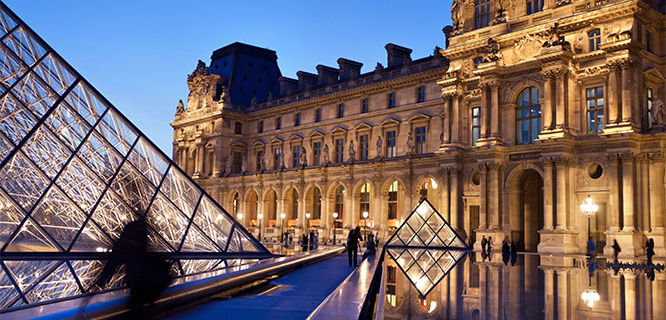
The pont Neuf, or "new bridge," is Paris' oldest standing bridge (built 1578–1607). Its 12 arches span the widest part of the river. Unlike other bridges, this one never had houses or buildings growing on it. The turrets were originally for vendors and street entertainers. In the days of Henry IV, who promised his peasants "a chicken in every pot every Sunday," this would have been a lively scene. From the bridge, look downstream (west) to see the next bridge, the pedestrian-only pont des Arts. Ahead on the Right Bank is the long Louvre Museum. Beyond that, on the Left Bank, is the Orsay. And what's that tall black tower in the distance?
The Seine
Our walk ends where Paris began — on the Seine River. From Dijon to the English Channel, the Seine meanders 500 miles, cutting through the center of Paris. The river is shallow and slow within the city but still dangerous enough to require steep stone embankments (built 1910) to prevent occasional floods.
In summer, the roads that run along the river are replaced with acres of sand, as well as beach chairs and tanned locals, creating Paris Plage. The success of the Paris Plage event has motivated some city officials to propose the permanent removal of vehicles from those fast lanes — turning the lanes into riverside parks instead.
Any time of year, you'll see tourist boats and the commercial barges that carry 20 percent of Paris' transported goods. And on the banks, sportsmen today cast into the waters once fished by Paris' original Celtic inhabitants.
We're done. The closest Métro stop is Pont Neuf, across the bridge on the Right Bank.
Updated for 2008. For lots more information, check out our best-selling Rick Steves' Paris guidebook — or join us on one of our free-spirited tours in Paris.