Home > Plan Your Trip > Best Destinations > Italy

Assisi's Basilica of Saint Francis

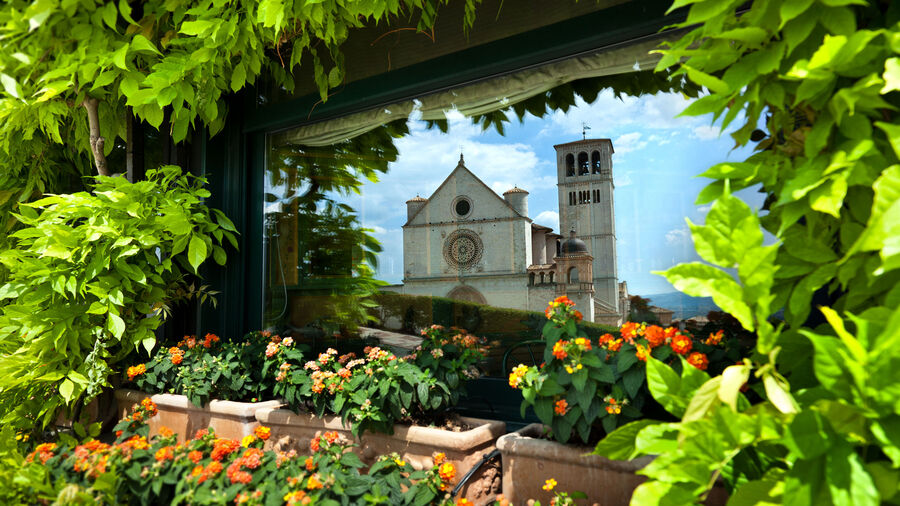
Basilica of Saint Francis

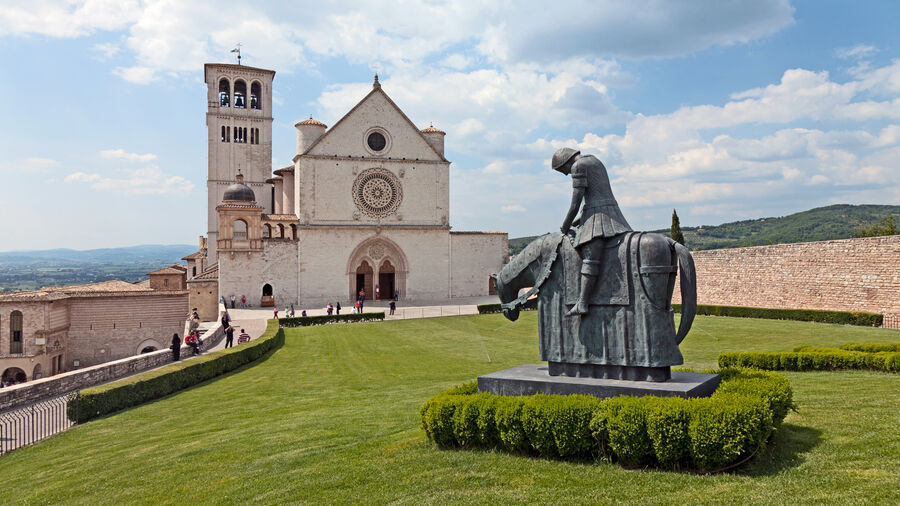
In 1226 St. Francis was buried (with the outcasts he had stood by) outside of his town on the "hill of the damned." Now called the "Hill of Paradise," this is one of the artistic highlights of medieval Europe. It's frescoed from top to bottom by the leading artists of the day: Cimabue, Giotto, Simone Martini, and Pietro Lorenzetti. A 13th-century historian wrote "No more exquisite monument to the Lord has been built."

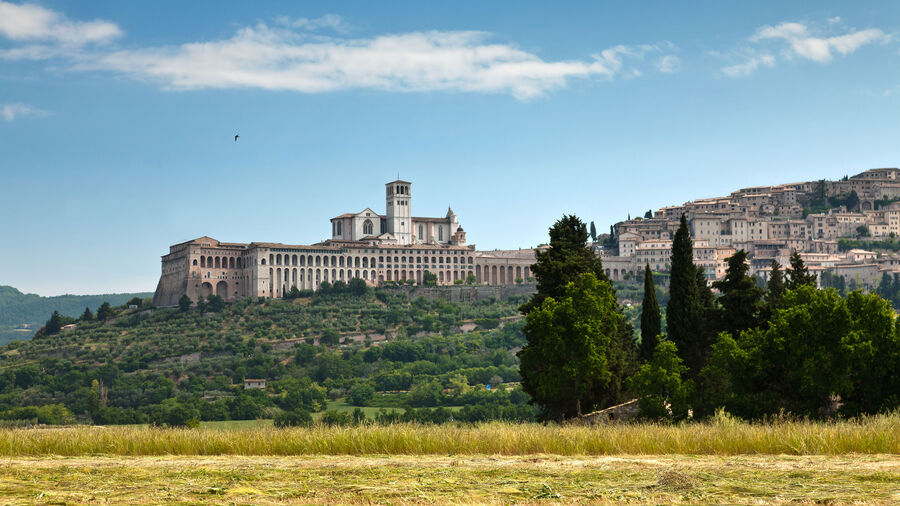
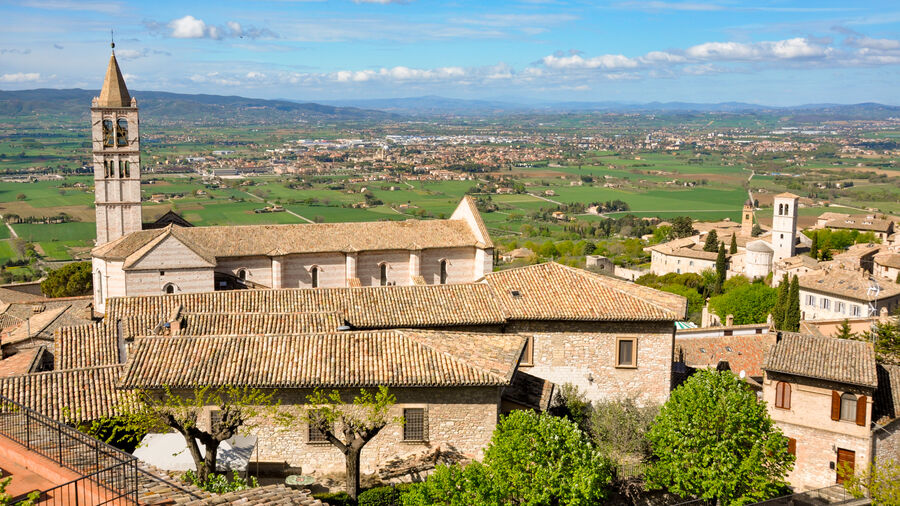
From a distance you see the huge arcades "supporting" the basilica. These were 15th-century quarters for the monks. The arcades lining the square leading to the church housed medieval pilgrims.

There are three parts to the church: upper basilica, lower basilica, and the saint's tomb (below the lower basilica). In the 1997 earthquake, the lower basilica (with nine-foot-thick walls) was undamaged. The upper basilica (with three-foot-thick walls and bigger windows) was damaged. Restoration was completed in November 1999.

Cost, Hours, Information: Free entry, lower basilica daily 6:30-18:45, until 18:00 in winter, relic chapel in lower basilica supposedly 9:00-18:00 but often closed, upper basilica daily 8:30-18:50, until 17:50 in winter (tel. 075-819-100, www.sanfrancescoassisi.org). Modest dress is required to enter the church — no sleeveless tops or shorts for men, women, or children. The info center (ask about €4 audioguide, 75 min) sells an excellent guidebook, The Basilica of Saint Francis: A Spiritual Pilgrimage (€2.50, by Goulet, McInally, and Wood), which was used as a source for the self-guided tour (see below).

Self-Guided Tour

Inside the Basilica of St. Francis

The Basilica of St. Francis — a theological work of genius — is difficult for the 21st-century tourist/pilgrim to appreciate. Since the basilica is the reason most visit Assisi and the message of St. Francis has even the least devout blessing the town Vespas, I've designed this self-guided tour with the stress on the place's theology (rather than art history).

Enter through the grand doorway of the lower basilica. Just inside, decorating the top of the first arch, look up and see St. Francis, who greets you with a Latin inscription. Sounding a bit like John Wayne, he says the equivalent of "Slow down and be joyful, pilgrim. You've reached the Hill of Paradise, and this church will knock your spiritual socks off." Start with the tomb (turn left into the nave; midway down the nave to your right, follow signs and go downstairs to the tomb).

The Message

Francis' message caused a stir. He traded a life of power and riches for one of obedience, poverty, and chastity. The Franciscan existence (Brother Sun, Sister Moon, and so on) is a space where God, man, and the natural world frolic harmoniously. Franciscan friars, known as the "Jugglers of God," were a joyful part of the community. In an Italy torn by fighting between towns and families, Francis promoted peace and the restoration of order. (He set an example by reconstructing a crumbled chapel.) While the Church was waging bloody Crusades, Francis pushed ecumenism and understanding. Even today the leaders of the world's great religions meet here for summits.

This rich building seems to contradict the teachings of the poor monk it honors. But it was built as an act of religious and civic pride to remember the hometown saint. It was also designed and still functions as a pilgrimage center and a splendid classroom.

The Tomb

Holy relics were the "ruby slippers" of medieval Europe. They gave you power — got your prayers answered and helped you win wars — and ultimately helped you get back to your eternal Kansas. For obvious reasons of security, you didn't flaunt your relics. In fact, Francis' tomb was hidden until 1818, when this crypt was opened to the public. The saint's remains are above the altar in the stone box with the iron ties. His four closest friends are buried in the corners of the room. Opposite the altar, up four steps in between the entrance and exit, notice the remains of Francis' rich Roman patron, Jacopa dei Settesoli, in an urn behind the black metal grill. Climb back to the lower nave.

The lower basilica is appropriately Franciscan, subdued and Romanesque. The nave was frescoed with parallel scenes from the lives of Christ and Francis — connected by a ceiling of stars. Unfortunately, after the church was built and decorated, the popularity of the Franciscans meant side chapels needed to be built. Huge arches were cut out of some scenes, but others survive. The first panels show Jesus being stripped of his clothing, across the nave from the famous scene of Francis stripping off his clothes in front of his father. In the second arch fresco on the right wall, Christ is being taken down from the cross (just half his body can be seen) and it looks like the story is over. Defeat. But in the opposite fresco we see Francis preaching to the birds, reminding the faithful that through baptism, the message of the Gospel survives.

These stories directed the attention of the medieval pilgrim to the altar where, through the sacraments, he met God. The church was thought of as a community of believers sailing toward God. The prayers coming out of the nave (navis, or ship) fill the triangular sections of the ceiling — called vele, or sails — with spiritual wind. With a priest for a navigator and the altar for a helm, faith propels the ship.

Stand behind the altar (toes to the bottom step) and look up. The three scenes in front of you are, to the right, Obedience (Francis wearing a yoke); to the left, Chastity (in a tower of purity held up by two angels); and straight ahead, Poverty. Here, Jesus blesses the marriage as Francis slips a ring on Lady Poverty. In the foreground two "self-sufficient" merchants (the new rich of a thriving North Italy) are throwing sticks and stones at the bride. But Poverty, in her patched wedding dress, is fertile and strong, and even those brambles blossom into a rosebush crown.

Putting your heels to the altar and bending back like a drum major, look up at Francis, who traded a life of earthly simplicity for glory in heaven. Now, turn to the right and march . . .

In the corner, steps lead into the Relic Chapel (often closed for weddings or services, but worth a look if open). Circle the room clockwise. You'll see the silver chalice and plate that Francis used for the bread and wine of the Eucharist (in small, dark, windowed case set into wall, marked Calice con Patena) . Francis believed that his personal possessions should be simple, but the items used for worship should be made of the finest materials. In the corner display case is a small section of the haircloth worn by Francis as penitence. In the next corner are the tunic and slippers that Francis wore during his last days. Next, find a prayer (in a fancy silver stand) that St. Francis wrote for Brother Leo, signed with his tau cross. Tav ("tau" in Greek), the last letter in the Hebrew alphabet, is symbolic of faithfulness to the end. Francis signed his name with this simple character. Next is a papal document (1223) legitimizing the Franciscan order and assuring his followers that they were not risking a (deadly) heresy charge. Finally, see the tunic lovingly patched and stitched by followers of the five-foot, four-inch-tall St. Francis.

Back upstairs, look around at the painted scenes in this transept. In 1300 this was radical art — believable homespun scenes, landscapes, trees, real people. Check out the crucifix (by Giotto) with the eight sparrow-like angels. For the first time, holy people are expressing emotion: one angel turns her head sadly at the sight of Jesus, and another scratches her hands down her cheeks, drawing blood. Mary, who'd been in control until now, has fainted in despair. The Franciscans, with their goal of bringing God to the people, found a natural partner in Europe's first modern painter, Giotto.

To see the Renaissance leap, look at the painting to the right. This is by Cimabue — it's Gothic, without the 3-D architecture, natural backdrop, and slice-of-life reality of the Giotto work. Cimabue's St. Francis is considered by some to be the earliest existing portrait of the saint.

This church brought together the greatest Sienese (Martini and Lorenzetti) and Florentine (Cimabue and Giotto) artists of the day. Enjoy the Martini saints and their exquisite halos at eye-level on the left.

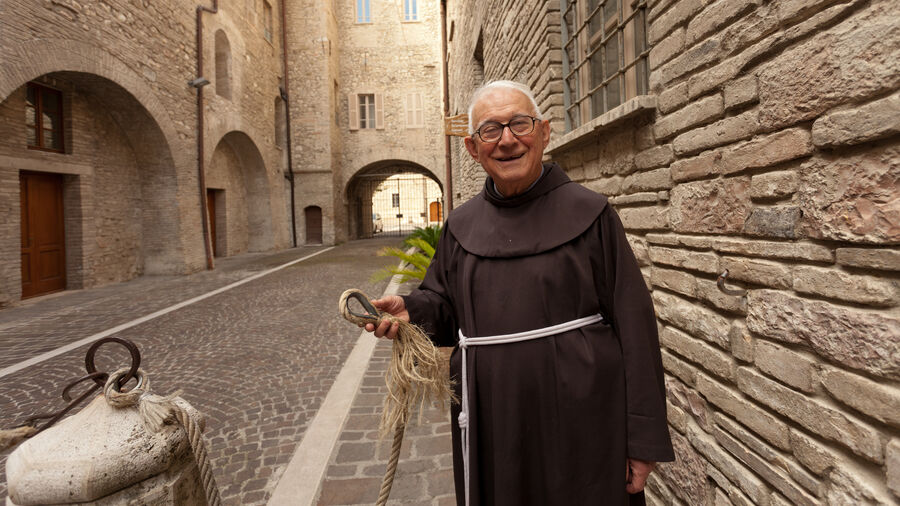
Francis' friend, "Sister Death," was really not all that terrible. In fact, Francis would like to introduce you to her now (above and to the right of the door leading into the relic chapel). Go ahead, block the light and meet her. I'll wait for you upstairs, in the courtyard. By the way, monks in robes are not my idea of easy-to-approach people, but the Franciscans are still God's jugglers (and most of them speak English).

From the courtyard, climb the stairs to the upper basilica. The upper basilica, built later than the lower, is brighter, Gothic (the first Gothic church in Italy, 1228), and nearly wallpapered by Giotto. This gallery of frescoes by Giotto and his assistants shows 28 scenes from the life of St. Francis.

Look for these scenes:

Before you leave, look at the ceiling above the altar and front entrance to see large tan patches. These careful repairs were made after the basilica was damaged in the 1997 earthquake. It's a blessing that so many of the frescoes remain.

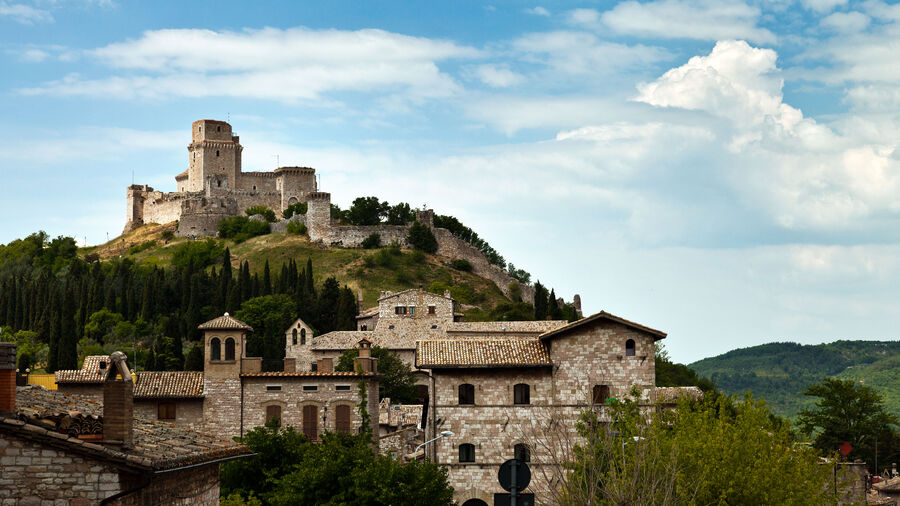
Near the outside of the upper basilica are the Latin pax (peace) and the Franciscan tau cross in the grass. Tau and pax. For more pax, take the high lane back to town, up to the castle, or into the countryside.

Updated for 2007. For lots more information, check out our best-selling Rick Steves' Italy guidebook — or join us on one of our free-spirited tours in Italy.