

Norway’s Scenic Wonders, in a Nutshell
By Rick Steves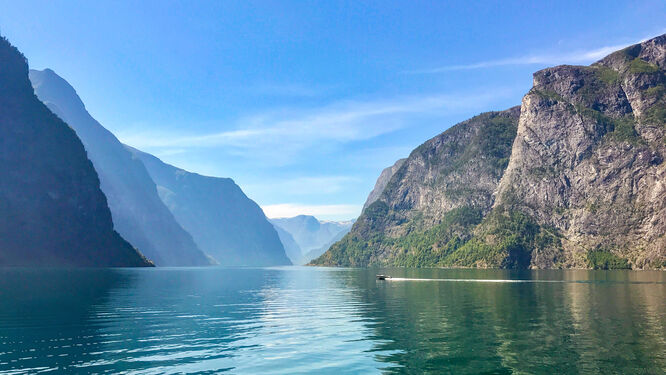
My grandparents came over on the boat from Norway, so I'm partial to that corner of Europe. But you don't have to be from Viking stock to appreciate Norway's otherworldly natural beauty. And you can appreciate it even on a short trip: From Oslo, northern Europe's most scenic train ride takes you up and over the country's mountainous spine and into the land of shiplap dreams in one day. The tourist board calls it "Norway in a Nutshell," and that's just what it gives you.
Norway's greatest claim to scenic fame is its deep and lush saltwater inlets. And, frankly, if you go to Oslo and don't get out to the fjords, your passport should be revoked. Sognefjord, Norway's longest (120 miles) and deepest (one mile), offers Norway's best combination of scenic wonder and accessibility.
For the most efficient one-day look at fjords, follow the Nutshell trip's series of well-organized train, ferry, and bus connections, which puts this beautiful fjord country on a scenic platter. Ambitious and energetic travelers can see the whole shebang in a day; with more time or less energy, consider an overnight along the fjord or in Bergen.
You can book the Nutshell route from Oslo to Bergen on your own or take a package tour; either way, you'll want to make your reservations at least or or five weeks in advance. July and August are the best months to go. (For details see my advice on train travel in Norway.)
The Nutshell route starts with a spectacular train ride, leaving Oslo at about 6:30 a.m. for Bergen. As the train roars over Norway's mountainous backbone, the windswept heaths, glaciers, deep forests, countless lakes, and a few rugged ski resorts create a harsh beauty. This stretch of railroad is an amazing engineering feat. Completed in 1909, it's 300 miles long and peaks at 4,266 feet — which, at this Alaskan latitude, is far above the tree line. You'll go under 18 miles of snow sheds, over 300 bridges, and through 200 tunnels in just under seven hours.
At Myrdal, a 12-mile spur line drops you 2,800 breathtaking feet in 55 minutes to the village of Flåm, on an arm of the Sognefjord. It's party time on board, and the engineer even stops the train for photos at the best waterfall, Kjosfossen.
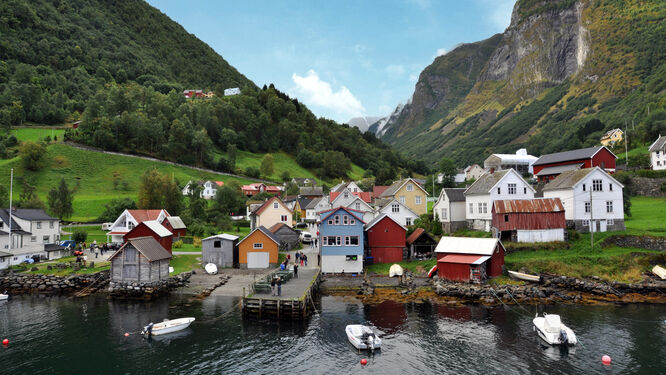
While most Norway in a Nutshell tourists zip immediately from the train onto the scenic fjord boat in Flåm, those with time enjoy an overnight stop on the fjord.
Flåm is a handy tourist depot with several simple hotels. Aurland, a few miles up the fjord from Flåm, is more of a town. It's famous for producing some of Norway's sweetest geitost — goat cheese. Aurland makes a good home base if you're staying longer. Nearly every train arriving in Flåm connects with a bus or boat to Aurland. While nearby Bergen is famous for its rain — more than six feet a year — Sognefjord is in a relative sun belt, with only two feet of rain a year.
The train from Myrdal to Flåm is quite scenic, but the ride doesn't do the view justice. For the best single day's activity from Flåm, take the train up to Myrdal and then hike or bike (rentable in Flåm) the half-gravel, half-paved road back down to Flåm. Bring a picnic and your camera.
From Flåm, Nutshellers catch the most scenic of fjord cruises (sightseeing boats leave throughout the day). For two hours, photo-snapping tourists scurry on the drool-stained deck like nervous roosters, scratching fitfully for a shot that catches the magic. Waterfalls turn the black-rock cliffs into a bridal fair. You can nearly reach out and touch the sheer, towering walls. The ride is one of those fine times, like being high on the tip of an Alp, when a warm camaraderie spontaneously combusts among the strangers who've come together for the experience. The boat takes you up one narrow arm (Aurlandsfjord) and down the next (Nærøyfjord) to the nothing-to-stop-for town of Gudvangen, where waiting buses shuttle you back to the main train line at Voss. From Voss, carry on into Bergen for a short evening visit (or skip Bergen and return to Oslo from here).
Bergen, Norway's second city and historic capital, is an entertaining place. You can finish the day there by browsing the touristy but fun wharf area, or zipping up the funicular to the top of 1,000-foot-tall "Mount" Fløyen for city and fjord views. While Bergen certainly deserves more time, those who need to make the Nutshell a true day trip can catch the night train back to Oslo. Returning early the next morning to Oslo's station, as you yawn and stretch and scout out a cup of coffee, it'll hit you: You were gone for 24 hours, experienced the fjord wonder of Europe, and sampled a bit of scenic Bergen to boot.