

Feeling Barcelona’s Creative Pulse
By Rick Steves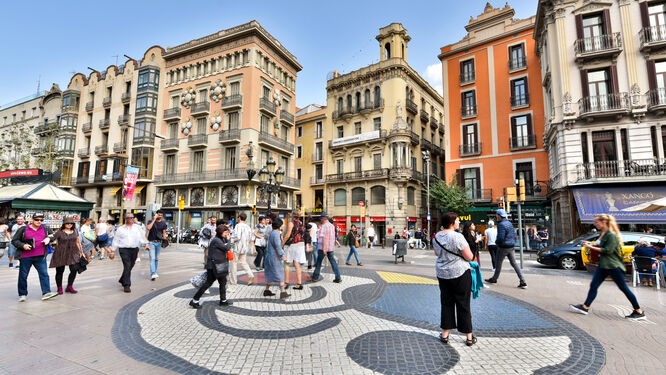
If you're in the mood to surrender to a city's charms, let it be in Barcelona. Life bubbles in its narrow old town alleys, grand boulevards, and elegant modern district. While Barcelona has an illustrious past — from Roman colony to 14th-century maritime power — it's enjoyable to throw out the history books and just drift through the city.
A stroll down Barcelona's main pedestrian drag, the Ramblas, is a good place to start. This grand boulevard takes you from rich (the elegant main square, Plaça de Catalunya) to rough (the port) in a one-mile walk past plenty of historic pieces of this great city.
The street, whose name comes from the Arabic for "stream," is an endless current of people and action. For generations, this boulevard was beloved by locals and tourists alike for its parade of local charm and thriving market. But be warned that with the advent of short-term rentals, locals have been driven out of the neighborhood by higher rents as landlords choose to make more money housing tourists. And with that exodus, so goes the local charm. Today the Ramblas is a tourist trap made even more disappointing by the overabundance of pickpockets also targeting the tourists. It's still worth a look, but if you have fond memories from a previous visit, you leave thinking: Ramblas…R.I.P.
East of the Ramblas is Barcelona's Gothic quarter, the Barri Gòtic, which surrounds the colossal Barcelona Cathedral. The narrow streets that weave around the cathedral are a tangled but inviting grab bag of undiscovered Art Nouveau storefronts, neighborhood flea markets, musty junk shops, classy antique shops, and musicians strumming the folk songs of Catalunya (the independent-minded region of northeast Spain, of which Barcelona is the capital). If you visit, be sure to look up at the wrought-iron balconies whose bars barely contain their domestic jungles.
A creative spirit is part of the ebb and flow of daily life in Barcelona. The designs of Modern artist Joan Miró, who lived in the Barri Gòtic, show up all over the city, from murals to mobiles to the La Caixa bank logo. If you enjoy his childlike style, ride the funicular up to Parc de Montjuïc, and peek into the Fundació Joan Miró, a showcase for his art.
The Barri Gòtic was also home to a teenage Pablo Picasso. It was in Barcelona, in the 1890s, that Picasso grabbed hold of the artistic vision that rocketed him to Paris and fame. The Picasso Museum, in the Ribera district, offers the best collection of the artist's work in Spain. Seeing Picasso's youthful, realistic art, you can better appreciate the genius of his later, more abstract art.
For a refreshing break from the dense old city, head north to the more modern Eixample neighborhood, with its wide sidewalks, graceful shade trees, chic shops, and Art Nouveau frills. Barcelona was busting out of its medieval walls by the 1850s, so a new town — called the Eixample ("expansion") — was laid out in a grid pattern.
The district's original vision was egalitarian. But over time the Eixample became a showcase for wealthy residents and their Catalan architects, who turned the flourishing Art Nouveau style into Modernisme, their own brand of decorative design. Buildings bloom with characteristic colorful, leafy, and flowing shapes in doorways, entrances, facades, and ceilings.
Barcelona's most famous Modernista artist, Antoni Gaudí, created architectural fantasies that are a quirky quilt of galloping gables and organic curves. A quintessential example of Modernisme, La Pedrera (a.k.a. Casa Milà) has walls of wavy stone and a fanciful, undulating rooftop, where 30 chimneys play volleyball with the clouds. At Casa Batlló, a green-blue ceramic-speckled facade, tibia-esque pillars, and shell-like balconies are inspired by nature, while the humpback roofline suggests a cresting dragon's back.
But Gaudí's best-known and most exciting work is the still-unfinished Sagrada Família, with its melting-ice-cream-cone spires and towers. The Nativity Facade, the only part of the church essentially completed in Gaudí's lifetime, shows the architect's original vision. Mixing Christian symbolism, images from nature, and the organic flair of Modernisme, it's a fine example of his unmistakable style.
Take an elevator up one of the towers for a gargoyle's-eye perspective of this inspiring church. Local craftsmen often finish up their careers by putting in a couple of years working on the project. Over a lifetime of visits, I've enjoyed watching its progress, and I can't wait to see it completed — perhaps within this decade. Your admission helps pay for the ongoing construction (buy your timed-entry ticket well in advance).
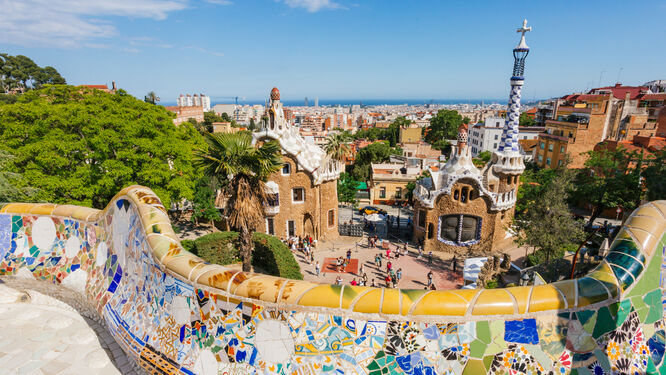
Gaudí fans also enjoy the artist's fun-loving genius in the colorful, freewheeling Park Güell, a 30-acre hilltop garden once intended to be a 60-residence housing project. Carpeted with fanciful mosaics and dotted with sculptures (including a giant tiled lizard), this park is a great place to cap the day.
Whether in its art, characteristic back lanes, architecture, or proud Catalan culture, Barcelona offers visitors an always colorful, always lively experience.