Home > Plan Your Trip > Best Destinations > Spain

Granada's Alhambra: An Oasis of Elegance

Rick Steves' do-it-yourself tour

The Alhambra

This last and greatest Moorish palace is one of Europe's top attractions. Attracting up to 8,000 visitors a day, it's the reason most tourists come to Granada. Nowhere else does the splendor of Moorish civilization shine so brightly.

The last Moorish stronghold in Europe is, with all due respect, really a symbol of retreat. Granada was only a regional capital for centuries. Gradually the Christian Reconquista moved south, taking Córdoba (1237) and Sevilla (1248). The Moors held Granada until 1492. As you tour their grand palace, remember that while Europe slumbered through the Dark Ages, Moorish magnificence blossomed: busy stucco, plaster "stalactites," colors galore, scalloped windows framing Granada views, exuberant gardens, and water, water everywhere. Water — so rare and precious in most of the Islamic world — was the purest symbol of life to the Moors. The Alhambra is decorated with water: standing still, cascading, masking secret conversations, and drip-dropping playfully.

The Alhambra in Four Parts

The Alhambra — not nearly as confusing as it might seem — consists of four sights clustered together atop a hill: Charles V's Palace (Christian Renaissance palace plopped on top of the Alhambra after the reconquest, free entry), Alcazaba (empty old fort with tower and views), Palacios Nazaries (exquisite Moorish palace, a must-see), and Generalife (fancy gardens).

1. Charles V's Palace

It's only natural for a conquering king to build his own palace over his foe's palace, and that's exactly what the Christian king Charles V did. The Palacios Nazaries wasn't good enough for Charles, so he built this new home, which was financed by a salt-in-the-wound tax on Granada's defeated Muslim population. With a unique circle within a square design by Pedro Machuca, a devotee of Michelangelo and Raphael, this is Spain's most impressive Renaissance building. Stand in the circular courtyard surrounded by mottled marble columns, then climb the stairs. Charles' palace was designed to have a dome, but it was never finished — his son, Philip II, abandoned it to build his own palace, El Escorial. Even without the dome, acoustics are perfect in the center — stand in the middle and sing your best aria. The palace doubles as one of the venues for the popular International Festival of Music and Dance. Inside are two not-so-interesting museums (both free to enter, as is the palace itself): Museo de Bellas Artes (upstairs) and the better Museo de la Alhambra, showing off some of the Alhambra's best surviving Moorish art, along with one of the lions from Palacios Nazaries' fountain (Tue–Sun 8:30–14:30, closed Mon, on ground floor).

2. Alcazaba

The fort — the original "red castle" or "Alhambra" — is the oldest and most ruined part of the complex, offering exercise and fine city views. What you see is from the mid-13th century, but there was probably a fort here in Roman times. Once upon a time, this tower defended a town (or medina) of 2,000 Muslims living within the Alhambra walls. From the top (looking north), find Plaza Nueva and the San Nicolás viewpoint (in the Albayzín). To the south are the Sierra Nevada mountains. Is anybody skiing today?

Think of that day in 1492 when the Christian cross and the flags of Aragon and Castile were raised on this tower, and the fleeing Moorish king Boabdil (Abu Abdullah in Arabic) looked back and wept. His mom chewed him out, saying, "Weep like a woman for what you couldn't defend like a man." With this defeat, over seven centuries of Muslim rule in Spain came to an end. Much later, Napoleon stationed his troops at the Alhambra, contributing substantially to its ruin when he left.

To get to Palacios Nazaries, follow the signs down and around to the palace. If you're early, duck into the exhibit across from the palace entry. It's in Spanish, but the models of the Alhambra upstairs are easy to appreciate.

3. Palacios Nazaries
Palacios

During the 30-minute entry time slot stamped on your ticket, enter the jewel of the Alhambra: the Moorish royal palace. Once you're in, you can relax — there are no more time constraints. You'll walk through three basic sections: royal offices, ceremonial rooms, and private quarters. Built mostly in the 14th century, this palace offers your best possible look at the refined, elegant Moorish civilization of Al-Andalus (Arabic for the Iberian Peninsula).

You'll visit rooms decorated from top to bottom with carved wood ceilings, stucco "stalactites," ceramic tiles, molded-plaster walls, and filigree windows. Open-air courtyards in the palace feature fountains with bubbling water like a desert oasis, the Quran's symbol of heaven. The palace is well-preserved, but the trick is to imagine it furnished and filled with Moorish life...sultans with hookah pipes lounging on pillows on Persian carpets, tapestries on the walls, heavy curtains on the windows, and ivory-studded wooden furniture. The whole place was painted with bright colors, many suggested by the Quran — red (blood), blue (heaven), green (oasis), and gold (wealth). And throughout the palace, walls, ceilings, vases, carpets, and tiles were covered with decorative patterns, mostly calligraphy writing out verses of praise from the Quran.

As tempting as it might be to touch, stucco is very susceptible to the oils from your hand. If everyone that went through the Alhambra touched a wall, there would be no decoration left for the next generation to treasure.

As you wander, keep the palace themes in mind: water, no images, "stalactite" ceilings — and few signs telling you where you are. Even today, the route constantly changes. Use the map in this chapter to locate the essential stops listed below.

Court of Myrtles (Patio de los Arrayanes): Walk through a few administrative rooms (the mexuar) until you hit a big rectangular courtyard with a pond lined by a myrtle bush hedge — the Court of Myrtles (Patio de los Arrayanes). Moors loved their patios — with a garden and water, under the sky. Women, who rarely went out, stayed in touch with nature here, in the Court of Myrtles (Patio de los Arrayanes). One exotic theory about the function of this complex is that the living quarters for the women (harem) were upstairs — the Quran let a man have "all the women you can maintain with dignity." Notice the wooden screens (erected by jealous husbands) that allowed the cloistered women to look out without being clearly seen. The less interesting, but more likely, theory is that the upstairs was for winter use, and the cooler ground level was for the hotter summer.

Boat Room (Sala de la Barca): Head left (north) from the entry into the long, narrow antechamber to the throne room, called the "Boat Room." It's understandable that many think the Boat Room (Sala de la Barca) is named for the upside-down-hull shape of its fine cedar ceiling. But the name is actually derived from the Arab word baraka, meaning "divine blessing and luck" (which was corrupted to barca, similar to the Spanish word for "boat," barco.) As you passed through this room, blessings and luck are exactly what you'd need — because in the next room, you'd be face-to-face with the sultan.

The Hall of the Ambassadors (Gran Salón de Embajadores): A visitor here would have stepped from the glaring Court of Myrtles into this dim, cool, incense-filled world, to meet the silhouetted sultan. Imagine the alcoves functioning busily as work stations, and the light at sunrise or sunset, rich and warm, filling the room.

Note the finely carved Arabic script. Muslims avoided making images of living creatures — that was God's work. But they could carve decorative religious messages. One phrase — "only Allah is victorious" — is repeated 9,000 times throughout the palace. Find the character for "Allah" — it looks like a cursive W with a nose on its left side. The swoopy toboggan blades underneath are a kind of artistic punctuation setting off one phrase.

In 1492, two historic events likely took place in this room. Culminating a 700-year-long battle, the Reconquista was completed here as the last Moorish king, Boabdil, signed the terms of his surrender before eventually leaving for Africa.

And it was here that Columbus made his pitch to Isabel and Ferdinand to finance a sea voyage to the Orient. Imagine the scene: The king, the queen, and the greatest minds from the University of Salamanca gathered here while Columbus produced maps and pie charts to make his case that he could sail west to reach the East. Ferdinand and the professors laughed and called Columbus mad — not because they thought the world was flat (most educated people knew otherwise), but because they thought Columbus had underestimated the size of the globe, and thus the length and cost of the journey.

But Isabel said "Sí, señor." Columbus fell to his knees (promising to pack light, wear a money belt, and use the most current guidebook available).

Continue deeper into the palace to a court where, 600 years ago, only the royal family and their servants could enter. It's the much-photographed...

Court of the Lions

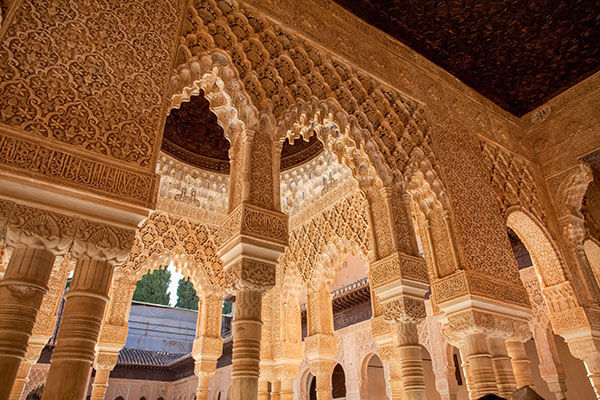
Court of the Lions (Patio de los Leones): This patio, the Patio de los Leones, features a fountain that's usually ringed with 12 lions, but they've been removed for two years for restoration (probably back in place in 2010). One of the lions is on display in the Museo de la Alhambra inside the Charles V palace.

Why did the fountain have 12 lions? Since the fountain was a gift from a Jewish leader celebrating good relations with the sultan (Granada had a big Jewish community), the lions probably represent the 12 tribes of Israel. During Moorish times, the fountain functioned as a clock, with a different lion spouting water each hour. (Conquering Christians disassembled the fountain to see how it worked, and it's never worked since.) From the center, four streams went out — figuratively to the corners of the earth and literally to various apartments of the royal family. Notice how the court, with its 124 columns, resembles the cloister of a Catholic monastery. The craftsmanship is first-class. For example, the lead fittings between the pre-cut sections of the columns allow things to flex during an earthquake (which it has, preventing destruction during shakes).

On the right, off the courtyard, is a square room called the Hall of the Abencerrajes (Sala de los Abencerrajes). According to legend, the father of Boabdil took a new wife and wanted to disinherit the children of his first marriage — one of whom was Boabdil. In order to deny power to Boabdil and his siblings, he killed nearly the entire pro-Boabdil Abencerraje family. The sultan thought this would pave the way for the son of his new wife to be the next sultan. Happily, he stacked 36 Abencerraje heads in the pool under this sumptuous honeycombed stucco ceiling. But his scheme failed, and Boabdil ultimately assumed the throne. Bloody power struggles like this were the norm here in the Alhambra.

The Hall of the Kings (Sala de los Reyes) is at the end of the court opposite where you entered. Notice the ceilings of the three chambers branching off this gallery. Breaking from the tradition of imageless art, paintings on the goat-leather ceiling depict scenes of the sultan and his family. The center room shows a group portrait of the first 10 of the Alhambra's 22 sultans. The scene is a fantasy, since these people lived over a span of many generations. The two end rooms show scenes of princely pastimes, such as hunting and shooting skeet. In a palace otherwise devoid of figures, these offer a rare look at royal life in the palace.

The next room, the Hall of the Two Sisters (Sala de Dos Hermanas), has another oh-wow stucco ceiling lit from below by clerestory windows. The room features geometric patterns and stylized Arabic script quoting verses from the Quran, but no figures. If the inlaid color tiles look "Escher-esque," you've got it backwards: Escher is Alhambra-esque. M. C. Escher was inspired by these very patterns on his visit. Study the patterns — they remind us of the Moorish expertise in math.

Washington Irving Room: That's about it for the palace. From here you wander through a few more rooms including one (marked with a large plaque) where Washington Irving wrote Tales of the Alhambra. While living in Spain in 1829, Irving stayed in the Alhambra. It was a romantic time, when the place was home to Gypsies and donkeys. His "tales" kindled interest in the place, causing it to become recognized as a national treasure. A plaque on the wall thanks Irving, who later served as the US ambassador to Spain (1842–1846). Here's a quote from Irving's "The Alhambra by Moonlight": "On such heavenly nights I would sit for hours at my window inhaling the sweetness of the garden, and musing on the checkered fortunes of those whose history was dimly shadowed out in the elegant memorials around."

Hallway with a view: Here you'll enjoy the best-in-the-palace view of the labyrinthine Albayzín — the old Moorish town on the opposite hillside. Find the famous viewpoint (below where the white San Nicolás church tower breaks the horizon). Creeping into the mountains on the right are the Roma (Gypsy) neighborhoods of Sacromonte. Still circling old Granada is the Moorish wall (built in the 1400s to protect the city's population, swollen by Muslim refugees driven south by the Reconquista).

Leaving the Palacios Nazaries, follow signs to the Partal Gardens, go through the gardens, then follow signs directing you left to the Generalife Gardens or right to the exit.

4. Generalife Gardens
Genaralife

If you have a long wait before your entry to the Palacios Nazaries, tour these gardens first, then the Alcazaba fort and Charles V's Palace.

The sultan's vegetable and fruit garden and summer palace, called the Generalife (hen-ne-raw-LEEF-ay), are a short hike uphill past the ticket office. The 2,000 residents of the Alhambra enjoyed the fresh fruit and veggies grown here. But most importantly, the sultan enjoyed a quiet and handy escape from things in the summer: his Generalife Palace.

Walk through the sprawling gardens (planted only in the 1930s — in Moorish times, there were no cypress trees here). The sleek, modern amphitheater has been recently renovated and continues to be an important concert venue for Granada. It sees most activity during the International Festival of Music and Dance. Many of the world's greatest artists have performed here, including Arthur Rubenstein, Rudolf Nureyev, and Margot Fonteyn. At the small palace, pass through the dismounting room (imagine dismounting onto the helpful stone ledge, and letting your horse drink in the trough here). Step past the guarded entry into the most perfect Arabian garden in Andalucía.

This summer home of the Moorish kings, the closest thing on earth to the Quran's description of Heaven, was planted over 600 years ago — remarkable longevity for a European garden. Five-hundred-year-old paintings show it looking essentially as it does today. The flowers, herbs, aromas, and water are exquisite...even for a sultan. Up the Darro River, the royal aqueduct diverted a life-giving stream of water into the Alhambra. It was channeled through this decorative fountain to irrigate the bigger garden outside, then along an aqueduct into the Alhambra for its 2,000 thirsty residents.

At the end of the pond, you enter the sultan's tiny, three-room summer palace. From the end, climb 10 steps into the Christian Renaissance gardens. The ancient, decrepit tree rising over the pond inspired Washington Irving, who wrote that this must be the "only surviving witness to the wonders of that age of Al-Andalus."

Exiting left to the top floor of the palace reveals a stunning view of the Albayzín. Don't climb the Escalera del Agua unless you need the exercise...it only goes up and then back down. Pass the turnstile (pausing for a view back down into the palace garden) and follow salida (exit) signs as you circle back to where you entered the Generalife.

Your visit to the Alhambra is complete, and you've earned your reward. "Surely Allah will make those who believe and do good deeds enter gardens beneath which rivers flow; they shall be adorned therein with bracelets of gold and pearls, and their garments therein shall be of silk" (Quran 22.23).

Getting there: There are three ways to get to the Alhambra.

1. From Plaza Nueva, hike 30 minutes up the street Cuesta de Gomérez. Keep going straight, with the Alhambra high on your left. The ticket pavilion is on the far side of the Alhambra, near the Generalife Gardens.

2. From Plaza Plaza Isabel La Católica, catch a red #32 minibus, marked Alhambra (€1.20, runs every 15 min)There are three Alhambra stops: Justice Gate (below Palacios Nazaries and Charles V's Palace), Charles V, and Generalife (where you must pick up your tickets, closest to the gardens).

3. Take a taxi (€5, taxi stand on Plaza Nueva).

Don't drive. Though there's convenient parking near the entrance of the Alhambra (€1.50/hr), leaving via the one-way streets will send you into the traffic-clogged center of modern Granada.

Planning Your Visit

It's a 15-minute walk from the entry (at the top end) to Palacios Nazaries at the other end. Be sure to arrive at the Alhambra with enough time to make it to the palace before your allotted half-hour entry time slot ends. The ticket-checkers at Palacios Nazaries are strict. Remember that if you have an appointment for Palacios Nazaries after 14:00, you can't be admitted to the Alhambra any earlier than 14:00. And, as mentioned earlier, once you're inside the palace, you can stay as long as you want. Note that some rooms may be closed for renovation.

To minimize walking, see Charles V's Palace and the Alcazaba fort before your visit to Palacios Nazaries. When you finish touring Palacios Nazaries, you'll leave through the Partal Gardens near the Alhambra entrance, not far from the Generalife Gardens. Depending on your time, you can visit the Generalife Gardens before or after your visit to Palacios Nazaries. If you have any time to kill before your palace appointment, you can do it luxuriously on the breezy view terrace of the parador bar (actually within the Alhambra walls). While you can find drinks, WCs, and guidebooks near the entrance of Palacios Nazaries, you'll find none inside the actual palace. If you're going to the Albayzín afterwards, catch bus #32, which goes from the Alhambra back through Plaza Isabel La Católica and then up into the Albayzín.

Audioguide: The €4 audioguide brings the palace to life, providing providing two hours of description for 48 stops (rent it at the entrance and at Charles V's Palace; you'll need to return it where you picked it up). Audioguides are not available for night visits.

Guidebooks: Consider getting a guidebook in town and reading it the night before to understand the layout and history of this remarkable sight before entering. The classic is The Alhambra and the Generalife (€10, includes great map, sold in town and throughout the Alhambra), but even better is the slick Alhambra and Generalife in Focus, which is more readable and has vibrant color photos (€8, sold at many bookstores around town). The one called the "official guide" is not as good.

Cost: The Alcazaba fort, Palacios Nazaries (Moorish palace), and Generalife Gardens require a €12 combo-ticket. If the Palacios Nazaries is booked up during the day, consider getting the €6 ticket that covers only the Generalife and Alcazaba, viewing the garden and fort during the day, and then visiting the palace at night. Only Charles V's Palace is free. A good map is included with your ticket if you ask for it at the ticket window.

Hours: The Alhambra is open daily March–Oct 8:30–20:00, Nov–Feb 8:30–18:00 (ticket office opens at 8:00, last entry one hour before closing time, tel. 902-441-221). The Palacios Nazaries is also open most evenings.

The Alhambra by Moonlight: If you're frustrated by the reservation system, or just prefer doing things after dark, late-night visits to the Alhambra are easy (you never need a reservation — just buy your ticket upon arrival) and magical (less crowded and beautifully lit). The night visits only include the Palacios Nazaries (not the Alcazaba fort or the Generalife Gardens) — but, hey, the palace is 80 percent of the Alhambra's thrills anyway. It's open March–Oct Tue–Sat 22:00–23:30 (ticket office open 21:30–22:30), closed Sun–Mon; and Nov–Feb only Fri–Sat 20:00–21:30 (ticket office open 19:30–20:30), closed Sun–Thu.

Getting a Reservation for the Alhambra

Many tourists never get to see the Alhambra, because tickets sell out. Make a reservation as soon as you're ready to commit to a time (especially during Holy Week, on weekends, or on major holidays). Off-season (July–Aug and winter), you might be able to just walk right in. While things are getting easier, the crowds are unpredictable, and getting a reservation is quite easy.

The Alhambra complex's top sight is the Moorish palace — Palacios Nazaries. Only 300 visitors per half hour are allowed to enter. You have a 30-minute time slot during which you must enter the palace (printed on your ticket). Once inside the palace, however, you can linger as long as you like. If your entry time to Palacios Nazaries is before 14:00, you can stroll the Alhambra grounds anytime in the morning, see the palace at your appointed time, and leave the Alhambra by 14:00 (although you can get away with staying longer in the fort, gardens, or palace, you won't be allowed to enter any of these sites after 14:00). If your ticket is stamped for 14:00 or later, you can go inside the Alhambra grounds no earlier than 14:00.

For instance, if you have a reservation to visit Palacios Nazaries between 16:30 and 17:00, you can enter the Alhambra grounds as early as 14:00 and see the fort and Generalife Gardens before the palace. (Because of the time restriction on afternoon visits, morning times sell out the quickest. But for most travelers, an afternoon is ample time to see the site, the light is perfect, and there are fewer tour groups.)

Reserving in Advance: There are four options, each with a (worth it) €1 surcharge. On the day of your tour, make sure you arrive at the Alhambra about an hour before your palace appointment, since the ticket line may require up to a 20-minute wait, and walking from the ticket office to the palace takes 15 minutes. Bring the same debit/credit card that you used to make the reservation. If you have a foreign card, you will need to wait in line at the windows marked Retirada de Reservas to pick up your tickets. Bring photo identification and be prepared to enter your credit or debit card's PIN (this is the code required to withdraw cash, not your credit card's security code).

1. Order online at www.alhambra-tickets.es.

2. Order by phone. Within Spain, dial 934-923-750 (cheaper), 902-888-001, or 902-505-061. To call internationally, dial the international access code first (00 from a European country, 011 from the US or Canada), then 34-934-923-750 (daily 8:00–24:00, can reserve between one day and a year in advance; while waiting for an operator, a recording tells you the date of the next available tickets). Pay with a credit card (Visa, MasterCard, or American Express).

3. If you plan to stay at one of the fancier hotels, ask - when you book your hotel room - if the hotelier can book a reservation for you to visit the Alhambra the day after your arrival.

4. If you buy a Bono Turístico city pass in advance, you can also book your Alhambra appointment then.

Picking Up Tickets: On the day of your tour, make sure you arrive at the Alhambra about an hour before your palace appointment, since the ticket line may require up to a 20-minute wait, and walking from the ticket office to the palace takes 15 minutes. Bring a photo ID and the same debit/credit card that you used to make the reservation. If you have a foreign card, you will need to wait in line at the windows marked Retirada de Reservas to pick up your tickets. Be prepared to enter your credit or debit card's PIN (this is the code required to withdraw cash, not your credit card's security code).

If you're in Granada without a reservation: You have a number of alternatives, the least appealing of which involves getting up unnaturally early (#2).

1. Your hotel may able to book a reservation for you on short notice.

2. Stand in line at the Alhambra. The Alhambra admits 7,800 visitors a day. Six thousand tickets are sold in advance. The rest — 1,800 — are sold each day at the Alhambra ticket window labeled Venta Directa (near Generalife Gardens and parking lot). The ticket office opens at 8:00, and on busy peak-season days, tickets can sell out quickly. Generally if you're in line by about 7:30, you'll get an entry time, probably for later that day. On a slow day, you'll get in right away. During busy times, you'll have an appointment for later that day. If the Palacios Nazaries is booked up during the day, get the €6 ticket that covers only the Generalife Gardens and the Alcazaba fort, then return to visit the palace at night.

3. Consider getting Granada's Bono Turístico city pass if you'll be staying at least two days. It costs €30, covers admission to the Alhambra and Granada's other top sights, and includes a reservation for the Alhambra (scheduled when you buy the pass). But there are no guarantees that a time slot will be available (especially during April–June and Sept–Oct).

4. Take a tour of the Alhambra. The pricier hotels can book you on an expensive €49 GranaVisión tour that includes transportation to the Alhambra and a guided tour of the Palacios Nazaries. The same company also offers tours of the city and province (tel. 958-535-875, www.visitargranada.com).

5. Easiest of all, simply go at night.

Updated for 2010. For lots more information, check out our best-selling Rick Steves' Spain guidebook — or join us on one of our free-spirited tours in Spain.