Home > Plan Your Trip > Best Destinations > Spain

The Route of the White Hill Towns: Arcos de la Frontera

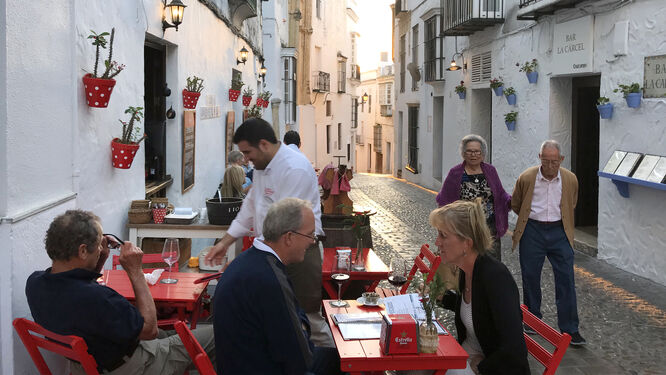
Rick with locals
"If you see 3 cute guys sitting on a bench, join them." — Rick gets friendly with the people of Arcos de la Frontera.

When tourists head south from Madrid, it's generally for Granada, Córdoba, Sevilla, or the Costa del Sol. The big cities have their urban charms, but the Costa del Sol is a concrete nightmare, worthwhile only as a bad example. The most Spanish thing about the south coast is the sunshine — but that's everywhere. For something different and more authentic, try exploring the interior of Andalucía along the Route of the White Hill Towns (Ruta de los Pueblos Blanchos). This charm bracelet of cute villages gives you wonderfully untouched Spanish culture.

Spend a night in the romantic queen of the white towns, Arcos de la Frontera. Towns with "de la Frontera" in their names were established on the front line of the Christians' centuries-long fight to recapture Spain from the Moors, who were slowly pushed back into Africa. Today, these hill towns — no longer strategic and no longer on any frontier — are just passing time peacefully.

A Walk through Arcos

Arcos smothers its long, narrow hilltop and tumbles down the back of the ridge like the train of a wedding dress. It's larger than the other Andalusian hill towns but equally atmospheric. Arcos consists of two towns: The fairy-tale old town on top of the hill, and the fun-loving lower or new town. The old center is a labyrinthine wonderland, a photographer's feast. Viewpoint-hop through town. Feel the wind funnel through the narrow streets as cars inch around tight corners. Join the kids' soccer game on the churchyard patio. Enjoy the moonlit view from the main square, Plaza del Cabildo.

The thoughtful traveler's challenge is to find meaning in the generally overlooked tiny details of historic towns such as Arcos. A short walk from its Church of Santa María to the Church of San Pedro (St. Peter) is littered with fun glimpses into the town's past.

Stand at the viewpoint opposite the church on Plaza del Cabildo. Survey the square, which in the old days doubled as a bullring. On your right is the parador, a former palace of the governor. On your left is the city hall (with the TI), below the 11th-century Moorish castle where Ferdinand and Isabel held Reconquista strategy meetings (closed to the public). Directly in front is the Church of Santa María. Notice the church's fine but unfinished bell tower. The old one fell in the earthquake of 1755 (famous for destroying Lisbon). The new replacement was intended to be the tallest in Andalucía after Sevilla's — but money ran out. It looks like someone lives on an upper floor. Someone does. The church guardian lives there in a room strewn with bell-ringing ropes.

Enjoy the square's viewpoint. Belly up to the railing and look down. The people of Arcos boast that only they see the backs of the birds as they fly. Ponder the parador's erosion concerns (it lost part of its lounge in the 1990s — dropped right off), orderly orange groves, and fine views toward Morocco. The city council considered building an underground parking lot to clear up the square, but nixed it because of the land's fragility. You're 330 feet above the river. This is the town's suicide departure point for men (women jump from the other side).Arcos streets

The Church of Santa María faces the main square. After Arcos was reconquered from the Moors in the 13th century, this church was built — atop a mosque. In the pavement, notice the 15th-century magic circle: 12 red and 12 white stones — the white ones with various constellations marked. When a child came to the church to be baptized, the parents would stop here first for a good Christian exorcism. The exorcist would stand inside the protective circle and cleanse the baby of any evil spirits. This was also a holy place back in Muslim times. While locals no longer use it (and a modern drain now marks the center), Sufis, a sect of Islam, still come here in a kind of magical pilgrimage every November.

In 1699 an earthquake cracked the church's foundation. Arches were added to prop it against neighboring buildings. Thanks to these, the church survived the bigger earthquake of 1755. All over town, arches support earthquake-damaged structures.

Lately the town rumbles only when the bulls run. Señor González Oca's tiny barbershop (on a corner behind the church) is plastered with posters of bulls running Pamplona-style through the streets of Arcos during Holy Week. An American from the nearby Navy base at Rota was killed here by a bull in 1994.

Completing your circle around the church, turn left under more earthquake-damaged arches and walk east down the bright, white Calle Escribanos. From now to the end of this walk you'll go basically straight until you come to the town's second big church (St. Peter's). After a block, you hit Plaza Boticas. At the end of the street on your left is the top restaurant in town, El Convento.

On your right is the last remaining convent in Arcos. Notice the no-nunsense window grilles high above, with tiny peepholes in the latticework for the cloistered nuns to see through. Step into the lobby under the fine portico to find their one-way mirror and a blind spinning cupboard. Push the buzzer and one of the eight sisters (several are from Kenya and speak English well) will spin out some €5 boxes of excellent, freshly-baked pine-nut cookies for you to consider buying. If you ask for magdalenas, bags of cupcakes will swing around (€1.50). These are traditional goodies made from completely natural ingredients (offered daily but not reliably 8:30–14:30 & 17:00–19:00; be careful, if you stand big and tall to block out the light, you can actually see the sister through the glass). Buy some cupcakes to support their church work and give them to kids as you complete your walk.

The covered market (mercado) at the bottom of the plaza (next to the convent) resides in an unfinished church. Notice the half-a-church-wall at the entry. The church was being built for the Jesuits, but construction stopped in 1767 when King Charles III, tired of the Jesuit appetite for politics, expelled the order from Spain. The market is closed on Sunday and on Monday — because they rest on Sunday, there's no produce, fish, or meat ready for Monday. Poke inside. It's tiny but has everything you need. Pop into the servicio público (public WC) — no gender bias here.

Continue straight (passing the market on your right) down Calle Boticas. Peek discreetly into private patios. These wonderful, cool-tiled courtyards filled with plants, pools, furniture, and happy family activities are typical of Arcos (and featured on the TI's Patios walks). Except in the mansions, these patios are generally shared by several families. Originally, each courtyard served as a catchment system, funneling rain water to a drain in the middle, which filled the well. You can still see tiny wells in wall niches with now-decorative pulleys for the bucket.

Look for Las Doce Campanas bakery, which sells traditional and delicious sultana cookies (€1.20 each). These big, dry macaroons (named for the sultans) go back to Moorish times. At the next corner, squint back above the bakery to the corner of the tiled rooftop. The tiny and very eroded mask was placed here to scare evil spirits from the house. This is Arcos' last surviving mask from a tradition that lasted until the mid-19th century.

At the next intersection, notice the ancient columns on each corner. All over town these columns — many actually Roman, appropriated from their ancient settlement at the foot of the hill — were put up to protect buildings from reckless donkey carts.

As you continue straight, notice that the walls are scooped out on either side of the windows. These are a reminder of the days when women stayed inside but wanted the best possible view of any people-action in the streets. These "window ears" also enabled boys in a more modest age to lean inconspicuously against the wall to chat up eligible young ladies.

Across from the old facade ahead, find the Association of San Miguel. Duck right, past a bar, into the oldest courtyard in town — you can still see the graceful Gothic lines of this noble home. The bar is a club for retired men — always busy when a bullfight's on TV or during card-game times. The guys are friendly. Drinks are cheap (a stiff Cuba Libre costs €1.50). You're welcome to flip on the light and explore the old-town photos in the back room.

Just beyond (facing the elegant front door of that noble house) is Arcos' second church, St. Peter's. You know it's St. Peter's because St. Peter, mother of God, is the centerpiece of the facade. Let me explain. It really is the second church, having had an extended battle with Santa María for papal recognition as the leading church in Arcos. When the pope finally favored Santa María, St. Peter's parishioners even changed their prayers. Rather than honoring "María," they wouldn't even say her name. They prayed "Saint Peter, mother of God."

In the cool of the evening, the tiny square in front of the church — about the only flat piece of pavement around — serves as the old-town soccer field for neighborhood kids. Until a few years ago, this church also had a resident bellman — notice the cozy balcony halfway up. He was a basket-maker and a colorful character, famous for bringing a donkey into his quarters that grew too big to get back out. Finally, he had no choice but to kill and eat the donkey (€1 donation, church open Mon–Fri 10:00–14:00 & 15:30-19:00).

Twenty yards beyond the church, step into the fine Galería de Arte San Pedro, featuring painting, pottery, and artisans in action. Walk inside. Find the water drain and the well.

Across the street, a sign directs you to "Mirador" — a tiny square 100 yards away that affords a commanding view of the countryside. The reservoir is used for water sports in the summertime, and forms part of a power plant that local residents protested based on environmental issues but to no avail.

From St. Peter's church, circle down and around back to the main square, wandering the tiny neighborhood lanes. Just below St. Peter's is a delightful little Andalusian garden (formal Arabic style, with aromatic plants such as jasmine, rose, and lavender, and water in the center). The lane, called Higinio Capote — below Santa Maria — is particularly picturesque with its many geraniums. Peek into patios, kick a few soccer balls, and savor the views.

More White Hill Towns

From Arcos, the back road to Ronda is spiked with plenty of undiscovered and interesting hill towns. About half the towns I visited were memorable. Only Arcos (by bus) and Ronda (by train) are easily accessible by public transportation. Other towns are best seen by car. Good information on the area is rare but not necessary. Pick up the tourist brochure on the white towns at a nearby big-city tourist office, get a good map, and crank your spirit of adventure to high.

Along with Arcos, here are my favorite white villages:

Zahara, a tiny town with a tingly setting under a Moorish castle, has a spectacular view. During Moorish times, Zahara was contained within the fortified castle walls above today's town. It was considered the gateway to Granada and a strategic stronghold for the Moors by the Spanish Christian forces of the Reconquista. Locals tell of the Spanish conquest of the Moors' castle as if it happened yesterday: After the Spanish failed several times to seize the castle, a clever Spanish soldier noticed that the Moorish sentinel would toss a rock over the wall to check if any attackers were hiding behind it. If birds flew up, the sentinel figured that no people were there. One night a Spaniard hid there with a bag of pigeons and let them fly when the sentinel tossed his rock. Seeing the birds fly, the guard figured he was clear to enjoy a snooze. The clever Spaniard then scaled the wall, opened the door to let his troops in, and the castle was conquered. That was in 1482. Ten years later Granada fell, the Muslims were back in Africa, and the Reconquista was completed. Today the castle is little more than an evocative ruin (always open, free, and worth the climb) with a commanding view. And Zahara is a fine overnight stop for those who want to hear only the sounds of birds, wind, and elderly footsteps on ancient cobbles.

Grazalema, another postcard-pretty hill town, offers a royal balcony for a memorable picnic, a square where you can watch old-timers playing cards, and plenty of quiet, whitewashed streets to explore. Graced with cork, carob, and pinsapo pine trees, Grazalema offers lots of scenery with greenery. Plaza de Andalucía, a block off the view terrace, has several decent little bars and restaurants and a popular candy store. Shops sell the town's beautiful handmade wool blankets. Situated on a west-facing slope of the mountains, Grazalema catches clouds and is known as the rainiest place in Spain — but I've had only blue skies on every visit.

Estepa, spilling over a hill crowned with a castle and convent, is a freshly washed, happy town that fits my dreams of southern Spain. It's situated halfway between Córdoba and Málaga, but it's light years away from either. Atop Estepa's hill is the convent of Santa Clara, worth three stars in any guidebook but found in none. Enjoy the territorial view from the summit, then step into the quiet, spiritual perfection of the church.

In any of these towns, evening is prime time. The promenade begins as everyone gravitates to the central square. The spotless streets are polished nightly by the feet of families licking ice cream. The whole town strolls — it's like "cruising" without cars. Buy an ice-cream sandwich and join the parade.

Updated for 2008. For lots more information, check out our best-selling Rick Steves' Spain guidebook — or join us on one of our free-spirited tours in Spain.