

Spanish History Set in Stone
By Rick Steves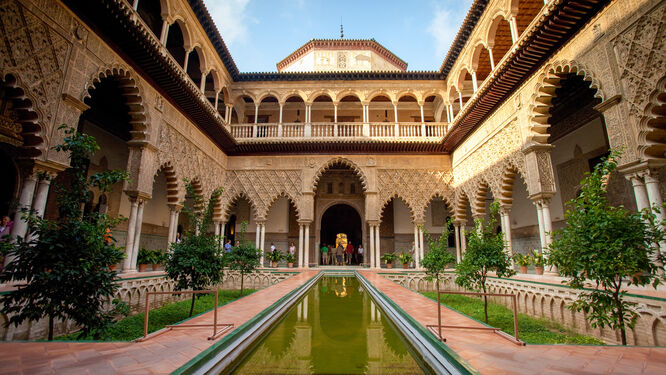
The story of Spain has all the thrills, tragedy, madness and inspiration of a Shakespeare (or Cervantes) drama — and they're true. And, if you know where to look, you can read this history in Spain's great buildings. For a quick "Cliff's Notes" sampling, let's pay a visit to four great sights: Sevilla's cathedral, Sevilla's Alcázar, the El Escorial palace outside of Madrid, and Gaudí's Park Güell in Barcelona.
Spain's history is dominated by 700 years of pushing the Muslim Moors (who invaded in 711, taking over all of Iberia) back into Africa. Throughout Iberia, it seems every old church was built upon a mosque. There is no bolder example of this than Sevilla's immense cathedral. Imagine the bloody fighting: Muslim against Christian. Finally, with the battle over — Christians standing among bloody bodies of defeated Moors — the victors looked at the huge mosque (which was built centuries earlier upon a Visigothic church) and declared, "We'll tear this down and build a cathedral...so big, people in the future will look at it and declare us madmen." Only the minaret was kept, refashioned into a bell tower with huge lettering on top declaring, "This is stronger now, made in the name of God." And beside it looms the biggest Gothic church in the world. Look around and you are likely to think..."madmen!"
It's no coincidence that 1492 is a date famous for two events: the final expulsion of the Moors, and Columbus' "discovery" of America. It's as if the momentum of the successful Reconquista propelled Spaniards into the Western hemisphere as conquistadors. This no-holds-barred mix of the world's most motivated explorers, warriors, shipbuilders, fortune-hunters, politicians, and evangelists planted Spain's flag and religion around the globe — enabling Spain to beat England to the claim that the sun never set on its empire.
Across the square from Sevilla's sprawling cathedral is its sprawling Alcázar palace, a Christian palace built in a Moorish style. As Christians reconquered Iberia, many Muslim artists and architects stayed on the peninsula, giving the new society the Mudejar style. (Mudejar means, literally, "those who stayed.")
The Alcázar feels like an Arabian Nights fairy tale: finely etched domes, lacy arcades, keyhole arches, and comfy courtyards. At its heart lies the elegantly proportioned 14th-century Court of the Maidens. Here the designers created an ingenious micro-climate: water, plants, pottery, thick walls, and darkness...all to be cool. It's a fine example of this Mudejar style. While the decor is Moorish or Arabic in style, you'll see depictions of peacocks, animals, and kings (which you wouldn't find in true Muslim decor). The walls are ornamented with a stylized Arabic script. In older Moorish buildings, such as Granada's Alhambra, this script creates a visual chant of Koranic verses. But in this Christian palace, the Arabic script relates New Testament verses and propaganda phrases, such as "dedicated to the magnificent Sultan Peter — thanks to God!"
Christopher Columbus is big in Spain, especially in Sevilla's Alcázar. It was here that Queen Isabel debriefed Columbus after his New World discoveries…and realized this could be very big business. In 1503, she created a new palace wing to administer Spain's New World ventures.
America was not the only thing being discovered as the 15th century rumbled into the 16th. In the eyes of traditionalists, a dangerous new generation of humanists and Renaissance thinkers seemed to revel in heresy (they not only believed the world was round, but that it was far from the center of the universe). It was also the generation which broke the Roman Catholic's monopoly on Christianity in Western Europe. After a long religious war, the continent split: half became Protestant and half remained Catholic. Each half believed the other was in Satan's grip. Spain, leading those who remained loyal to Rome, spearheaded the Counter-Reformation (with Europe's mightiest army supplemented by missionaries, inquisitors, and future saints) to protect and recruit as many souls as possible for its righteous Catholic cause.
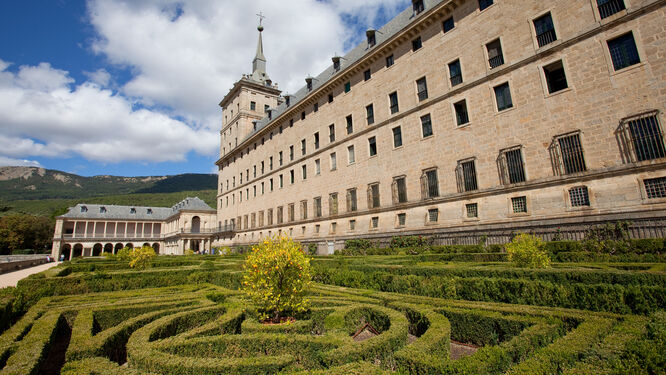
A 30-mile side-trip from Madrid takes you to the imposing palace of this age, El Escorial. The stern Monasterio de San Lorenzo de El Escorial is a complete turnabout from the elegant (even sensual) Alcázar. Instead, it exudes a sobering mix of power and no-nonsense religion. This 16th-century combo palace/monastery gives us a better feel for the Counter-Reformation and the Inquisition than any other building. Built at a time when Catholic Spain felt threatened by Protestant heretics, its construction dominated the Spanish economy for a generation (1563–1584). Because of this bully in the national budget, Spain has almost nothing else to show from this most powerful period of her history.
The giant, gloomy building made of gray-black stone looks more like a prison than a palace. About 650 feet long and 500 feet wide, it has 2,600 windows, 1,200 doors, more than 100 miles of passages, and 1,600 overwhelmed tourists. Four hundred years ago, the enigmatic, introverted, and extremely Catholic King Philip II ruled his empire and directed the Inquisition from here, surrounded by plain white walls, well-scrubbed floors, and austere furnishings. Today it's a time capsule of Spain's maturing "Golden Age," packed with history, art, and Inquisition ghosts.
El Escorial was conceived by Phillip II as a multi-purpose complex, including a grand mausoleum for Spain's royal family, a monastery for lots of prayer for the royal souls, a small palace to provide a kind of Camp David for Spain's royalty, and a school to embrace humanism in a "boundaried" way that also promoted the Catholic faith. In the immense library it's clear: Education was a priority for the Spanish royalty. As you leave, look back above the door. The plaque warns "Excomunion…" (i.e., you'll be excommunicated if you take a book without checking it out properly). Who needs late fees when you hold the keys to hell?
As we move ahead in time, much of Spain's more modern architecture feels like a rehash of its past. But Barcelona is a lively exception. As Europe leapt from the 19th century into the 20th, it celebrated a rising standard of living and nearly a century without a major war. Future revolutions were in their early, starry-eyed-dreamer stages. Impressionists came out of their studios to paint in the gardens, and Art Nouveau architects forced hard steel and concrete into softer organic shapes. Barcelona's answer to Art Nouveau was Modernisme, and its genius was Antonio Gaudí.
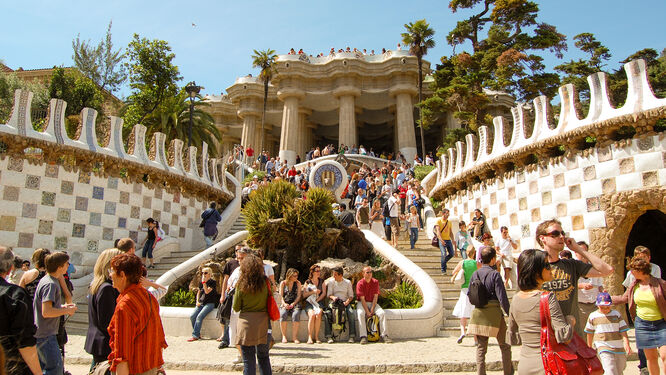
To appreciate Gaudí's work you need to understand it. For instance, his colorful, curvy Park Güell overlooking Barcelona was a place I never liked — until a visit with a local guide. Rather than the park it is today, Gaudí originally intended this garden to be a 60-residence housing project — a kind of gated community. As a high-income housing development, it flopped. As a park, it's a delight for local families. And like the Sagrada Família church in the distance, it offers travelers a fascinating peek into the eccentric personality of the architect and his times.
Imagine if this gated community was filled with Barcelona's wealthy, and you lived there. Stepping past fancy gatehouses, you'd walk by Gaudí's wrought iron gas lamps (his dad was a blacksmith and he always enjoyed this medium). Then you'd climb the grand stairway past the ceramic dragon fountain. At the top you'd drop by the Hall of 100 Columns, a produce market for the neighborhood's 60 mansions. These fun columns, each different (made from concrete and rebar, topped with colorful ceramics, and studded with broken bottles and bric-a-brac), add to the market's vitality. After shopping, you'd continue up, glancing down along the playful "pathway of columns" that support a long arcade. Gaudí drew his inspiration from nature, and these arc like a surfer's perfect "tube." At the top of the terrace, you'd relax on a colorful bench (designed to fit your body ergonomically) and enjoy one of Barcelona's best views.
A hundred years ago, Gaudí's shiny new Park Güell was out in the sticks — too far from Barcelona's cultural scene — and it failed after just two homes were constructed. Considering that the city's wealthiest neighborhoods surround the park today, it seems Gaudí's gated community brainstorm was just a century ahead of its time.