Catalunyan Monks & Serrated Mounts
By Rick Steves
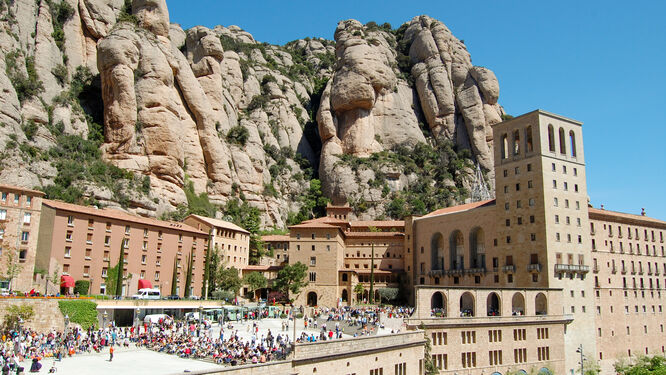
Montserrat, with its unique rock formations, dramatic mountain monastery, and connection with the Catalan people and their struggles, is a popular day trip from Barcelona (30 miles away). This has been Catalunya's most important pilgrimage site for a thousand years. Hymns explain how this "serrated mountain" was carved by little angels with golden saws. Geologists blame 10 million years of nature at work. While only 2,400 feet above sea level, the mountains seem higher as they rocket right up from the river valley. The air is certainly fresher than in Barcelona.
![]() |
| A church and monastic community hotbed high in the mountains above Barcelona. |
The monastery is Benedictine. Its monks (only 30 today) wear the Benedictine rope belts with three knots (symbolizing the three rules of St. Benedict: poverty, chastity, and obedience). Since 1025, the slogan "ora et labora" (prayer and work) pretty much sums up life for a monk here on the serrated mountain.
For centuries, Montserrat has been a strongly beating spiritual and cultural heart of the Catalan people. As Dictator Franco wanted a monolithic Spain, this wasn't a favorite place of his. In fact, during the tightest days of his rule, the Sardana dance was still performed here (but with a different name) and literature was published in the outlawed Catalan language. In 1970, 300 intellectuals demonstrating for more respect for human rights in Spain, were locked up in monastery for several days by Franco's police.
The Benedictines welcome visitors — both pilgrims and tourists — and offer this travel tip: Please remember that the most important part of your Montserrat visit is not enjoying the architecture, but rather discovering the religious, cultural, historical, social, and environmental values that together symbolically express the life of the Catalan people.
The first hermit monks built huts at Montserrat around A.D. 900. By 1025 a monastery was founded. The Montserrat Escolania, or choir school, soon followed and is considered to be the oldest music school in Europe. Fifty young boys, who live and study in the monastery itself, make up the choir, which performs daily except Saturday (Mon–Fri at 13:00, Sun-Thu at 18:45, and Sun also at 12:00, choir on vacation in July). Note: The boys sing for only ten minutes, the basilica is jam-packed, and you'll likely actually see almost nothing. Also note that if you attend the evening performance, you'll miss the last funicular down the mountain.
In 1811 the French destroyed Montserrat (only the Black Madonna survived, hidden away by monks). In the 1830s, the Spanish royalty, tired of dealing with the pesky religious orders, dissolved the monasteries and convents. In the Romantic age, around the 1850s, the monks returned and monastic community enjoyed a reawakening along with Catalan culture in general. The Basilica and monastery were reconstructed and became, once more, a powerful symbol of the Catalan people. In the late 19th century, here, as all over Europe, nations (especially those without states) were energized. In Catalunya, the much-loved football club, Palace of Music, even birth of local champagne (cava) all coincided with the reconstruction of Montserrat… Catalan culture was spreading its wings.
Orientation: Everything at the sanctuary is within a few minutes walk of your entry point. The parking lot, cable car station, rack train terminal from below and funicular whisking hikers to the ridge top above all meet at a long square below the basilica where you'll find the helpful tourist office (daily 9:00-19:40, closes at 18:00 in winter, tel. 938-777-701). There's a humble farmers' wives' market here each morning selling traditional produce. Arrive early or late, as tour groups mob the place in mid day.
Information: A helpful audioguide, available only at the TI, covers the general site, basilica, and museum (€5 includes book). The audiovisual center (next to TI) offers some cultural and historical perspective. The lame interactive exhibition — nowhere near as exciting as the mountains and basilica outside — includes computer touch-screens and a short 20-minute video in English, covers the mountain's history, and gives a glimpse into the daily lives of the monastery's resident monks (€2, same hours as TI).
The Basilica: Before entering the church, stand at the back of the square facing its façade and take this spin tour (counter-clockwise). Start like a good pilgrim by facing Mary, the centerpiece of the church's façade. St. Benedict is below her to the left. Five arches line the base of the church: the far right leads pilgrims to the highpoint of any visit (La Moreneta), the center arch leads into the church, the arch second from left directs you to a small ex-voto chapel filled with articles representing prayer requests or thanks. Left of the church, the delicate arches mark the old monks' cloister. Below that are four trees the monks like to plant for their symbolism (palm = martyrdom, cypress = eternal life, olive = peace, and laurel = victory). Next to the trees is a public library and peaceful reading room. The big archway is the private entrance to the monastery. Then comes the modern hotel and, below that, the modern white museum. Other buildings provide cells for pilgrims. The Sant Joan funicular lifts hikers up to the trail head (you can see the tiny building at the top). From there you can take a number of fine hikes. Another funicular station descends to the Sacred Cave. And finally five arches separate statues of founders of the great religious orders. Step over to the arches for a commanding view (on a clear day) all the way to the Mediterranean.
While there's been a church here since 11th century, the present church was built in 1850s, and the façade only dates from 1968. The decor is neo-Romanesque, so popular with the Romantic artists of the late 19th century. The basilica itself is ringed with interesting chapels but the focus is on the Black Madonna sitting high above the main altar.
La Moreneta: Montserrat's top attraction is La Moreneta, the statue of the Black Virgin. Pilgrims shuffle along a long and ornate passage leading along side the church for their few moments alone with the virgin (free, daily 8:00–10:30 & 12:00–18:30, in summer also 19:30-20:15). George is the patron saint of Catalunya and La Moreneta is its patroness. While called "black" in English, the Spanish call her Moreneta which means "tanning." The statue was originally lighter, but tanned over the centuries (from smoke from candles, humidity, or its original varnish darkening with age).
Join the line of pilgrims. While Mary's behind a protective glass case, the royal orb she cradles in her hands is exposed. Pilgrims touch Mary's orb with one hand and hold their other hand up to show they accept Jesus. Newlyweds in particular seek Mary's blessing. Immediately after La Moreneta, turn right into the delightful neo-Romanesque prayer chapel where worshippers sit behind the virgin and continue to pray. Don't miss the sumptuous ceiling painted in the Modernist style in 1898 by Joan Llimona. Jesus and Mary are high in heaven. The trail connecting Catalunya with heaven seems to lead through these serrated mountains. Lower figures are people symbolizing the history and culture of Catalunya.
![]() |
| Pilgrims touch the exposed orb of the Black Madonna. |
You'll leave walking along the Ave Maria Path which thoughtfully integrates nature and the basilica. Thousands of colorful votive candles are all busy helping the devout with their prayer needs. Before reaching the square, pop into the little room with the many votive offerings where people leave a personal belonging (wedding dresses, baby's baptism outfits, wax body parts in need of healing, and so on) as part of a prayer request or as a thanks for divine intercession.
The Museum of Montserrat is a bright and shiny and cool collection of paintings and artifacts mostly donated by devout Catalan Catholics. While nothing really earth-shaking, you'll enjoy an air-conditioned wander past lots of antiquities and fine paintings, including works by El Greco, Caravaggio, Monet, Picasso and Dalí (€7, Mon-Fri 10:00-17:45, Sat-Sun 10:00-19:00).
The Sant Joan funicular (see below) continues another 820 feet above the monastery (€4 one-way, €6.30 round-trip). At the top of the funicular, a 20-minute walk takes you to the Sant Joan chapel and the starting point of numerous hikes, described in the TI's Six Itineraries from the Monastery brochure. For a quick and easy chance to get out into the mountainous nature, simply ride up and follow the short 45-minute loop walk back down to the monastery.
The Moreneta was originally located in the Santa Cova (sacred cave), a 40-minute hike down from the monastery. The path is lined with statues depicting scenes from the life of Christ. While the original Black Virgin statue is now in the basilica, a replica sits in the cave. A three-minute funicular ride cuts 20 minutes off the hike (€1.70 one-way, €2.60 round-trip, daily April-Oct 10:30-17:15, Nov-March 11:30-16:15).
Sleeping: While there are ample rustic cells for pilgrim visitors, tourists are welcome to stay in the Hotel Abat Cisneros, a three-star place with 82 rooms and all the comforts. It's low key and appropriate for a sanctuary (Sb-€35-56, Db-€60-100, depending on season, includes breakfast, half- and full-board available, tel. 938-777-701, fax 938-777-724, www.abadiamontserrat.net, reserves@larsa-montserrat.com). An overnight here gets you monastic peace and total break from the modern crowds.
Getting There: By car, once drivers get out of Barcelona, it's a short 30-minute drive to the base of the mountain and a 10-minute series of switchbacks to the actual site (where you'll may find parking for €4 per day). It may be easier to park your car at the lift and ride the cable car up.
Trains leave hourly from Barcelona's Plaça d'Espanya, and take you to the base of the mountain. From there you can take a cable car (the most fun way), or a rack railway up the mountain. For most travelers, it’s simplest to buy a package ticket.
Package Tickets: You can buy one of two special package tickets in Barcelona from the train company. The €20 Trans Montserrat combo-ticket includes your Metro ride in Barcelona to the train station, the train trip, the ride on the cable car or Cremallera rack railway, unlimited trips on the two funiculars up on Montserrat, and entrance to the audiovisual presentation. The €33 Tot Montserrat ticket includes all of this, plus the museum and a self-serve lunch. If you plan to do it all, you’ll save at least €5 with either ticket. Buy your tickets in Barcelona at any of these three places: at the TI kiosk on Plaça d’Espanya; at the uncrowded FGC La Molina office next to Plaça de Catalunya (Mon–Fri 10:00–14:00 & 16:30–20:30, Sat 10:00–14:00, closed Sun, Pelai 17–39 Triangle, tel. 933-664-553, helpful Anna); or at the TI kiosk at Plaça de Catalunya (though it sells only the Trans Montserrat ticket).
![]() |
| A cable car provides a quick alternative to so many switchbacks. |
For cable car: Get off the train at the Montserrat-Aeri stop, where the cable car awaits (4/hr, daily 9:24-13:45 & 14:20-18:45 — note the lunch break). On the way back down, departures from the monastery at :25 past the hour make the Barcelona-bound trains leaving at :39 past the hour. The last efficient departure is at 18:25. Although there's a later cable car departure from the monastery at 18:45 (17:45 off-season), it entails almost an hour-long wait for the train.
For the Cremallera rack railway (mountain train): Get off the train the at Monistrol de Montserrat stop (one stop after Montserrat-Aeri) and catch the Cremallera mountain train (€4 one-way, €6.30 round trip, included with your train or package ticket, hourly, 9:38-18:38, until 20:38 in summer). Monastery departures at :06 past the hour catch the Barcelona-bound train (which departs at :33 past each hour).
Updated for 2008. For lots more tips on Spain, check out our best-selling Rick Steves' Spain guidebook — or join us on one of our free-spirited Spain & Portugal tours!