Istanbul's Grand Bazaar
![]() |
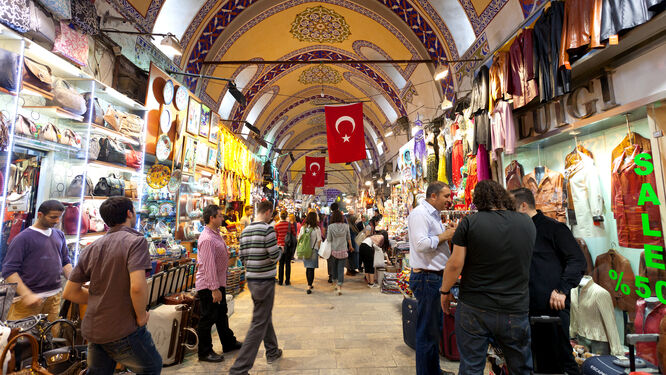
| Attention shoppers: Istanbul's Kapalı Çarşı is the mother of all malls. |
Sprawling over a huge area in the city center, Kapali Çarsi (kah-pah-luh chahr-shuh; "Covered Market") was the first shopping mall ever built. During Byzantine times, this was the site of a bustling market; when the Ottomans arrived, it grew bigger and more diverse. The prime location attracted guilds, manufacturers, and traders, and it grew quickly — its separate chunks were eventually connected and roofed to form a single market hall. Before long, the Grand Bazaar became the center for trade in the entire Ottoman Empire. At its prime, the market was locked down and guarded by more than a hundred soldiers every night, like a fortified castle.
The Grand Bazaar remained Turkey's commercial hub — for both locals and international traders — through the 1950s. Its 4,000 shops were bursting with everything you can imagine, from jewelry to silk clothing, and traditional copperware to exotic, Oriental imports. But then the Grand Bazaar was discovered by travelers seeking the ultimate "Oriental market" experience. Prodded by shopaholic tourists with fat wallets, prices and rents skyrocketed, and soon modest shopkeepers and manufacturers found themselves unable to compete with the big money circulating through the bazaar's lanes. These humble merchants moved outside the bazaar, displaced by souvenir and carpet shops.
Today's Grand Bazaar sells ten times more jewelry than it used to. And, while tourists find it plenty atmospheric, locals now consider its flavor more Western than Oriental. And yet, even though the bazaar has lost some of its traditional ambience, enough artifacts remain to make it an irreplaceable Istanbul experience. This tour takes you through the schlocky tourist zones...but it also takes you by the hand to the market's outer fringe, still frequented by more Turks than visitors.
Orientation
Cost: Free to enter and browse.
Getting There: It's behind the Nuruosmaniye Mosque, across the parking-lot square from the Çemberlitas tram stop.
Pickpocket Alert: The Grand Bazaar may contain the single highest concentration of pickpockets in Istanbul. Watch your valuables.
Self-Guided Tour
Enter the Grand Bazaar through the Nuruosmaniye Gate behind the Nuruosmaniye Mosque. As you walk through the gate, you're at the start of the bazaar's main street, called...
Kalpakçilar Caddesi
Stepping through the door into air heated by thousands of watts of electric bulbs — and by bustling shoppers and merchants — you'll notice the temperature rise by several degrees. This scene is a little overwhelming at first sight. Welcome to the Grand Bizarre...er, Bazaar. You're standing on the bazaar's main street, which leads straight from the Nuruosmaniye Mosque to the Beyazit district, where we'll exit, though we'll take a very roundabout route along the way. This street, Kalpakçilar Caddesi (kahl-pahk-chuh-lahr jahd-deh-see), is "Hatmakers' Street." Historically each street, alley, or corner of the bazaar was dedicated to a particular craft or item, and they still bear those names.
All those light bulbs are illuminating...
Jewelry Showcases
Today's high-traffic, high-rent Kalpakçilar Caddesi is dominated by these glittering displays, containing bigger-ticket items than the traditional hats. Turks love gold, not because they're vain or greedy, but because they're practical: Since local currency has a tendency to devalue, people prefer to invest in something more tangible. Traditionally, Turks celebrating special occasions — such as a wedding or a boy's circumcision — receive gold as a gift. In fact, in the most traditional corners of Turkey, the groom's family still must present the bride's family with gold bracelets before the couple can marry.
Because all this gold is used primarily as an investment, and only secondarily as an accessory, it's most commonly sold in the form of simple 22-carat bracelets (24-carat is too soft to wear). If you see a woman whose arm is lined with five or six of these bracelets, she's not making a fashion statement — she's wearing her family's savings on her sleeve...literally. Recently, jewelers are selling more elaborately decorated designer pieces. These are more expensive and less appealing to thrifty locals (since you're paying for the workmanship, not just the gold itself). Instead, locals who want jewelry for fashion buy cheaper 14- or 18-carat bracelets.
A few steps into the bazaar from the Nuruosmaniye Gate (after the fifth shop on the right), look for the entrance marked Old Bazaar — Sandal Bedesteni over the doorway, a little off the main street. Duck into the courtyard called...
Sandal Bedesteni
The Grand Bazaar is made up of a series of bedestens (beh-dehs-tehns) — commercial complexes of related shops. The Sandal Bedesteni is one of the oldest, dating from the late 15th century. After the Ottomans arrived and took over a Byzantine marketplace here, the bazaar grew organically — new buildings sporadically sprouted up, each one devoted to a particular trade or item. For the convenience of both the shopkeeper and the customer, shops dealing with similar items clustered together. These distinct units, many of which survive today, are called bedesten or han (hahn).
The most traditional bedestens (like this one) have a central courtyard surrounded by shops and workshops on two floors. Later, developers roofed these commercial units and connected them with alleys, creating a unified central market hall. But if you pay attention, you'll notice that each part of the bazaar still has its own unique characteristics (and characters).
The Sandal Bedesteni once housed merchants of valuable fabrics (such as silk and velvet), turban-makers, and jewelers specializing in precious stones. Today it carries ordinary textile products and assorted tourist knock-offs.
Backtrack out to the main drag (Kalpakçilar Caddesi), turn right, and continue to the first intersection, where you'll turn right on Sandal Bedesteni Sokak. Look high above. As in confusing Venice, signs point to various landmarks. Walk straight downhill on this alley — with a high concentration of souvenir shops, carpets, tiles, leather and kilim bags, and chandeliers — toward the intersecting arches. On the right, you'll pass another entrance to the Sandal Bedesteni we just visited. After that, take the next alley on the right. Walk 50 yards to the...
Free Exchange Market
You'll hear it before you see it. From about 10:00 until 17:00, the little alleys branching off this strip are squeezed full of hundreds of boisterous men shouting into their mobile phones and waving their arms. These are currency brokers, and this zone of the bazaar is like a poor man's Wall Street. In this humble setting, people are cutting deals involving hundreds of thousands of dollars and euros every minute.
The Turkish lira is (by European standards) an extremely unstable currency. So, in addition to gold, many Turks still invest in euros or dollars to shore up their savings. Turkey tried to grow with controlled inflation in the 1980s, in order to be more compatible in the international markets. But inflation got out of control — reaching almost 100 percent annually in the 1990s. During this time, people began buying US dollars or German marks. Exchange offices popped up on every corner. On payday, you'd immediately take your paycheck to be converted into dollars, then convert it back to lira when you were ready to buy something with it. Gradually, $100 billion worth of non-Turkish currency was circulating in Turkey — and one-third of this huge amount never showed up in bank accounts. On January 1, 2005, the New Turkish Lira (Yeni Türk Lirasi, or YTL) entered into circulation, trimming off six zeroes and sporting a fresh new look. In 2009, the central bank changed the currency's name back to Türk Lirasi (TL), omitting the word yeni new).
Backtrack to the alley called Sandal Bedesteni Sokak, turn right, and continue one block to where it intersects with the wider...
Aga Sokak
Since the "g" is a vowel lengthener, without any sound of its own, the word "aga" is pronounced "aaa-aah." Looking to the left up Aga Sokak, you'll see the entrance to Cevahir Bedesteni, where they sell antiques, semi-precious stones, and silver items. We'll pass through that bedesten later on the walk.
Continue up the narrow alley called Sandal Bedesteni Sokak. Notice that the shops become less colorful and the clientele becomes more local. This section of the bazaar is mostly devoted to...
Pawn Shops
Many of these shops look empty, with signs on the windows and a few gold items and coins on display. This is where locals can exchange those "investment bracelets" and valuables for some hard cash. When these shops buy jewelry, they deduct whatever the seller paid for workmanship, charge a small commission, and pay for the actual value of the gold.
Continue to the end of the alley, where it ends at Aynacilar Sokak (eye-nah-juh-lahr; "Mirror-Makers' Alley"). Looking to your right, you'll see another gate of the bazaar, named after the neighboring district...
Mahmutpasa Gate
If you went through this exit and walked five blocks down the hill, you'd reach the Spice Market. The area between here and there is a huge outdoor textile bazaar, with retail shops, wholesalers, and workshops. Vendors sell a range of textile products, from underwear and socks to wool sweaters and jackets, to more conservative clothing, turbans, and raincoats. The week before schools open (usually the second week of September), the area is packed with bargain-hunters seeking back-to-school deals.
Step outside the Mahmutpasa Gate and walk a short distance down to a second gate, which opens onto Mahmutpasa Yokusu Sokak. Just beyond this second gate, on the left, is the entrance to...
Kalcilar Han
This is also known as the Gümüsçüler ("silversmith") Hani, because it's a center for the production and sale of all sorts of handcrafted silver objects. Its original name was "Kalicilar" ("lodgers") because it was built to accommodate tradesmen coming here for business. Over time, locals dropped an "i" and began calling it the easier-to-pronounce "Kalcilar" (kahl-juh-lahr). The Kalcilar Han, like others of its kind, resembles a factory. In each workshop, an artisan completes a different step of the production process. A single silver object goes from one workshop to another, just like in a factory production line, with artisans working together to create a finished piece. As you walk the long entryway to the open courtyard, you're looking at a typical han — built on two floors around a central courtyard. The first (ground) floor contained stables and storage, while travelers stayed in upper-floor rooms. Today, all the rooms on the upper floor are workshops.
Take time to visit a silversmith. Turn to your immediate right as you step into the courtyard, walk in, and take the stairs on the left (mind the low iron bar) to the upper floor. Turn right at the top and find the workshop of Kapik Usta at #10. Kapik Usta (kah-peek oos-tah; "Kapik the Master") is a master sivamaci (suh-vah-mah-juh), a silversmith who uses molds. As a potter shapes clay, Kapik shapes silver into plates, bowls, and other everyday items using a power lathe and steel molds (in the past, the molds were made of walnut). If he's not too busy, he may show you how he does it. Stay away from the lathe, and watch as Kapik transforms a flat piece of metal into a three-dimensional object. Kapik is kind and modest, and doesn't speak much English. Like many others working in this complex and throughout the Grand Bazaar, Kapik is of Armenian origin. But he's a native of the city, and this is his family business; his son, Alex, works with him as an apprentice, and is enthusiastic when it comes to demonstrating his skill. Head to the opposite side of the han (by the stairs). On your way, you can step into other workshops, but first ask for permission to walk in — especially if there is work going on — and try to keep your visits brief. At the workshop at #20, Master Zavel uses sand molds to shape melted silver.
Find Barocco Silver at #31. It's owned by Kapik Usta's Armenian business partner, Arus Usta (ah-roosh oos-tah; "Arus the Master"). He is a master dövücü (dew-vew-jew), a silversmith who uses a hammer to shape flat metal. Walk into his shop, where he works with his son, Dikran, who is also a master craftsman. He's a kakmaci (kahk-mah-juh), a silversmith who uses a hammer and other tools to create designs. Dikran worked as an unpaid apprentice for a decade, studying under a master until he himself became one. He reveres his retired master. Now the other masters in this complex say that Dikran is one the best at what he does — anywhere. The master-apprentice relationship is still an important aspect of commerce here on the outskirts of the bazaar, despite the fact that nowadays the masters are having a hard time recruiting apprentices. In the past, a volunteer apprentice often had to work hard to persuade a master to accept him as an apprentice. Today's young men are more reluctant to enter a field where business is down and incomes are limited, although it is still considered an honor to be an apprentice to a reputable master.
Backtrack to the Mahmutpasa Gate, step back inside the Grand Bazaar, and walk straight on Aynacilar Sokak until you hit the intersection marked by a charming little...
Oriental Kiosk
This adorable structure was built as a teahouse in the 17th century, and sells jewelry today. Notice the fountain next to the kiosk. The alley it's on is Aci Çesme (ah-juh chesh-meh), which means "Bitter Fountain." Avoid the water here...just in case.
Turn right at the kiosk onto Aci Çesme, and walk to the end of the alley. On your right just before the bazaar exit, marked by an arrow hanging from the vaulted ceiling, is the entrance to...
Zincirli Han
Rough steps take you into Zincirli Han (zeen-jeer-lee hahn; "Chain Han"), which is surrounded by mostly jewelry shops, with some workshops on the upper floor. The shops here are less polished and fancy, and less aggressive, than those in the more touristy zones back in the heart of the bazaar.
At the far end of the courtyard, on the right (unmarked, at #13), is Merim Kuyumculuk (koo-yoom-joo-look; jewelry). Rather than selling lots of jewelry, this place is focused on production and wholesale — one of the few jewelers in the bazaar with its own workshop nearby. If the owner Ferdi is around, ask him nicely if you can take a look into his tiny workshop upstairs (he may say no if they're very busy).
To the left of Merim, fronting the courtyard, is Osman's Carpet Shop. Run by a hard-to-miss "professor of carpets" nicknamed Sisko (sheesh-koh; "Fatty"), this shop is regarded as the place to go to get a high-quality, expensive carpet with expert advice. Sisko — often assisted by son Nurullah or nephew Bilgin — won't hustle you and try to talk you into something, like the cheap carpet hawkers elsewhere in the bazaar. He prefers to equip customers with information to be sure they get the carpet that's right for them. This fifth-generation shop is hardly a secret — notice the celebrity photos, magazine clippings, and guidebook blurbs hanging on the wall.
Leave Zincirli Han, head back to Aci Çesme, turn right, and step outside the Grand Bazaar. The jewelry shop to your left just outside the Mercan Gate — with hundreds of 22-karat gold bracelets — will give an idea what most jewelry around here looked like a decade or two ago, before fancier bracelets came into fashion. Continue a few steps beyond the Mercan Gate, and go through the first building entrance to your left. You're now in...
Kizlaragasi Han
The kizlaragasi was the master of all eunuchs (castrated slaves who looked after the sultan's palace and harem). This humble courtyard is where you'll find middlemen who recycle secondhand gold and silver — or shavings and unwanted fragments from other workshops — and turn them into something usable. Notice the low-profile teahouse in the center, serving simple glasses of tea to an almost exclusively local crowd. If you've got some time, buy a glass of tea and join the gang playing backgammon at the little table. If any children or teenagers are around — as they usually are in the summer — they might know a few words of English, and can translate for you.
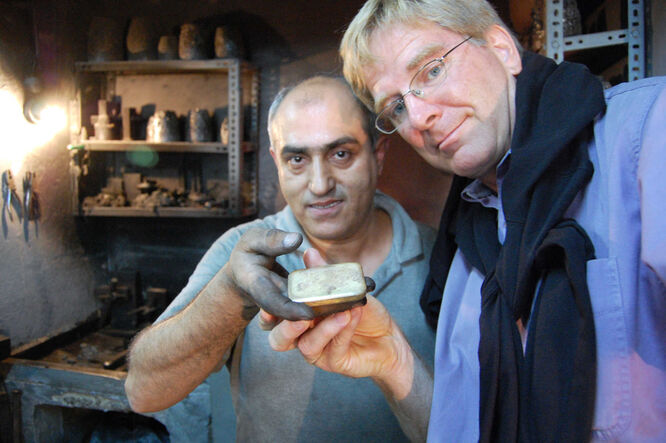
Ayhan Usta (eye-hahn oos-tah; "Ayhan the Master") is one of the goldsmiths who works here. His shop is the third one on the left as you enter, across from the teahouse. Ayhan speaks only Turkish, but if you peek into his shop and if he's up for visitors and not too busy, he'll motion you inside to watch him at work. Cautious at first, but sweet and easygoing, Ayhan enjoys showing travelers what he does. You need not pay or tip him in return — he simply likes to share his craft with curious travelers. Stay safely away from the fire (burning at 2,200°F) — especially when he tosses in some white powder to increase the temperature as he melts the gold.
Ayhan belongs to a dying breed. Not much gold production still takes place near the Grand Bazaar, and the few goldsmiths who remain may soon be moved to a plant outside the city. Craftspeople such as Ayhan like where they are, and loudly oppose this new plan. In the opinion of locals, the Grand Bazaar needs both shops and workshops to be successful. Traditionally, if a customer wants to buy something, but it's not ideal — such as a garment that doesn't quite fit — the shopkeeper could send it to his workshop (or a neighbor's) for an adjustment to make it just right. But if all of the workshops are forced out by high rents, and replaced with nothing but "Made in Taiwan" gift shops, locals fear the soul of the Grand Bazaar will be lost.
On the way out (a few steps from Ayhan's shop), note the tiny shoeshine hut with Cafer (jah-fehr) happily polishing shoes (2-4 YTL). Let him give you a shine, and he'll get you tea. You'll step out with slick shoes and a shiny memory.
Now go back in the Grand Bazaar, and take the first right as you step in. You'll walk down the big lane called...
Perdahçilar Sokak (pehr-dah-chuh-lahr soh-kahk), which was once the main clothing section of the bazaar; now it's a combination of carpet stores, souvenir shops, "genuine fake items" stands, and shops selling tourist knock-off versions of traditional clothes — like fake pashminas or a tongue-in-cheek "one size fits all" belly-dancing outfit.
Continue to the T-junction, and turn right onto Yaglikçilar Sokak (yaah-luhk-chuh-lahr soh-kahk), with similar items to what you've just seen. Walk all the way to the bazaar exit. To the right, just inside the exit door, notice the textile store called...
Egin Tekstil
This unassuming little shop provided many of the costumes for the 2004 blockbuster Troy — about the ancient city-state near today's Truva, in northwestern Turkey. Go inside and say hello to owner Süleyman or his assistants, who'd be happy to tell you all about their shop's history...and, of course, what they're selling. Egin Tekstil (eh-een tehks-teel), has been in the same family for five generations, nearly 150 years. In fact, Süleyman — who continues the family tradition even though he's actually a doctor by trade — still has the Ottoman deed to the store. Their specialty is the pestemal (pehsh-teh-mahl), the traditional wrap-around sheet for visits to a Turkish bath. This is one of the Grand Bazaar's stores that actually has an annex behind the main shop built during Byzantine times, which is used for storage (the entrance is on the back wall).
Stepping outside the store, turn left and head back the way you came on Yaglikçilar Sokak. After about 50 yards, on the right — marked with a sign for Brothers Restaurant — you'll see the entrance to...
Astarci Han
Go through the doorway, between shops and stands, into Astarci Han (ahs-tahr-juh hahn; "Courtyard of the Cloth Lining"). Historically, this courtyard was home to textile workshops. A few still remain here: Notice the one in the right-hand corner as you enter (peek inside with a smile to see the textile-makers in action).
On the left as you enter the courtyard is the recommended...
Brothers (Kardesler) Restaurant
This place specializes in southeastern Turkish cuisine. WCs are next to the restaurant. And if you'd like a cup of Turkish coffee after (or instead of) a meal, the perfect spot is coming right up.
Exit Astarci Han and turn right onto Yaglikçilar Sokak, continuing in the same direction as before. After a few blocks, keep an eye out on the right-hand side for the tiny, green, box-like wooden balcony — used for the call to prayer, like a low-tech minaret — marking one of the bazaar's mosques (attached to the wall above the jewelry store); next to it are steps leading up to the mosque. Go 50 yards past the mosque on the right-hand corner to find a venerable tea and coffee house called...
Sark Kahvesi
Sark Kahvesi (shark kah-veh-see; "Oriental Coffee Shop") is an Istanbul institution, and a good place to sample Turkish coffee if you haven't yet.
Just past Sark Kahvesi on Yaglikçilar Sokak, a lane on the right leads to the recommended Havuzlu Lokanta restaurant. But instead, we'll head left, down Zenneciler Sokak (zehn-neh-jee-lehr soh-kahk). After about 100 yards, you'll emerge into a courtyard we saw earlier from the other side...
Cevahir Bedesten
Cevahir Bedesten (jeh-vah-heer beh-dehs-tehn) was built as a freestanding warehouse for merchants in the 15th century. It has been used for many purposes since, but the basic structure — with domed bays supported by eight massive pillars — is still intact. Entering the courtyard, you may notice it's taller than the rest of the bazaar — and, since it's devoted to big-ticket items, it's a bit quieter. Most merchants here are antique dealers, selling icons, metal objects, miniatures, coins, cameras, daggers, and so on; while others sell semiprecious stones, either by the piece or on chains. There are also a few silver shops and places where you can buy worry beads with semiprecious stones.
From here, you can explore the bazaar on your own. But first, we'll head back to the main drag and get oriented; we'll also suggest a possible detour to an enjoyable book market nearby. From the center of Cevahir Bedesten, turn 90 degrees to the right and leave through the door into the bustling alleys of the bazaar — this zone is packed with souvenir shops, as well as carpets and traditional metal items. Soon you'll run into the main street, Kalpakçilar Caddesi. To leave the market now and go back the way we came, turn left on this main drag and walk back to the Nuruosmaniye Gate (at the Nuruosmaniye Mosque, near the Çemberlitas tram stop — you can take the tram from here right back to Sultanahmet). If you want to see more, instead turn right on Kalpakçilar Caddesi and walk about 200 yards to the gate leading to the Beyazit (beh-yah-zuht) district. Halfway to the Beyazit exit, keep an eye on your right, behind the fountain, for a stretch of shops selling leather, denim, and other textiles. At the end of Kalpakçilar Caddesi, you'll exit through the...
Beyazit Gate and Sahaflar Book Market
You may feel that you've only seen a small part of the very Grand Bazaar. You're right — there are another 4,000 shops we haven't passed on this tour. Entire trips, books, and lifetimes are devoted to the wonders of the Grand Bazaar. But for now, let's look at one more interesting corner of the Grand Bazaar scene. As you exit through the Beyazit Gate (with a tram stop 100 yards to your left), turn right and walk toward the crowded market area for textiles, clothes, and shoes — popular with local bargain-hunters. After about 20 yards, look on your left for steps leading to Sahaflar (sah-hahf-lahr), or the old book market. For two centuries, this was a magnet for bibliophiles — even 20 years ago, you could find rare old collector's items with fancy illustrations. But today only a few shops sell those items (or handmade replicas of them), while most others carry textbooks, books that are hard to sell at a mainstream bookstore, and books on religious topics.
Our bazaar tour is finished.
Dealing with Aggressive Merchants
![]() |
| It's fun to banter with merchants...when you know the rules. |
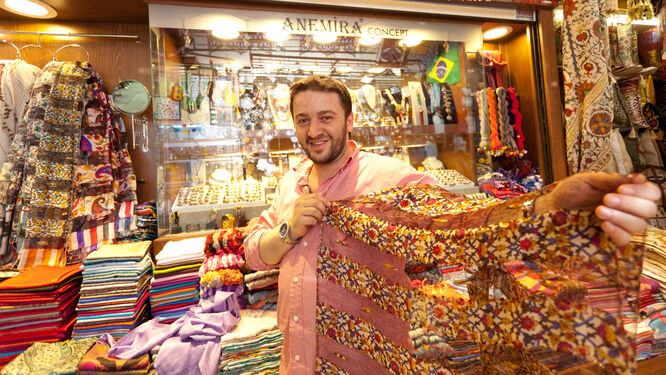
Throughout the Grand Bazaar — and just about everywhere in the Old Town — you'll constantly be barraged by people selling everything you can imagine. This can be intimidating, but it's fun if you loosen up and approach it with a sense of humor. The main rule of thumb: Don't feel compelled to look at or buy anything you don't want. These salesmen prey on Americans' gregariousness, and our tendency to respond politely to anyone who offers us a friendly greeting. They often use surprising or attention-grabbing openers:
- "Hello, Americans! Where are you from? I have a cousin there!"
- "Are you lost? Can I help you find something?"
- "Nice shoes! Are those Turkish shoes?"
- "Would you like a cup of tea?"
- The list is endless — collect your favorites.
If you're not interested, simply say a firm, "No, thanks!" and brush past them, ignoring any additional comments. This seems cold, but it's the only way to cover the market without constantly getting tied up in a conversation. Depending on my mood, sometimes I just look at them with great seriousness and declare, "Pay peanuts, get monkeys" and then walk away.
If, on the other hand, you're looking to chat, merchants are often very talkative — but be warned that a lengthy conversation may give them false hopes that you're looking to buy, and could make it even more difficult to extract yourself gracefully from the interaction.
For up-to-date specifics, see the latest edition of the Rick Steves' Istanbul travel guide. We also offer free-spirited Turkey tours.