

Learning Le Métro: Basic Tips for Paris’ Underground Arteries
By Rick Steves, Steve Smith, and Gene Openshaw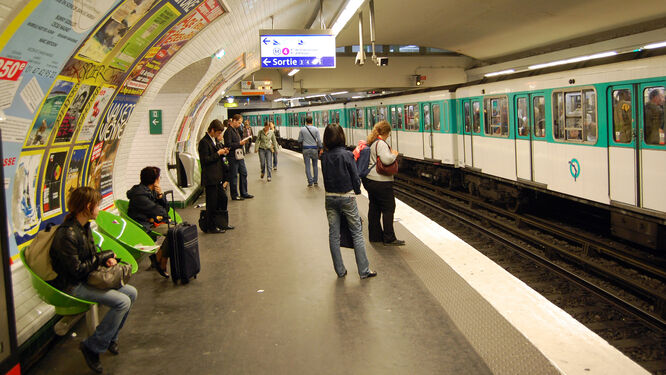
In Paris, you’re never more than a 10-minute walk from a Métro station. Europe’s best subway system allows you to hop from sight to sight quickly and cheaply. Learn to use it — Paris’ Métro is one of Europe’s great bargains.
Hopping from railed strand to railed strand, you pass musicians pulling Brahms out of plugged-in cellos and beggars with greasy hair pasted to their faces. Hoping for step-across-the-track transfers, you end up on 500 yards of moving sidewalk sliding past a parade of meaningless ads repeated and repeated and repeated. And budget travelers — the kind who eat too much at a buffet — delight in the thought that you could go around and around forever on just one ticket!
Waiting for my train, I peer down the tunnel. In the distance is another subterranean bubble, a hamlet of light with more people waiting for the same train. Nearly 300 such bubbles — some hamlets, some virtual cities — fill that parallel world…under the streets of the City of Light.
Trains whistle, wheeze, and screech around corners and past venous intersections. Gazing out the window into the darkness and recalling the “Lara on the tram” scene from Dr. Zhivago, I accidentally make eye contact with the reflection of the lady across from me. Upon arrival at my station, I seek out its plan du Quartier. This neighborhood map generally offers a few unexpected sightseeing treats. Happy blue and white signs announce sortie (exit). Another slice of Paris…right this way.
How the Métro Works
To get to your destination, determine the closest “Mo” stop and which line or lines will get you there. The lines are color-coded and numbered, and you can tell their direction by their end-of-the-line stops. For example, the La Défense/Château de Vincennes line, also known as line 1 (yellow), runs between La Défense, on its west end, and Vincennes on its east end. Once in the Métro station, you’ll see the color-coded line numbers and/or blue-and-white signs directing you to the train going in your direction (e.g., direction: La Défense). Insert your ticket in the automatic turnstile, reclaim your ticket, pass through, and keep it until you exit the system (some stations require you to pass your ticket through a turnstile to exit). The smallest stations are unstaffed and have ticket machines (coins are essential). Be warned that fare inspectors regularly check for cheaters and accept absolutely no excuses — keep that ticket or pay a minimum fine of €45.
Be prepared to walk significant distances within Métro stations (especially when you transfer). Transfers are free and can be made wherever lines cross, provided you do so within 1.5 hours. When you transfer, follow the appropriately colored line number and end-of-the-line stop to find your next train, or look for orange correspondance (connection) signs that lead to your next line.
When you reach your destination, look for the blue-and-white sortie signs pointing you to the exit. Before leaving the station, check the helpful plan du quartier (map of the neighborhood) to get your bearings. At stops with several sorties, you can save time by choosing the best exit.
After you exit the system, toss or tear your used ticket so you don’t confuse it with unused tickets.
Resources
Métro maps are free at Métro stations and included on freebie Paris maps at your hotel. Several good online tools can also help you navigate the public-transit system. The free Bonjour RATP mobile app (in English) can estimate Métro travel times, help you locate the best station exit, and tell you when the next bus will arrive, among other things. Just be careful when using your smartphone in any crowded area, as it can attract…
Pickpockets
Thieves dig the Métro and RER. Be on guard. If your pocket is picked as you pass through a turnstile, you end up stuck on the wrong side (after the turnstile bar has closed behind you) while the thief gets away. Stand away from Métro doors to avoid being a target for a theft-and-run just before the doors close. Any jostling or commotion — especially when boarding or leaving trains — is likely the sign of a thief or a team of thieves in action. Make any fare inspector show proof of identity (ask locals for help if you’re not certain). Keep your bag close, and never show anyone your wallet.
Steve Smith and Gene Openshaw are co-authors of the Rick Steves Paris guidebook.