

Roman Treasures in Nîmes
By Rick Steves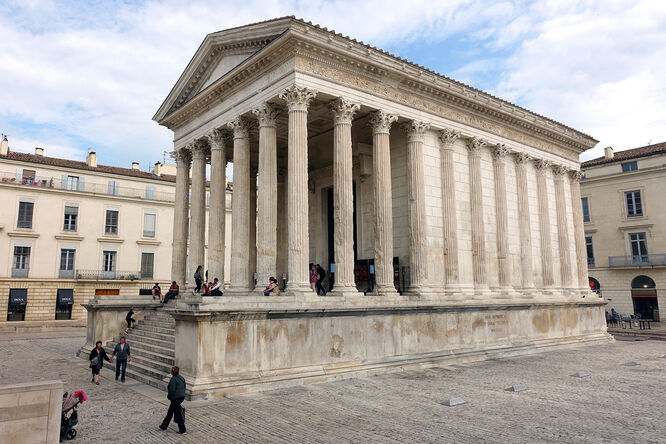
Most travelers to southern France's Provence region will visit Arles and Avignon, but ignore nearby Nîmes. While those two towns have name recognition and greater touristic appeal, Nîmes (pronounced "neem") feels richer and more authentic. A visit to this thriving town rewards you with impressive Roman monuments and peaceful, pedestrian-polished streets that feel like a secret between its well-heeled residents.
Born a Celtic city around 500 BC, Nîmes joined the Roman Empire in the first century BC. Emperor Augustus made it a regional capital whose importance merited fine architecture, one of the longest protective walls in the Roman world, and a 30-mile-long aqueduct to bring water to its growing population.
The core of Roman Nîmes was a temple called Maison Carrée ("Square House," named before they had a word for rectangle). The temple rivals Rome's Pantheon as the most complete and splendid building that survives from the Roman Empire. Maison Carrée survived in part because it's been in constant use for the past thousand years — from a temple to a church, to a city hall, to a people's art gallery after the Revolution, and finally as the monument travelers see today.
Nîmes also had an impressive amphitheater for entertaining residents. Today, this arena — one of the best-preserved of the Roman world — is a superb example of Roman engineering, with its perfectly symmetrical oval shape, seating for 24,000 spectators, 60 passageways to prevent bottlenecks, and system of underground rooms and a lift used to hoist animals up to the floor for gladiator games. Touring the place provides an interesting history lesson, and climbing to the top offers the rare opportunity to enjoy city views from the nosebleed seats of a Roman arena.
Facing the arena is the Roman World Museum (Musée de la Romanité), with its high-tech interactive stations that help show off 5,000 artifacts from Roman Nîmes (plus a few from pre-Roman and medieval times). A highlight is its rich collection of Latin-inscribed stones and mosaics — some of which were discovered when digging the garage for the site.
As one of ancient Europe's privileged cities, Nîmes needed a reliable water supply. So in about 19 BC, the Romans built a 30-mile-long aqueduct. While most of the aqueduct is on or below ground, one stretch is especially impressive: the Pont du Gard. About 30 minutes northeast of Nîmes, this bridge stretches over the Gardon River and is one of the most remarkable surviving Roman ruins anywhere.
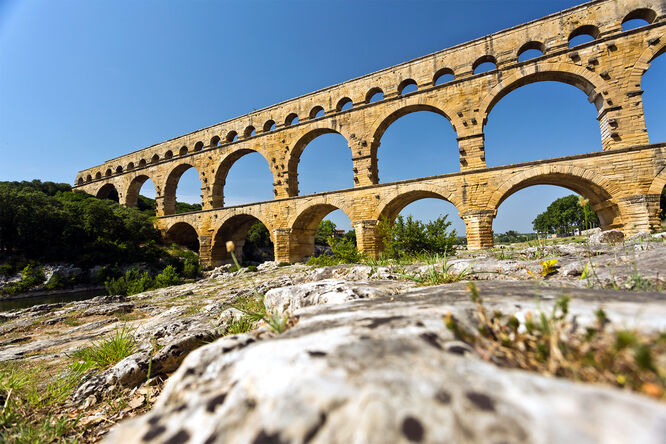
Throughout the ancient world, aqueducts heralded the greatness of Rome. Even after many visits here, I'm forever impressed by the skill of ancient Roman engineers. This structure, built with perfectly cut stones fitted together without mortar, was designed to slope ever so slightly — less than an inch every hundred yards — to let water flow effortlessly into Nîmes.
There are many ways to enjoy the Pont du Gard. Visitors can hike to viewpoints, join a guided walking tour through the top channel of the aqueduct, and see its fine museum, where exhibits show the immensity of the undertaking. Summers are a great time to visit, as you can enjoy a picnic by the water, swim or canoe in the river, and stay into the evening, when a light show is projected on the monument.
After seeing the Pont du Gard, it's especially interesting to visit the castellum of Nîmes, the distribution tank marking the end of the aqueduct. Examining the castellum's water-distribution holes, you can appreciate them as evidence of Roman Nîmes' social compassion. The lower channel served top-priority needs, providing water via stone and lead pipes to the public wells that graced neighborhood squares. The higher holes — which got wet only when the supply was plentiful — routed water to the homes of the wealthy, to public baths, and to nonessential fountains.
While Nîmes is most notable for its Roman sights, the city offers other things to enjoy, such as the carefully preserved old center and thriving market hall. Another fine activity is strolling the Jardin de la Fontaine, a lavish park filled with Baroque sculptures and an ornate network of canals and paths. Finished just 50 years after the construction of Versailles, the Jardin de la Fontaine has special significance to the French, as these were the first grand gardens not meant for a king, but for the public.
Perhaps the most appealing part of Nîmes is its mellowness. It's a great place to slow down and enjoy the inviting café scene, wander the traffic-free lanes, and savor a tranquil, less touristed slice of southern France.