

How to Picnic Shop Like a Parisian
By Rick Steves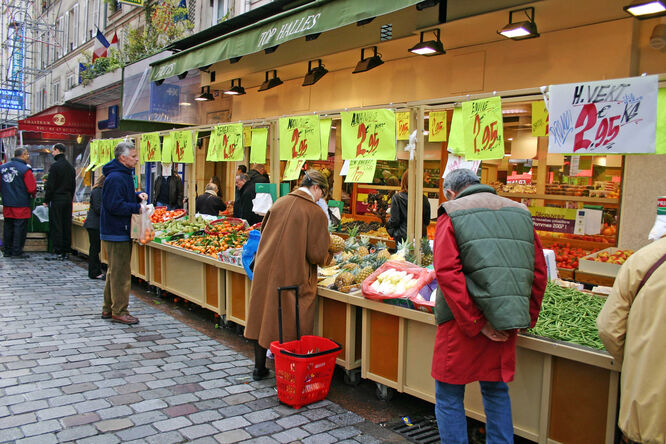
In all of Paris, my favorite street is Rue Cler, a small lane in the skinny shadow of the Eiffel Tower. Lined with shops that spill out into the street, it's a slice of village life in this giant city, and picnic shopping here is one of my favorite Parisian pleasures.
I grew up thinking cheese was orange and the shape of the bread was square: slap, fwomp…sandwich. Even though I'm still far from a gourmet eater, my time in Paris has substantially bumped up my appreciation of good cuisine (as well as the French knack for good living).
Parisians shop almost daily for three good reasons: Refrigerators are small (tiny kitchens), Parisian palates are too refined for anything but the freshest produce, and shopping is an important social event. It's a chance to hear about the butcher's vacation plans, see photos of the florist's new grandchild, relax over un café, and kiss the cheeks of friends (the French standard is twice for regular acquaintances, three times for friends you haven't seen in a while).
Produce shops are stocked with the freshest fruits and vegetables. Each morning produce is trucked in from farmers to a huge market near Orly Airport, and then out to merchants with FedEx speed and precision. Locals generally shop with a small trolley cart brought from home, rather than use bags needlessly. I've also noticed how the French resist packaged produce and instead go with what's in season.
Parisians shop with their noses. For a sense of how they pore over the produce, sniff the cheap foreign strawberries, then inhale the rich scent of the torpedo-shaped French ones (gariguettes). Find the herbs. Is today's delivery in? Look at the price of those melons. What's the country of origin? (By law, it must be posted.) If the melons are out of season, they come from the French Caribbean. Many locals turn up their noses at anything but French products.
The fish monger on Rue Cler sells yesterday's catch — brought in daily from ports on the English Channel, 100 miles away. (Since Paris is a commerce hub, fish here is likely to be fresher than what you'll find in many towns closer to the sea.) Anything wiggling?
Rue Cler's strongest olfactory experience is at the fromagerie (cheese shop): wedges, cylinders, balls, and miniature hockey pucks all powdered white, gray, and burnt marshmallow — it's a festival of mold. "Ooh la la" means you're impressed. If you like cheese, show greater excitement with more las. Ooh la la la la! On one visit, my Parisian friend Marie held the stinkiest glob close to her nose, took an orgasmic breath, and exhaled, "Yes, this smells like zee feet of angels."
Even in this tiny shop, you can browse through 400 different types of French cheese. In the back room are les meules — big, 170-pound wheels of cheese made from 250 gallons of milk. The hard cheeses are cut from these. Don't eat the skin of these big ones, as they're only easy to transport by rolling them along the floor. But the skin on most smaller cheeses, such as brie and camembert, is part of the taste. As Marie says, "It completes the package."
The charcuterie (also called a traiteur) sells mouthwatering deli food to go. This kind of gourmet deli, especially common in Paris, is handy for dinner-party hosts, as it allows them to use their tiny kitchens to concentrate on the main course while outsourcing beautifully prepared side dishes to round out a fine meal.
At the boucherie, Parisians sort through not just beef, pork, and chicken, but also equally popular rabbit (lapin), quail (caille), lamb (agneau), and duck (canard). You'll also see things you may want to avoid in restaurants: kidneys (rognons), liver (foie), heart of beef (coeur de boeuf). Horse meat has gone out of fashion, but the head of a calf is considered a delight for its many tasty bits. Why is that shopper hoisting a duck into the air? She's checking its feet, which should be rough and calloused — an indication that the duck wasn't always stuck in an industrial kennel but ran free on a farm. What's available in the shop depends on the season. In winter, game swings from shop ceilings.
Parisians debate the merits of rival boulangeries. At French cooking schools, bakers-to-be major in either bread or pastries. It's widely held here that when you make good bread, you have no time to make good pastry. And if the baker specializes in pastry, the bread suffers. But here on Rue Cler, the baker bucks the trend — the baguettes make for great sandwiches, and the pastries a delectable picnic dessert.
Parisian shoppers often visit the neighborhood wine shop last, so they can pick a wine appropriate to the meal they've assembled. If you're less attuned to these nuances than the typical Parisian, chat up the shop's salesperson, whom you can expect to be skilled advisor — they'll factor in your tastes, menu, and budget. Don't be put off by the low prices; it's common in France for high-quality "wines of the month" to sell for under $10. Even without a sale, you can always get a fine bottle for $10–15.
On your next Paris visit, leave time to peruse some neighborhood food shops and enjoy a sensory adventure you're unlikely to forget. And remember: Whenever popping in and out of French shops, it's polite to greet the proprietors ("Bonjour, Madame") and say "Merci" and "Au revoir" as you leave. Bon appétit!