Rue Cler: The Art of Parisian Living
By Rick Steves
Walking down Rue Cler makes me feel like I must have been a poodle in a previous life. It's a cobbled pedestrian street lined with shops run by people who've found their niche...boys who grew up on quiche. Aproned fruit stall attendants coax doll-like girls into trying their cherries. And ladies, after a lifetime of baguette munching, debate the merits of the street's rival boulangeries.
Surveying Paris from my hotel room's fourth-floor window, only the churches and the Eiffel Tower exceed the six-story code. Buildings fill the city like waffle mix — done just about right. Stately black grillework, frosted with big-city dust, treats humble windows like aristocratic balconies. Below me is village Paris and my market street, Rue Cler.
Shopping for groceries is an integral part of everyday life here. Parisians shop almost daily for three good reasons: Refrigerators are small (tiny kitchens), produce must be fresh, and it's an important social event. Shopping is a chance to hear about the butcher's vacation plans, see photos of the florist's new grandchild, relax over un café, and kiss the cheeks of friends (the French standard is twice for regular acquaintances, three times for friends you haven't seen in a while).
Rue Cler — traffic-free since 1984 — offers plenty of space for tiny stores and their patrons to spill into the street. It's an ideal environment for this ritual to survive and for you to explore. The street is lined with the essential shops — wine, cheese, chocolate, bread — as well as a bank and a post office. And the shops of this community are run by people who've found their niche: boys who grew up on quiche, girls who know a good wine. The people in uniform you might see are likely from the Ecole Militaire (military school, Napoleon's alma mater, two blocks away).
If you wish to learn the fine art of living Parisian-style, rue Cler provides an excellent classroom. And if you want to assemble the ultimate French picnic, there's no better place. This is the only walking tour in the Rick Steves' Paris guidebook you should start hungry. Do this walk at the start of your Paris visit, as it provides a helpful orientation to the local culture. And visit when the market is open and lively (see sidebar). Remember that these shops are busy serving regular customers. Be polite and careful not to get in the way. Start your walk where the pedestrian section of rue Cler begins, at rue de Grenelle (Mo: Ecole Militaire or bus #69 stop).
1.
Café Roussillon
This place, a neighborhood fixture, recently dumped its old-fashioned, characteristic look for the latest café style — warm, natural wood tones, easy lighting, and music. The various chèque déjeuner decals on the door advertise that this café accepts lunch "checks." In France, an employee lunch subsidy program is an expected perk. Employers — responding to strong tax incentives designed to keep the café culture vital — issue a voucher check (worth about €5) for each day an employee works in a month. Sack lunches are rare, since a good lunch is sacred.
Inside, drinks at the always-active bar (comptoir) are about a third the price of drinks at the tables. The blackboard lists wines sold by the little (7-centiliter) glass.
If you're shopping for designer baby clothes, you'll find them across the street at...
2. Petit Bateau
The French spend at least as much on their babies as they do on their dogs — dolling them up with designer jammies. This store is one of a popular chain. Babies-in-the-know just aren't comfortable unless they're making a fashion statement (such as underwear with sailor stripes). In the last generation, an aging and actually shrinking population has been a serious problem for Europe's wealthier nations. But France now has one of Europe's biggest baby populations — the fertile French average two children per family, compared to 1.6 for the rest of Europe. Babies are trendy today, and the government rewards parents with substantial tax deductions for their first two children — and then doubles the deductions after that. Making babies is good business.
Cross rue de Grenelle to find..
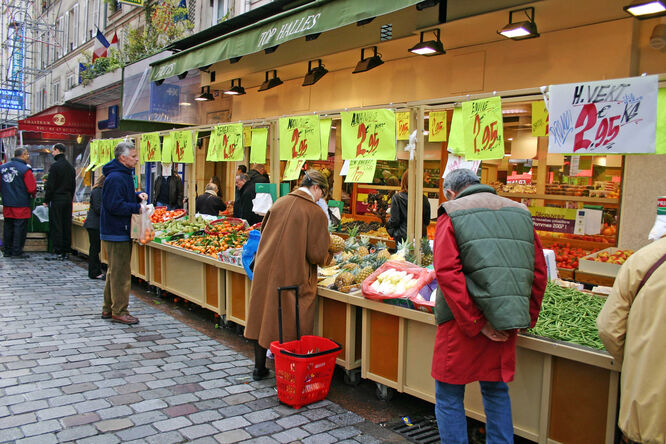
3. Top Halles Fruits and
Vegetables 
Each morning, fresh produce is trucked in from farmers' fields to Paris' huge Rungis market — Europe's largest, near Orly Airport — and then dispatched to merchants with FedEx-like speed and precision. Good luck finding a shopping bag — locals bring their own two-wheeled carts or reusable bags. Also, notice how the earth-friendly French resist excessive packaging.
Parisians — who know they eat best by being tuned into the seasons — shop with their noses. Try it. Smell the cheap foreign strawberries. One sniff of the torpedo-shaped French ones (garriguettes) in June, and you know which is better. Find the herbs in the back. Is today's delivery in? Look at the price of those melons. What's the country of origin? (It must be posted.) If they're out of season, they come from Guadeloupe. Many people buy only local products.
The Franprix across the street is a small Safeway-type store. Opposite Grand Hôtel Lévêque is Asie Traiteur. Fast Asian food to go is popular in Paris. These shops — about as common as bakeries now — are making an impact on Parisian eating habits.
Across the street, the large red-and-yellow cone-shaped sign high on the wall marks a...
4. Tabac at Le Diplomat
Just as the US has liquor stores licensed to sell booze, the only place for people (over 16) to buy tobacco legally in France is at a tabac (tah-bah) counter. This one, run by hardworking Madame Delpuech, is part of Le Diplomat bar. Tobacco counters like this one are a much-appreciated fixture of each neighborhood, offering lots of services (and interesting insight into the local culture).
Even non-smokers enjoy perusing the wares at a tabac. Notice how European laws require a bold warning sign on cigarettes — about half the size of the package — that says, bluntly, fumer tue (smoking kills). Even so, you may not be able to resist the temptation to pick up a petit Corona — your chance to buy a fine Cuban cigar for €6 without breaking US law.
Tabacs also serve their neighborhoods as a kind of government cash desk. All sell stamps and most sell public transit tickets (for the same price you'd pay at Métro stations — but they pocket a five percent profit). Locals pay for parking meters in tabacs by buying a card...or pay fines if they don't. Like back home, the LOTO is a big deal — and a lucrative way for the government to tax poor and less-educated people.
Just past Grand Hôtel Lévêque is...
5. Wine Bacchus
Shoppers often visit the neighborhood wine shop last, once they've assembled their meal and are able to pick the appropriate wine. The wine is classified by region. Most "Parisians" (born elsewhere) have an affinity for the wines of their home region. Check out the great prices. Wines of the month — in the center — sell for about €5. You can get a fine bottle for €10. The clerk is a counselor who works with your needs and budget, and he can put a bottle of white in the fridge for you to pick up later (open until 20:00 except Sun).
Next door, smell the...
6. Fromagerie
A long, narrow, canopied cheese table brings the fromagerie into the street. Wedges, cylinders, balls, and miniature hockey pucks are all powdered white, gray, and burnt marshmallow — it's a festival of mold. The street cart and front window feature both cow and goat cheeses. Locals know the shape indicates the region of origin (for example, a pyramid shape indicates a cheese from the Loire). And this is important. Regions create the terroir (physical and magical union of sun, soil, and generations of farmer love) that gives the production — whether wine or cheese — its personality. Ooh la la means you're impressed. If you like cheese, show greater excitement with more las. Ooh la la la la. My local friend once held the stinkiest glob close to her nose, took an orgasmic breath, and exhaled, "Yes, it smells like zee feet of angels." Go ahead...inhale.
Step inside and browse through more than 400 types of French cheese. A cheese shop — lab-coat-serious but friendly, and known as a "BOF" for beurre, oeuf, and fromage — iswhere people shop for butter, eggs, and cheese. In the back room, they store les meules, the big, 170-pound wheels of cheese (made from 250 gallons of milk). The "hard" cheeses are cut from these. Don't eat the skin of these big ones...they're rolled on the floor. But the skin on most smaller cheeses — the Brie, the Camembert — is part of the taste. "It completes the package," says my local friend.
At dinner tonight, you can take the cheese course just before or instead of dessert. On a good cheese plate, you have a hard cheese (like Emmentaler — a.k.a. "Swiss cheese"), a flowery cheese (maybe Brie or Camembert), a bleu cheese, and a goat cheese — ideally from different regions. Because it's strongest, the goat cheese is usually eaten last.
Across the street, find the fish shop, known as the...
7. Poissonnerie
Fresh fish is brought into Paris daily from ports on the English Channel, 110 miles away. In fact, fish here is likely fresher than in many towns closer to the sea, because Paris is a commerce hub (from here, it's shipped to outlying towns). Anything wiggling? This poissonnerie, like all such shops, has been recently upgraded to meet the new Europe-wide hygiene standards.
Next door at the Crêperie (under the awning — get close to see) is a particularly tempting rue Cler storefront.
8. No More Horse Meat
The stones and glass set over the doorway advertise horse meat: Boucherie Chevaline. While today this store serves souvlaki and crêpes, the classy old storefront survives from the previous occupant. Created in the 1930s and signed by the artist, it's a work of art fit for a museum — but it belongs right here. Notice that the door is decorated with lunch coupon decals for local workers.
A few steps farther along is a flower shop. Across the street is the...
9. Pharmacy and Oldest Building
In France, the pharmacist makes the first diagnosis and has the authority to prescribe certain drugs. If it's out of his league, he'll recommend a doctor.
Next to the pharmacy is rue Cler's oldest building (with the orange awning). It's from the early 1800s, when this street was part of a village near Paris, and was lined with structures like this. Over the years, Paris engulfed these surrounding villages — and now the street is a mishmash of architectural styles.
Across the street from this oldest house is...
10. La Maison du Jambon
A charcuterie sells mouthwatering deli food to go. Because Parisian kitchens are so small, these gourmet delis are handy, even for those who cook. It lets the hosts concentrate on creating the main course, and then buy beautifully prepared side dishes to complete a fine dinner. Each day, the charcuteries cook up plats du jour (specials of the day), advertised on the board outside. Note the system: Order, take your ticket to the cashier to pay, and return with the receipt to pick up your food.
A few doors down is...
10. Café du Marché and More
Café du Marché, on the corner, is the place to sit and enjoy the action. It's rue Cler's living room, where locals gather before heading home, many staying for a relaxed and affordable dinner. The owner priced his menu so that locals could afford to dine out on a regular basis, and it worked — many patrons eat here five days a week. For a reasonable meal, grab a chair and check the chalk menu listing the plat du jour.
The shiny, sterile Leader Price grocery store (across the street) is a Parisian Costco, selling bulk items. Because storage space is so limited in most Parisian apartments, bulk purchases are unlikely to become a big deal here. The latest trend is to stock up on non-perishables by shopping online, pick up produce three times a week, and buy fresh bread daily. The awful exterior of this store suggests a sneaky bending of the rules. Normally any proposed building modification on rue Cler must undergo a rigorous design review in order for the owner to obtain the required permit.
Notice how sidewalk "garbage cans" are actually green plastic bags. In the 1990s, Paris suffered a rash of bombings (bad guys improvised little bombs by hiding campstove canisters in metal cans that provided deadly "shrapnel" when they exploded). Local authorities solved this by replacing cans with these see-through bags.
From Café du Marché,
cross rue du Champ de Mars to the store on the corner.
12. Caffè Vergnano
This flashy place, the new and big kid on the block, makes an impression. It's an interesting, upscale blend of American Starbucks, French brasserie, and Italian restaurant. However, as part of a big international chain, it has some locals up in arms as they see their precious rue Cler succumbing to globalization.
Opposite Caffè Vergnano is a bakery, or...
13. Boulangerie
Since the French Revolution, the government has regulated the cost of a basic baguette. The Prix du Pain sign in the window tells you the going rate. Locals debate the merits of Paris' many boulangeries. It's said that a baker cannot be both good at bread and good at pastry. At cooking school, they major in one or the other. Here, the baker makes good bread, and another baker does the tasty little pastries for him.
Next door is a strangely out-of-place...
14. Japanese Restaurant
Sushi is mysteriously for sale everywhere in Paris these days. Locals explain that the phenomenon is the same as when Chinese restaurants were spreading like gastronomic weeds. Real French restaurants found it hard to compete with these inexpensive places, and in some areas, local authorities actually forbid giving business permits to Chinese restaurants.
A bit farther along is...
15. Le Mère de Famille Gourmand Chocolats Confiseries
This shop has been in the neighborhood for 30 years. The wholesalers wanted the owner to take the new products, but she kept the old traditional candies, too. "The old ladies, they want the same sweets that made them so happy 80 years ago," she says. You can buy "naked bonbons" right out of the jar and chocolate by the piece. One hundred grams (about 10 pieces) costs €6.40.
Until a few years ago, the chocolate was dipped and decorated right on the premises. As was the tradition in rue Cler shops, the merchants resided and produced in the back and sold in the front
Across the street, you'll find...
16. Oliviers & Co. Olive Oils
This shop, typical of an upscale neighborhood like this, sells fine gourmet goodies from the south of France and olive oil from around the Mediterranean. They are happy to give visitors a taste test — with tiny spoons — of three distinct oils.
For the perfect finale for this walk, backtrack a half block to Café du Marché, turn left on rue du Champ de Mars, and within a few steps, you'll reach...
17. L'Epicerie Fine
This fine-foods boutique stands out from the rest because of its gentle owner, Pascal. His mission in life is to explain to travelers, in fluent English, what the French fuss over food is all about. Say bonjour to Pascal and let him tempt you with fine gourmet treats, Berthillon ice cream, and generous tastes of balsamic vinegar, French and Italian olive oil, and caramel (Tue–Sat 9:00–13:00 & 15:00–19:30, Sun 10:00–13:00, closed Mon, tel. 01 47 05 98 18).
Rue Cler ends at the post office. The Ecole Militaire Métro stop is just around the corner. If you bought a picnic along this walk, you'll find benches and gardens nearby: From the post office, avenue de la Motte-Picquet leads to two fine parks — turn left for the Army Museum or right for the Eiffel Tower
Bon appétit!