Home > Plan Your Trip > Best Destinations > France

Triomphing Along the Champs-Elysées

By Rick Steves

Waving down a taxi, I ride up the Champs-Elysées toward Europe's wildest traffic circle. My cabbie waits to plunge into place Charles de Gaulle, a grand circle where a dozen boulevards converge on the Arc de Triomphe. Like referees at gladiator camp, traffic cops, stationed at each entrance to this ten-lane circus, let in bursts of eager cars.

As marble Lady Liberties scramble up Napoleon's arch, heroically thrusting their swords and shrieking at the traffic, all of Paris seems drawn into this whirlpool.

It's a game of fender-bender chicken. This circle is the great equalizer. Tippy little Citroen 2CVs, their rooftops cranked open like sardine lids, bring lumbering buses to a sudden, cussing halt. Stirred by this call to arms, otherwise sedate tour bus drivers become daredevils. Egged on by applause from their suddenly bloodthirsty tour groups, they cut off six lanes at once as they charge to the inner lane.

My friend tells me, "In Paris a good driver gets only scratches, not dents."

Groping for the lost end of my seat belt, I say, "There must be an accident every few minutes here."

"When there is, each driver is considered equally at fault," he replies. "This is the only place in Paris where the accidents are not judged. No matter what the circumstances, insurance companies split the costs 50-50."

Momentarily stalled on the inside lane, I pay and hop out. The cabbie drives away, leaving me under Europe's grandest arch and at the top of its ultimate boulevard. My plan is to stroll the length of the Champs-Elysées ("Elysian fields"), but first the flame of France's unknown soldier — flickering silently in the eye of this urban storm — seems to invite me to savor this grandiose monument to French nationalism.

The Arc de Triomphe affords a great Paris view, but only to those who earn it. There are 284 steps — and no public elevator. Begun in 1806, the arch was intended to honor Napoleon's soldiers, who, in spite of being vastly outnumbered by the Austrians, scored a remarkable victory at the battle of Austerlitz. Napoleon died long before the arch was completed. But it was finished in time for his posthumous homecoming in 1840. Nineteen years after he died in exile on St. Helena, his remains were carried in a grand parade underneath his grand arch.

The Arc de Triomphe is dedicated to the glory of all French armies. Like its Roman ancestors, this arch has served as a parade gateway for triumphal armies (French or foe) and important ceremonies. From 1941 to 1944, a large swastika flew from here as Nazis goose-stepped daily down the Champs-Elysées. Allied troops marched triumphantly under this arch in August 1944.

Standing under the arch, you're surrounded by names of French victories since the Revolution, the names of great French generals (with a line under the names of those who died in battle) and by France's Tomb of the Unknown Soldier. Every day at 18:30 since just after World War I, the flame is rekindled and new flowers set in place, but any time of day it's a place of patriotic reverence.

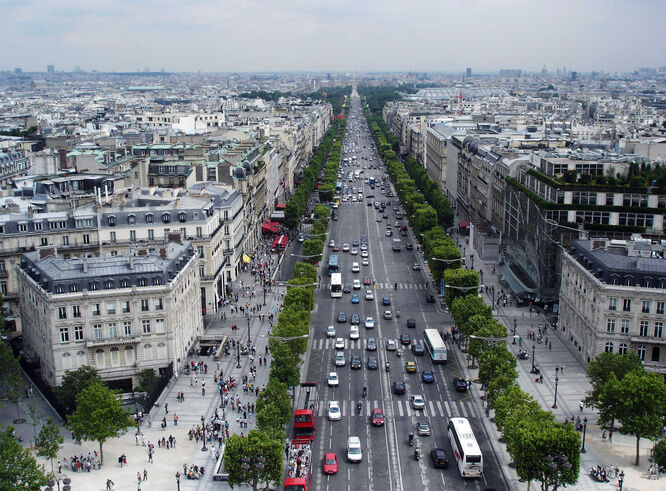
Once you've climbed to the top of the top of the arch, look down along the huge axis that shoots like an arrow all the way from the Louvre, up the Champs-Elysées, through the arch, then straight down the avenue Grande Armée to a forest of distant skyscrapers around an even bigger modern arch in suburban La Défense. Notice the contrast between the skyscrapers in the suburbs and the uniform heights of the buildings downtown. The beauty of Paris — basically a flat basin with a river running through it — is man-made. The key to this beauty is the harmonious relationship between the width of its grand boulevards and the uniformity in the height and design of the buildings. This elegant skyline is broken only by venerable historic domes and spires — and the rude and lonely Montparnasse Tower, which stands like the box the Eiffel Tower came in. The appearance of this tower served as a wake-up call in the early 1970s to preserve the historic skyline of downtown Paris.

Map
Paris' Royal Perspective
"Paris was lucky to have kings and presidents who loved the city," my Parisian friend says. "Do you know the perspective royale? This one view [from the Louvre] tells the history of Paris, century by century...." Read the Full Article

In the mid-19th century, Baron Haussmann set out to make Paris the grandest city in Europe. The 12 arterials that radiate from the Arc de Triomphe were part of his master plan: The creation of a series of major boulevards, intersecting at diagonals with monuments (such as the Arc de Triomphe) as centerpieces.

His plan did not anticipate the automobile — obvious when you watch the traffic scene below. But see how smoothly it really functions. Cars entering the circle have the right of way (the only roundabout in France with this rule); those in the circle must yield. Parisian drivers navigate the circle like a comet circling the earth, making a parabola. They quickly arc toward the smoothly-flowing center. Then, a couple of avenues before their desired exit, they begin working their way back out.

A stroll down the Champs-Elysées gives you Paris at its most Parisian: sprawling sidewalks, stylish shops, grand cafés, and glimmering showrooms. Europe's characteristic love of strolling (a stately-paced triathalon of walking, window shopping and high-profile sipping) dates from the same period as this ultimate "course" — the booming 19th century, with its abundance of upper-class leisure time and cash.

So, don an aristocratic air. From the Arc de Triomphe, amble gently downhill to the immense and historic square called the place de la Concorde at the bottom of the hill. But before you stroll the Champs-Elysées, you must master the name. Say it: "shahn-zay-lee-zay."

Even small-town French kids who haven't traveled beyond a TV screen know this is their country's ultimate parade ground, where major events — the Tour de France finale, Bastille Day parades, New Years' festivities — all unfold.

In 1667, Louis XIV opened the first stretch of the Champs-Elysées: a short extension of the Tuileries Gardens leading to Versailles Palace. This date is considered the birth of Paris as a grand city. The Champs-Elysées soon became the place to cruise in your carriage. (It still is today — traffic can be jammed up even at midnight.) One hundred years later, the café scene arrived.

The grand café scene survives today, amid pop clothing outlets and music megastores. Two cafés, Fouquet's and Ladurée (a block apart on the quiet side of the boulevard) are among the most venerable in Paris. Even elegant cafés like these often have humble roots. (Fouquet's started as a coachman's bistro in 1899.) Today Parisians keep 12,000 cafés in business.

Fouquet's gained fame as the hangout of French biplane pilots during WWI (Paris was just a few nervous miles from the Western Front). It also served as James Joyce's dining room. Today it's pretty stuffy — unless you're a film star. The golden plaques at the entry are from winners of France's version of our Oscar awards, the Césars. While the intimidating interior is impressive, the outdoor setting is great for people-watching — and you can buy the most expensive shot of espresso I found in Paris.

You're more likely to see me hanging out at Café Ladurée, munching on a macaroon. This classic 19th-century tea salon / restaurant / pastry shop has an interior right out of the 1860s. Wander around and peek into the cozy rooms upstairs. The bakery makes traditional little cakes and gift-wrapped finger sandwiches. The traditional macaroons — with a palette of flavors from mint to raspberry to rose — really are worth the journey. Get a frilly little gift box to go, or pay the ransom and sit down for a très élégant coffee and enjoy the Champs-Elysées show.

From the 1920s through the 1960s, this was a street of top-end hotels, cafés, and residences — pure elegance. Locals actually dressed up to stroll here. Then in 1963, the government, wanting to pump up the neighborhood's commercial metabolism, brought in the RER (underground light rail). Suddenly, suburbanites had easy access. Bam — there went the neighborhood.

The coming of McDonald's was a shock to the boulevard. At first it was allowed only white arches painted on the window. Today the hamburger joint spills out onto the sidewalk — providing it has café-quality chairs and flower boxes.

As fast food and pop culture invaded and grand old buildings began to fall, Paris realized what it was losing. In 1985, a law prohibited the demolition of the elegant building fronts that once gave the boulevard a uniform grace. Consequently, many of today's modern businesses hide behind preserved facades. As you stroll, imagine the boulevard pre-'63, with only the finest structures lining both sides all the way to the palace gardens.

The nouveau Champs-Elysées, revitalized in 1994, has new street benches, lamps, and an army of green-suited workers armed with high-tech pooper scoopers. Two lanes of traffic were traded away to make broader sidewalks. And plane trees (a kind of sycamore that thrives despite big-city pollution) provide a leafy ambiance.

As you stroll you'll notice the French appetite for good living. The foyer of the famous Lido, Paris' largest cabaret, comes with leggy photos and a perky R-rated promo video. The Lido is also a multiplex cinema. Moviegoing on the Champs-Elysées is popular. Showings (séances) with a "v.o." (version originale) next to the time indicate the film will be in its original language.

General Charles de Gaulle led France's liberation parade on August 25, 1944.

The Club Med building is a reminder of the French commitment to the vacation. Since 1936 the French, by law, have enjoyed five weeks of paid vacation. In the swinging sixties, Club Med made hedonism accessible to France's middle class.

Luxury car dealerships show off their futuristic "concept cars" alongside their current and classic models. Buying a new Mercedes here is like a fashion make-over — you pick out a leather jacket and purse to match.

That new-car smell is a far cry from the 19th century, when this block carried the aroma of horse stables (which evolved into upper-crust limousine garages en route to today's dealerships).

Cross the boulevard at least once to pause at one of the mid-stream pedestrian islands, and enjoy the view. Look up at the Arc de Triomphe with its rooftop bristling with tourists. Notice three kinds of architecture: old and elegant; new; and new behind old facades.

On the Champs-Elysées, the shopping ends and the park begins at a big traffic circle called Rond-Point. This leafy circle is always colorful, lined with flowers or festive seasonal decorations (thousands of pumpkins at Halloween, hundreds of decorated trees at Christmas). Nearby a new statue of General Charles de Gaulle strides out toward the boulevard as he did on the day Paris was liberated in 1944 (6'4" tall, walking proudly erect for the length of the Champs-Elysées, as others around him ducked during sporadic gunfire).

From here, it's a straight shot down the last stretch of the Champs-Elysées to the sprawling 21-acre square called the place de la Concorde. Its centerpiece is the 3,300-year-old, 72-foot, 220-ton red granite obelisk of Luxor. It was carted here from Egypt in 1830s, a gift to the French king. The gold pictures on the pedestal tell the story of its laborious two-year journey.

During the French Revolution, this was named "place de la Revolution." A guillotine stood where the obelisk now stands. A bronze plaque memorializes the place where Louis XVI, Marie-Antoinette, and over 2,000 others were made "a foot shorter on top." Invented as a humane alternative to the poorly-aimed executioner's axe, the guillotine's efficiency was breathtaking. It took a crew of three: one to manage the blade, one to hold the blood bucket, and one to catch the head and raise it high to the roaring crowd.

Standing in the shadow of that obelisk with your back to the Louvre and looking up the grandest boulevard in Europe, you can't help but think of the sweep of history… and those great macaroons.

Updated for 2008. For lots more information, check out our best-selling Rick Steves' Paris guidebook — or join us on one of our free-spirited tours in Paris.