

Great Sights and New Insights in Dresden
By Rick Steves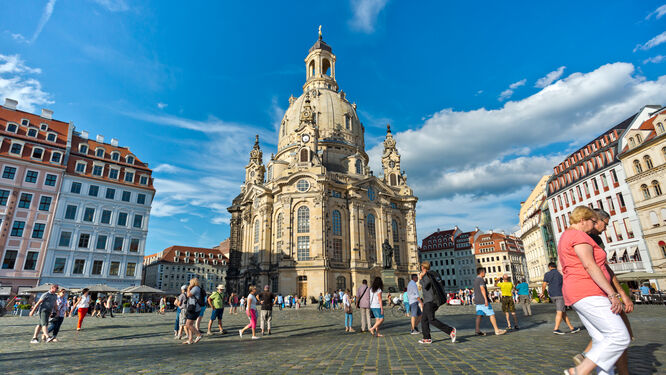
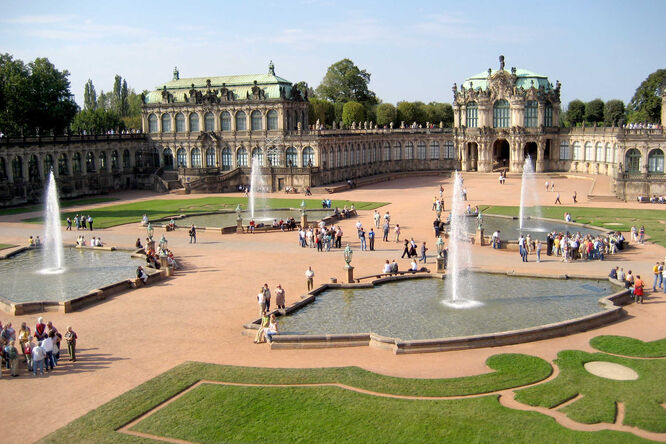
At exactly 10:15 a.m. in the courtyard of the Zwinger palace complex in Dresden, 40 Meissen porcelain bells began a sweet three-minute melody. I left the shelter of my guide's umbrella to get a closer look at the glockenspiel. Squinting into a mist, I could just see the porcelain bells vibrate when hit. I was mesmerized by this little royal trick.
Then I realized I was on a Dresden high. In an eastern German town I've known for just a few years, I had enjoyed great sights and new insights.
The Wettin Dynasty ruled Saxony from Dresden for eight centuries, right up until the end of the World War I. Their Louis XIV-style big shot was Augustus the Strong. They say he could break horseshoes with his bare hands and fathered 365 children. He loved being portrayed with the rose of Luther (symbol of the Protestant movement in Germany) being crushed under his horse's hoof.
The Wettins taught the rest of Europe's royal courts the art and importance of having their own porcelain works. The Wettins' Meissen was the first. I thought I knew the best crown jewels...until I saw the glittering Wettin jewels in Dresden's Historic Green Vault. They're absolutely dazzling, and a clear reminder that those Wettins were a powerhouse in their day (they're also popular, and with a limited number of visitors allowed every half-hour, it's smart to reserve ahead).
After lingering to enjoy a group of street musicians, I zipped out to Volkswagen's "Transparent Factory" on the edge of Dresden, where visitors are welcome to watch fancy new models actually being assembled. The factory is so politically correct that parts are brought in by special "cargo trams" that congest the city's traffic less than trucks do.
Back in town, along the Elbe River, I headed for the terrace called the Balcony of Europe — once Dresden's defensive rampart. By Baroque times, fortresses were no longer necessary, and this became one of Europe's most charming promenades. A stroll beneath a leafy canopy of linden trees to the balcony's east end takes you to the Albertinum, which houses several of Dresden's best collections: the Sculpture Collection and the New Masters Gallery, featuring works by 19th- and 20th-century greats such as Renoir, Rodin, Van Gogh, Degas, and Klimt.
Finally, the highlight: the restored Frauenkirche — the heart and soul of the city. Dresden's 310-foot-tall Church of Our Lady was destroyed during the massive Allied bombings that flattened two-thirds of the city on February 13, 1945. The church sat in ruins for decades. Finally, in 1992, a huge international rebuilding effort was launched. Like a massive jigsaw puzzle, the church was painstakingly reassembled using as much of the original stone as possible, and reopened to the public in 2005. The interior is stunning: pastel to heighten the festive nature of the worship, curvy balconies to enhance the feeling of community, and with seven equal doors — to welcome all equally and send worshippers out symbolically to all corners to share their enthusiasm for their faith.
My visit to Dresden had started rocky. Riding the express train into town, I figured it would end at the main station. The train pulled into Dresden Neustadt — Dresden's New Town. It sounded good to me. Most of the passengers got out. So did I. The train took off. I must have walked 20 minutes, in denial that I had gotten off at the wrong station. After circling the big block — and pretty embarrassed at my mistake — I pondered cutting my losses and just taking a taxi to my hotel in the Old Town. But another train was leaving in minutes for what must be the central station. I hopped on. Five minutes later we arrived. I hopped out at Dresden Mitte. The train took off and I stepped outside, only to realize: I had made the same mistake again. Another train came in a few minutes. I got on it and finally made it to my intended station: Dresden Hauptbahnhof — a block from my hotel. As I tell travelers in lectures: "Many towns have more than one train station."
One of my best skills — extremely helpful in my line of work — is the ability to make mistakes…with gusto. After a day in Dresden, the frustrating start was a distant memory. And I had a new appreciation of a city that nearly 70 years ago lay in smoldering rubble, 25 years ago was in a USSR-imposed economic hole, and today has caught up with Western Germany.
Today's Dresden is a young and vibrant city, crawling with proud locals and happy-go-lucky students who barely remember communism. While the city is packed with tourists, most of them are German or Russian. Until Americans rediscover Dresden, you'll feel like you're in on a secret.