

Sobering Sites of Nazi Europe
By Rick Steves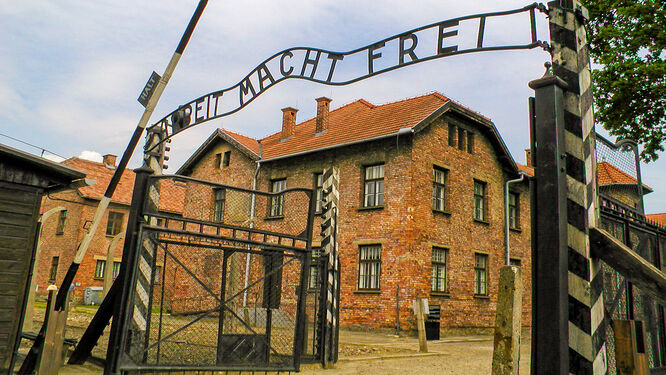
Fondue, nutcrackers, Monet, Big Ben…gas chambers. A trip to once-upon-a-time Europe can be a fairy tale. It can also help tell the story of Europe's 20th-century fascist nightmare. While few travelers go to Europe to dwell on the horrors of Nazism, most value visiting the memorials of fascism's reign of terror and honoring the wish of its survivors: "Forgive but never forget." These sites are committed to making the point that intolerance and fascism are still alive and strong. Their message: Fascism can emerge from its loony fringe if we get complacent and think the horrors of Hitler could never happen again.
Austria
The town of Mauthausen sits cute and prim on the romantic Danube at the start of the very scenic trip downstream to Vienna. But nearby, atop a now-still quarry, linger the memories of a horrible slave-labor camp. Mauthausen's camp is now a solemn place of meditation and continuous mourning. Fresh flowers adorn yellowed photos of lost loved ones. The home country of each victim has erected a gripping monument. You'll find yourself in an artistic gallery of grief, resting on a foundation of "Never Forget." Retrace the steep and treacherous steps of the camp's inmates — the "stairway of death" (Todesstiege) — to and from the quarry where they worked themselves to death. Mauthausen offers an English booklet, an audioguide, an English movie, and a painful but necessary museum.
On Vienna's Judenplatz, you'll find the Austrian Holocaust Memorial — a library turned inside-out to remind visitors that each victim had a story. Nearby is the Judenplatz Museum, displaying the ruins of a forgotten 14th-century synagogue unearthed during the memorial's construction.
Czech Republic
Just outside of Prague is the Terezín concentration camp ("Theresienstadt" in German). This particularly insidious place was dolled up as a model camp for Red Cross inspection purposes. Inmates had their own newspaper, and the children put on cute plays. But after the camp passed its inspection, life returned to slave labor and death. Ponder the touching collection of Jewish children's art, also on display in the Pinkas Synagogue in Prague's Jewish Quarter.
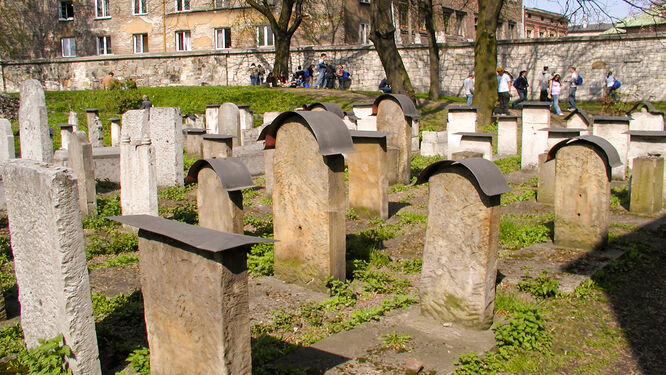
After completing his "Final Solution," Hitler had hoped to build a grand museum of the "decadent" Jewish culture in Prague. Today, the five synagogues of Prague's Jewish Quarter (Josefov), containing artifacts the Nazis assembled from that city's once-thriving Jewish community, stand together as a persistently unforgettable memorial. In addition to the synagogues, a joint ticket also covers the Old Jewish Cemetery and the Ceremonial Hall. All of these sights are scattered over a three-block area between Prague's Old Town and the Vltava River.
France
Possibly the most moving Nazi sight of all is the martyred village of Oradour-sur-Glane, 15 miles northwest of Limoges, in central France. In 1944, the entire town was machine-gunned and burned in 1944 by Nazi SS troops. Seeking revenge for the killing of one of their officers, they left 642 townspeople dead in a blackened crust of a town under a silent blanket of ashes. The poignant ruins of Oradour-sur-Glane — scorched sewing machines, pots, pans, bikes, and cars — have been preserved as an eternal reminder of the reality of war. When you visit, you'll see the simple sign that greets every pilgrim who enters: Souviens-toi...remember.
Paris commemorates the 200,000 French victims of Hitler's camps with the Mémorial des Martyrs de la Déportation. Walking through this evocative park, on the tip of the Ile de la Cité just behind Notre-Dame, is like entering a work of art. Walk down the claustrophobic stairs into a world of concrete, iron bars, water, and sky. Inside the structure, an eternal flame, triangular niches containing soil from various concentration camps, and powerful rdquoes will etch the message into your mind. Then gaze at the 200,000 crystals — one for each French person who perished.
Germany
Since destruction and death are fascist fortes, only relatively insignificant bits and pieces of Hitler's Germany survive. But as time passes, today's Germans are increasingly aware of the need to remember the horrors that began in their country.
While some visitors complain that the Dachau camp memorial is too "prettied-up," it gives a powerful look at how these camps worked. Built in 1933, this first Nazi concentration camp offers a compelling voice from our recent, grisly past, warning and pleading "Never Again" — the memorial's theme. On arrival, pick up the mini-guide and check when the next documentary film in English will be shown. The museum, the movie, the chilling camp-inspired art, the reconstructed barracks, the gas chambers, the cremation ovens, and the memorial shrines will chisel into you the hidden meaning of fascism.
Other camp memorials in Germany include Sachsenhausen (near Berlin) and Buchenwald (near Weimar).
Hitler got his start — and had his strongest support — in the beer halls of Munich. The Munich City Museum traces the origin and development of Nazism. To uncover Nazi sites in Munich, take one of the Third Reich–themed walking tours offered by Radius Tours or Munich Walks.
Now that its Wall is history, Berlin is giving the Nazi chapter of its history a little more attention. To help uncover its (mostly hidden) Nazi sites and sights, take one of the Third Reich–themed tours offered by Original Berlin Walks or Insider Tour.
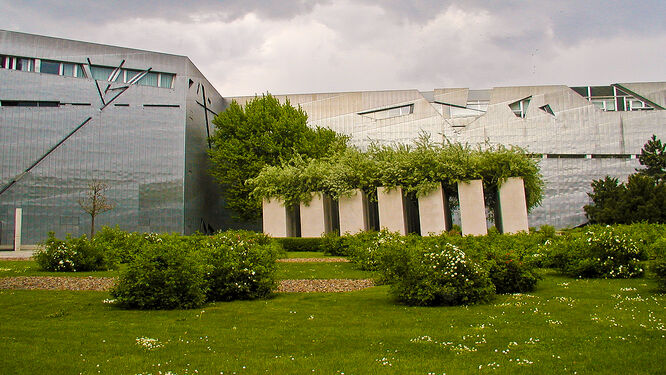
Berlin has several Nazi-related museums and memorials. The Topography of Terror exhibit illustrates SS tactics (in the ruins of the former SS/Gestapo headquarters, near what was Checkpoint Charlie. The adjacent four small "mountains" are made from the rubble of the bombed-out city. The chilling Book Burning Monument commemorates the 20,000 books that were burned on Berlin's Bebelplatz at the order of the Nazis. Glance into the glass floor in the middle of the square (on Unter den Linden) to see a huge underground room with empty shelves. The gripping Käthe Kollwitz Museum is filled with art inspired by the horrors of Berlin's Nazi experience. Berlin's New Synagogue was burned on Kristallnacht in 1938, but has since been restored. The excellent Jewish Museum Berlin, which focuses on Jewish culture, was designed by the American architect Daniel Libeskind. The zigzag shape of the zinc-walled building is pierced by voids, symbolic of the irreplaceable cultural loss caused by the Holocaust. In nearby Wannsee (near Potsdam), you can tour the house where Hitler's cronies came up with the "Final Solution" of the Holocaust.
There was strong resistance to Hitler even in Berlin. In front of the glass-domed Reichstag is a row of slate slabs embedded in the ground, memorializing the 96 politicians who were persecuted and murdered because their politics didn't agree with Chancellor Hitler's. Near the Kulturforum museums is a former military headquarters (Benderblock) where conspirators plotted an ill-fated attempt to assassinate Hitler — and where they were also shot for the crime. It's now the site of the German Resistance Memorial. Just outside of the city is the Plötzensee Prison, where Nazi enemies were imprisoned and executed.
Berlin's Memorial to the Murdered Jews of Europe consists of 2,711 gravestone-like pillars. Completed in 2005, it is the first formal German government-sponsored Holocaust memorial. The pillars are made of hollow concrete, each chemically coated for easy removal of graffiti. The number of pillars, symbolic of nothing, is simply how many fit on the provided land. Is it a labyrinth...symbolic cemetery...intentionally disorienting? The meaning is entirely up to the visitor. The memorial's location — where the Berlin Wall once stood — is coincidental. It's just a place where lots of people can easily experience it. The bunker of Nazi propagandist Joseph Goebbels was discovered during the work and left buried (under the northeast corner of the memorial). Hitler's bunker is just 200 yards away, under a nondescript parking lot.
In Nürnberg, the ghosts of Hitler's showy propaganda rallies still rustle in the Rally Grounds (now Dutzendteich Park), down the Great Road, and through the Congress Hall. The north wing of the hall houses the Nazi Documentation Center, with a "Fascination and Terror" exhibit that examines the causes and consequences of the Nazi phenomenon. Across town, you can also tour the Nürnberg Trials Courtroom — where high-ranking Nazi officers answered to an international tribunal after the war ended.
The town of Berchtesgaden, near the Austrian border, is any German's choice for a great mountain hideaway — including Hitler's. The remains of Hitler's Obersalzberg headquarters, with its extensive tunnel system and Documentation Center, will interest WWII buffs.
Just north of Trier, near the Luxembourg border, in the town of Irrel, is the Westwall Museum, with tourable bunkers that made up part of the Nazis' supposedly impenetrable western fortification (closed in winter).
Netherlands
In Amsterdam, the Anne Frank House gives the cold, mind-boggling statistics of fascism the all-important intimacy of a young girl who lived through it and died from it. Even bah-humbug types, who are dragged in because it's raining and their spouses read the diary, find themselves caught up in Anne's story.
Amsterdam's Dutch Theater, which was used as an assembly hall for local Jews destined for Nazi concentration camps, is a powerful memorial. On the wall, 6,700 family names represent the 104,000 Jews deported and killed by the Nazis. The nearby Jewish Historical Museum — four historic synagogues joined together by steel and glass to make one modern complex — tells the story and struggles of Judaism through the ages.
While Hitler controlled Europe, each country had a courageous, if small, resistance movement. All over Europe you'll find streets and squares named after the martyrs of the resistance. Any history buff or champion of the underdog will be inspired by the patriotism documented in Europe's Nazi-resistance museums — the most extensive is Amsterdam's Dutch Resistance Museum. You'll see propaganda movie clips, study a forged ID card under a magnifying glass, and read of ingenious, daring efforts to hide local Jews from the Germans.
The small town of Haarlem, 20 minutes by train from Amsterdam, has its own Anne Frank-type story. Touring a cozy apartment above a clock shop just off the busy market square, you'll see Corrie ten Boom's "Hiding Place." The sight was popularized by an inspirational book and movie about this woman and her family's experience hiding Jews from Nazis. Tipped off by an informant, Nazis raided their house but didn't find the Jews, who were hiding behind a wall in Corrie's bedroom. Because the Nazis found a suspiciously large number of ration coupons, they sent the Ten Boom family to a concentration camp. Only Corrie survived.
Poland
Poland was hit harder by World War II than any other country — more than six million Poles died, half of them Jews. But the Poles — Jewish or not — did not go quietly. Monuments around the capital city remember their valiant, though eventually unsuccessful, uprisings. In 1940, nearly a half million Jews were moved into a ghetto in Warsaw. By 1943, only a tenth of the ghetto's Jews survived — the rest had died from disease or been shipped to concentration camps. The survivors staged the Ghetto Uprising against their Nazi oppressors, but almost all of them were eventually killed in the fighting, captured and executed, or sent to concentration camps. A year later, as the Soviet army approached, a Polish resistance army staged the 1944 Warsaw Uprising against the Nazis, which resulted in the deaths of a quarter of a million Warsaw civilians. Today, you can still visit the neighborhoods and landmarks where these brave uprisings began.
While many camps were slave-labor camps, Auschwitz, the dreaded destination of Polish Jews such as those on Oskar Schindler's list, was built to exterminate. View the horrifying film shot by the Russians who liberated the camp in early 1945. In the museum, the simple yet emotionally powerful display of prisoners' shoes, hairbrushes, and suitcases puts lumps in even the most stoic throats. Allow plenty of time to wander and ponder.
A second Auschwitz camp, Birkenau (also known as Auschwitz II), is about a mile away. This bleak ghost camp, an endless panorama of demolished barracks and looming watchtowers overlooking an ash-gray lake, is left as if no one after the war had the nerve to even enter the place. Today, pilgrims do. Auschwitz-Birkenau is just 90 minutes by train from Kraków, Poland's best-preserved medieval city.
Oskar Schindler, hero of the film Schindler's List, lived and worked in the Polish city of Kraków, just two blocks from Wawel Castle. Today, Schindler's Factory Museum, one of Europe's best museums about the Nazi occupation, fills the actual factory building where Oskar Schindler and his Jewish employees worked. The Jarden Bookshop, located in Kraków's Jewish Quarter, offers walking tours that include "Schindler's List" sights.
Scandinavia
Oslo's Norwegian Resistance Museum is fascinating, as is Copenhagen's Museum of Danish Resistance.