

Italy’s Civita di Bagnoregio: Jewel on the Hill
By Rick Steves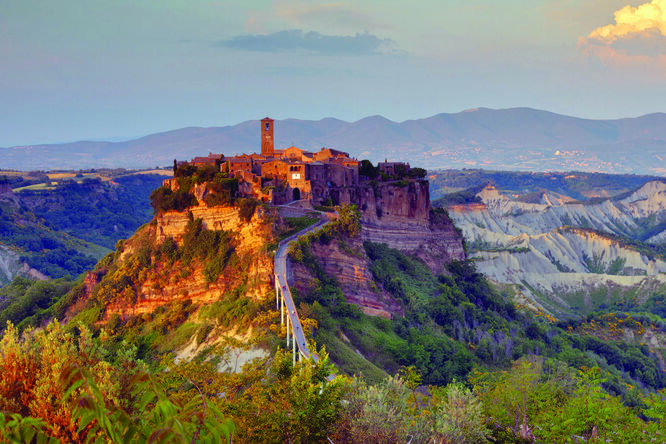
Of all the Italian hill towns, Civita di Bagnoregio is my favorite. Less well-known than Siena or Assisi, this stunning little gem has escaped the modern age mostly because of topography.
The town teeters atop a crest rising high above a vast canyon ruled by wind and erosion. The saddle of earth that once connected Civita to its bigger and busier sister town, Bagnoregio, has worn away. Photographs around town show the old donkey path that once linked the hamlets. Today, the only way in or out is by a footbridge. Supplies are ferried in on mopeds.
The main entrance is a huge stone passageway, cut by the Etruscans 2,500 years ago and decorated in the 12th century with a Romanesque arch. Passing through the portal, you enter another world — one stuck in the Middle Ages. You can feel history in the smooth cobblestones under your feet.
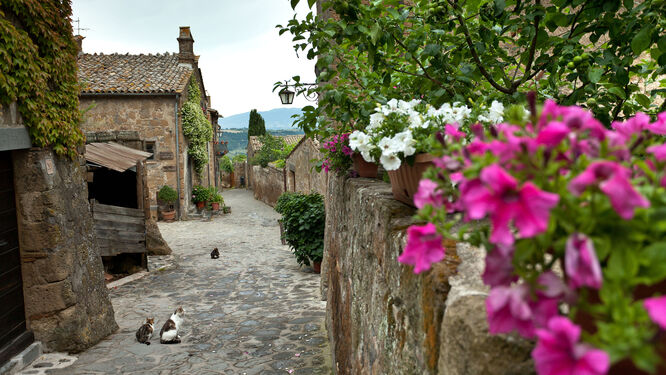
Inside the gate, the charms of Civita are subtle. Those searching for arcade tourism won't know where to look. There are no lists of attractions, orientation tours, or museum hours. It's just Italy. Civita is an artist's dream, a town in the nude. Each lane and footpath holds a surprise. Ivy drapes over arches and scrambles up walls; potted flowers parade across balconies. The warm stone walls glow, and each stairway is dessert to a sketch pad or camera.
For me, exploring Civita is a cultural scavenger hunt. Rounding one quiet corner, I encounter the stately facade of a Renaissance palace with a fancy wooden door and grand windows leading to — thin air. The rest of the building fell away into the valley decades ago, riding a chunk of the town's ever-eroding rock. Pondering the view, I'm reminded that slowly but surely this town will succumb to the march of geological time.
The Swiss-cheese ground beneath Civita is honeycombed with ancient cellars, perfect for storing wine, and cisterns for collecting rainwater. Many date from Etruscan times. A pre-Roman tunnel below the town doubled as a bomb shelter in World War II.
Civita has one famous son, St. Bonaventure, the "second founder" of the Franciscan order. His home is long gone, but the basic grid plan of the old town survives, with a church as its centerpiece. The identity of this holy place of worship has rotated with the centuries: An Etruscan temple, then a Roman temple, rose here before today's Catholic church. Ancient pillars from those pagan temples stand like giant bar stools just outside the church door. To beat the heat, I like to step inside and enjoy a quiet moment in a pew.
The main piazza is the heartbeat and pride of the village, the spot where festivals and processions start, visitors are escorted, and the town's past is honored. Wild donkey races take place here in June and September, and at Christmastime, a living nativity scene is enacted in the square.
Civita's young people are gone, lured away by the dazzle of more modern places where they can take part in Italy's cosmopolitan parade. And as old people become frail, they move into apartments in nearby Bagnoregio. With the permanent population dwindling, Civita is becoming a weekend getaway for wealthy urbanites, who are slowly buying up the place. The remaining full-time families cater to visitors.
To enrich your experience of this rustic place, be an extrovert. Poke around and talk to people. I take a seat in the piazza, and smile and nod at each passerby. It's a social jigsaw puzzle, and each person fits. Cats, the fastest-growing segment of the population, scratch their itches on age-old stones.
Nothing is abandoned in this town. At one restaurant, the owner proudly shows off a huge olive press that is about 1,500 years old. Until the 1960s, blindfolded donkeys trudged in a circle to operate the press, crushing olives. Now it is the centerpiece of the restaurant, which sells bruschetta to day-trippers. Bread toasted on an open fire, drizzled with the finest oil, rubbed with pungent garlic, and topped with chopped tomatoes — these edible souvenirs stay on your breath for hours and in your memory forever.
I love my cool, late evenings in Civita. After dinner, I wander back to sit on the church steps with people who've been doing exactly this under the same moon, night after night, year after year. Children play on the piazza until midnight in the light of the lampposts. I listen to the sounds of rural Italy, mixed with voices and fortissimo crickets. Towering high above, Civita feels well-fortified against change.