

There’s No Place Like Rome for the Holidays
By Rick Steves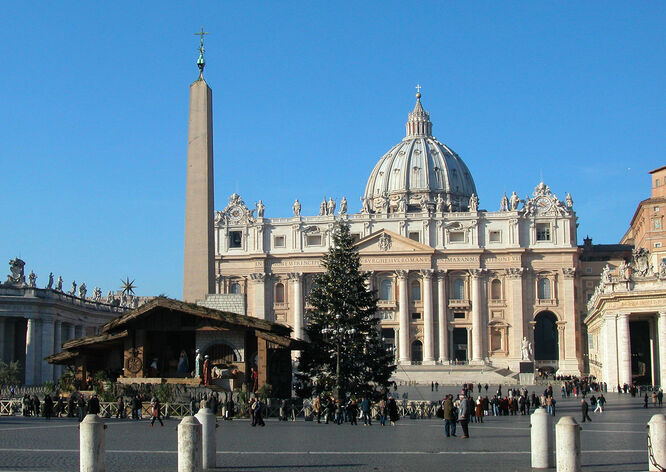
I find the holiday season in Rome a joy: crisp air, stylish big-city Italians cupping hot cappuccinos in corner cafés, and hurried shoppers bundled up with panache, thoughtfully pausing at grand manger scenes. The season here stretches for over a month — not to maximize shopping days, but to fit in the season's many holy days.
As home to Vatican City, the headquarters of the Roman Catholic Church, Rome is rich with Christmas's most sacred traditions. Manger scenes, called presepi, originated just a little north of Rome in Assisi some 800 years ago, when St. Francis taught the story of Jesus's birth with props. For a bit of manger history, visit the Basilica of Santa Maria Maggiore. There you can see five wooden planks, said to be from the original Christmas manger.
Creative crèches are on display all over town, ranging from old and traditional to avant-garde. Dip into any church in town from early December through Epiphany (January 6) to see one, or visit Piazza del Popolo's annual exhibition, with 100 presepi made by artists and schoolchildren. Artistic quality varies, but each is unique.
One of the most important relics in Rome is at the Church of Santa Maria in Aracoeli. The Santo Bambino, a statue of the holy child, is clothed in rich fabrics and covered with jewels. He's believed to have miraculous healing powers, and it's said that the Bambino's lips turn red if a prayer is about to be answered and pale if there is no hope. Children especially love the Bambino, writing him letters and reciting poems to him on Christmas Day. The Bambino figure is usually kept in a glass case in a chapel, but at the stroke of midnight on Christmas Eve, he's presented to the church's eager and expectant congregation.
The Vatican's Nativity scene has always been the premier decoration on St. Peter's Square. But Pope John Paul II, who grew up in Poland and became the first non-Italian pope in a very long time, missed having a Christmas tree. So, in 1982, he added a lighted evergreen to the celebrations, standing tall near the central obelisk. Each year on Christmas Eve, the pope celebrates midnight Mass at St. Peter's Basilica. (Though the church holds 15,000 people, you must book far in advance to attend the Mass.)
For many Roman families, Epiphany, not Christmas, is the big gift-giving day, when kids open presents delivered by the broom-riding witch, La Befana. My Roman friend Francesca is adamant that Italy's beloved Befana is "100 percent Roman," and holds a special place in her city's popular imagination. On the eve of Epiphany, the Befana flies over the rooftops of Rome on her broom and brings gifts to the good children or coal for the bad ones — although, these days the "coal" is a crunchy black confection sold at street-corner carts. According to Francesca, the children of Rome leave La Befana a snack of some soft ricotta cheese since she has hardly any teeth.
Some Roman parents threaten naughty kids with, "Lo dico alla Befana!" (I'll tell the Befana!), or the ever-popular, "Viene la Befana e ti porta via!" (The Befana will come and take you away!), which is very bad news indeed, because Befana has an ogre of a husband who devours children. According to legend, the three Wise Men stopped to ask Befana for directions to Bethlehem and the Christ child, but she was too busy to help. As time passed, Befana kept thinking about the strange visitors and their quest. With a sack filled with bread, she set out to find baby Jesus, too. Whenever she saw a baby boy, she gave him a piece of bread, hoping he might be the Christ child. Befana still wanders through Italy each Christmas season looking for the baby and leaving goodies for the children. Her name means "gift-bringer."
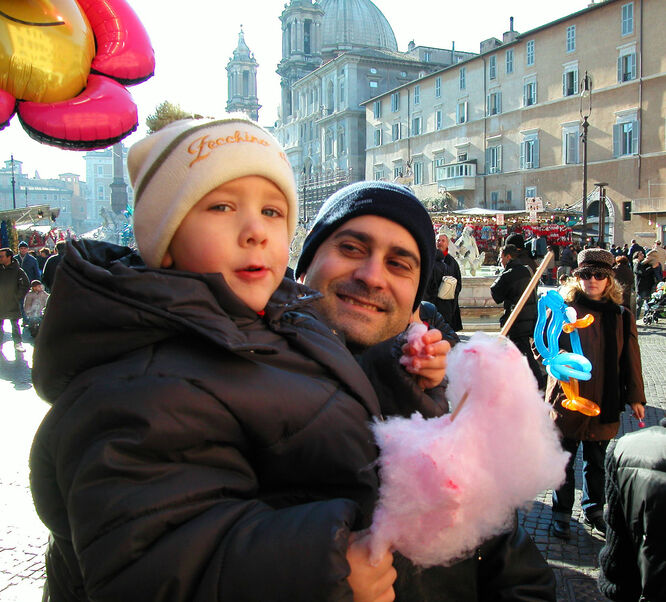
Lively Piazza Navona hosts a holiday market — known locally as the "Befana Market" — that bustles with street performers and vendors from early December until Epiphany. Here you can shop for decorations, toys, and other gift items. Or pop into one of the city's many fine bakeries for their Christmas confections. These vary, but you'll find one constant — fruitcakes. In Italy, fruit-"cake" is disguised as bread (pane). There's big bread (panettone), golden bread (pandoro), strong bread (panforte), and sweet bread (pandolce). Panforte is a dense mixture of honey, candied fruit, nuts, and spices — and it's rugged enough to toss around at parties and still consume later.
Whether spiritual or secular, at this time of year in Rome people are wishing their families, friends — and even strangers — the same thing: Merry Christmas, or as they say in Italy, Buon Natale!