

Tips for Beating the Heat in Europe
By Rick Steves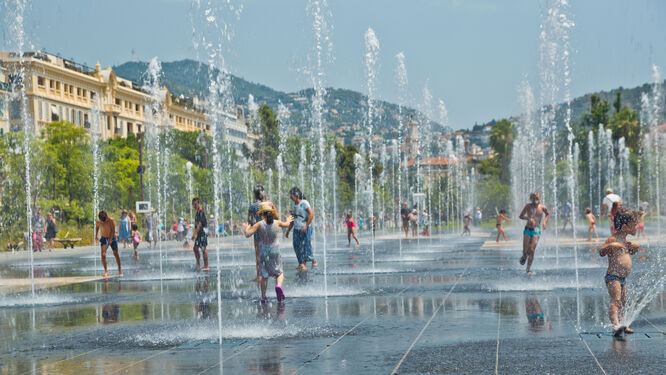
Heat waves are becoming the new summertime normal across Europe — and while Europe is doing its best to adapt, travelers need to as well. With the following advice in mind, you can enjoy a cool trip despite hot temps.
Time your trip with climes in mind. Save July and August for the Alps and northern Europe, and visit the warmest destinations at cooler times. Italy, Spain, Greece, and Croatia can be balmy even in shoulder-season months like May and October — but in March or November, expect these areas to be pleasantly mild.
Be prepared for a heat wave almost anywhere you go. It's no longer just southern Europe that heats up in the summer. Areas north of the Alps that historically never needed air-conditioning — including England, Ireland, and even parts of Scandinavia — are seeing heat waves often enough that many old hotels are being retrofitted to accommodate cooling systems.
Pack for at least a day or two of extreme heat. Your usual summer wardrobe may not be cool enough for a heat wave on the road: When traveling, you're outdoors more than at home — and air-conditioning isn't the indoor norm in Europe like it is in much of the US. Loose-fitting linen — breathable, cool to the touch, and sweat-wicking — is worth the expense when it's sweltering. A wide-brimmed hat can also help.
Pay for air-conditioning when you can. When booking your accommodations, consider springing for rooms with AC, especially if high temps are a near certainty. I long prided myself on not needing air-conditioning on the road, but lately I've been prioritizing it when choosing where to stay in the summer.
Expect warmer indoor spaces. You might notice that places like airports and shopping malls aren't refrigerated like back home — they're just cool enough. So even if your hotel has air-conditioning, don't expect it to be where's-my-sweater robust. Several countries prohibit businesses from turning on their air-con when it's under a certain temperature indoors (usually around 80°F). Hotels are generally exempt from these laws, but don't be surprised if you check into your "air-conditioned" Venetian hotel on a 75° day to find a disconnected AC unit and a receptionist who shrugs and suggests you open the window.
Europe's shutters are functional — use them! Before you leave your room in the morning, close your shutters and/or curtains. The more sunlight you can block, the cooler your room will be when you return in the evening. Of course, not all windows have shutters, but don't be too quick to assume yours don't — rolling shutters may be built into the window frame. Look for a control panel with up/down arrows or a tension strap on the interior wall beside the window (gently pulling the strap should release your rolling shutters).
Ask for a fan sooner than later. Most hotels that lack air-conditioning are stocking up on fans these days, but if you don't find one in your room, ask at reception to borrow one. These are first-come, first-served, so don't wait until you're sweltering late at night.
Turn your duvet cover into a top sheet. In places that make the bed with a thick duvet and no top sheet, you needn't choose between a too-hot cover and none at all: Just take the poofy duvet out of its cover, and voilà — you've got a two-layer top sheet.
Plan a heat-smart day. Exploring sunbaked city streets, ancient ruins, or town walls can be torturous in the sizzling afternoon hours — or a delight in the relative cool of morning or evening. Strategize your activities to minimize outdoor time in the heat of the day. Get out earlier and/or stay out later than you may be inclined to (more easily done if you go local and take a true siesta), and aim to visit museums when it's warmest out. Schedule your day a little more loosely than you normally would to allow for a slower pace, breaks in the shade, and gelato pit stops.
Drink water before you're thirsty. It can be harder to listen to your body when you're out of your routine and surrounded by new sights and sounds. Keep your water bottle filled (water is drinkable from bathroom sinks and even many public fountains — look for locals filling their own bottles). Remember that alcohol dehydrates — for every boozy glass, aim to drink just as much water at the same sitting.
Get wet. Keep a bandana on hand to dunk in a fountain or run under a sink — when tied around your neck, a wet one can work wonders. At night, a damp towel over your legs or shoulders can be cooling enough to help you fall asleep. Better yet, soak a T-shirt in the sink, wring it out well, and wear it to bed.
Know the signs of heat exhaustion (and heatstroke). If the heat has you feeling seriously unwell, do whatever you can to lower your body temperature ASAP. No sight in Europe is worth risking your physical health.
Europe can be a joy, even in the heat. Plan around it if you can, but if you find yourself in a heat wave, some travel smarts can help you not sweat it.